

Using KiwiSaver for a Prefab: 2026 Property Ladder Guide

What if the biggest barrier to your first home isn't the size of your savings, but an outdated idea of what a "real" house looks like? For many Kiwis, the dream of homeownership feels like it's slipping away as traditional property prices continue to climb beyond reach. You've likely spent years watching your balance grow and wondering if using kiwisaver for a prefab home is even a valid option, or if you're stuck waiting for a conventional build that might never fit your budget. It's frustrating to feel like you're doing everything right while the goalposts keep moving.
At Smart Spaces NZ, we know the confusion that comes with navigating Kainga Ora eligibility, especially now that the First Home Grant is gone and default contribution rates have shifted to 3.5%. This guide will show you exactly how to leverage your savings for a high-quality, factory-direct home that meets all withdrawal criteria. You'll learn how to secure a First Home Loan with just a 5% deposit and manage the withdrawal timeline effectively. It's time to find an affordable housing solution that offers genuine freedom without the burden of a massive mortgage.
Table of Contents
Is Using KiwiSaver for a Prefab Home a Fair Dinkum Option?
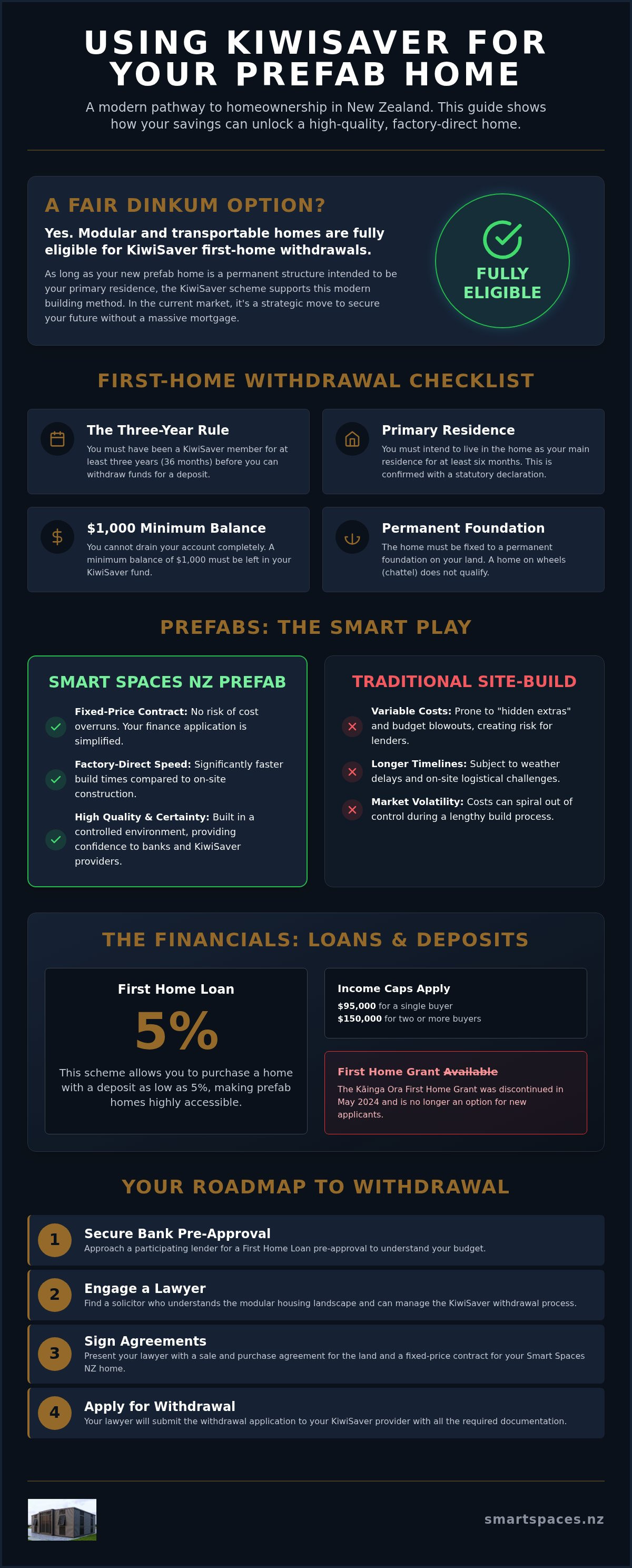
The short answer is a resounding yes. If you've been wondering about using kiwisaver for a prefab home, you'll be pleased to know that the rules are incredibly supportive of modern building methods. The KiwiSaver scheme was specifically designed to help New Zealanders step onto the property ladder, and as long as your new dwelling is a permanent structure intended for you to live in, the "prefab" label doesn't disqualify you. In the 2026 property market, where traditional build costs often spiral out of control, choosing a modular path is a strategic move to secure your future without the typical 30-year debt trap.
The "Primary Residence" Rule
Your KiwiSaver funds are meant to put a roof over your head, not fund a holiday bach or an investment portfolio. To satisfy your provider, you must intend to live in the prefab home as your main residence for at least six months. Proving this usually involves a statutory declaration and a signed sale and purchase agreement. If you later decide to move the home to a different site, that is generally your business; however, you must meet the initial residency requirements at the time of purchase to stay on the right side of the law.
Prefab vs. Traditional: Does the Provider Care?
Years ago, some providers were a bit cagey about transportable units, but those days are long gone. In 2026, modular construction is a mainstream, high-quality solution that banks and KiwiSaver providers recognise as a smart investment. Most providers now view a fixed-price contract for a 2-bedroom expandable home or a container home from a reputable builder like Smart Spaces NZ as a lower risk than a variable-rate traditional build. Because our factory-direct pricing is set in stone, it gives your provider the certainty they need to approve your withdrawal without worrying about "hidden extras" that often plague site-built projects.
To make the process work, you need to have the "home and land" component sorted. You can use your withdrawal to purchase the land, but your provider will want to see that a dwelling is part of the immediate plan. By presenting a clear contract for a Smart Spaces NZ unit alongside your land agreement, you demonstrate a viable, affordable path to homeownership that satisfies even the strictest provider. It is a practical way to beat the market and get into your own home sooner.
The Nitty-Gritty: Eligibility Rules for First-Home Withdrawals
Securing your future starts with understanding the fine print. While the idea of using kiwisaver for a prefab home is straightforward, the execution requires meeting specific criteria set by both your provider and the government. You don't want to get six months into a project only to find your funds are locked away due to a technicality. Most providers require you to have been a member of the scheme for at least three years (36 months) before you can touch a cent for a deposit. It's also vital to remember that you can't drain the account entirely; you're required to leave a minimum of $1,000 in your fund as a "kickstart" for your retirement savings. You should verify your eligibility for a KiwiSaver first-home withdrawal early in the piece to confirm exactly which contributions are available to you.
The Shift from Grants to Loans
There is still plenty of talk about the First Home Grant, but it's essential to stay updated with the 2026 reality. The Kāinga Ora First Home Grant was discontinued in May 2024 and is no longer an option for new applicants. Instead, the focus has shifted to the First Home Loan scheme. This is a game-changer for prefab buyers because it allows you to purchase a home with just a 5% deposit. To qualify, you'll need to stay under the income caps, which currently sit at $95,000 for a single buyer and $150,000 for two or more buyers. Because our 2-bedroom expandable homes are factory-direct and fixed-price, they often fit perfectly within these lending frameworks, making the bank's "yes" much easier to obtain.
The Permanent Foundation Requirement
Your KiwiSaver provider won't release funds for a "chattel." In the eyes of the law, a tiny home on wheels is often treated like a caravan or a vehicle, which doesn't qualify for a housing withdrawal. To unlock your savings, your prefab must be fixed to a permanent foundation on the land you're building on. This distinction is a core part of the NZ tiny home regulations that govern whether your structure is legally a "building." You'll need to show your provider that the home will be connected to services and secured to the ground according to the building code. We've seen many buyers successfully navigate this by ensuring their site works and building consents are ready to go before the final withdrawal request.
Navigating these rules might feel like a bit of a mission, but it's simply a matter of having the right paperwork in order. If you're looking for a home that meets these strict criteria while remaining affordable, the team at Smart Spaces NZ can provide the detailed specifications your lawyer and provider will need. It's about making sure your dream of homeownership is built on a solid, compliant foundation from day one.
Why Prefabs are the Smart Play for First-Home Buyers
Choosing a home is as much a financial decision as it is a lifestyle one. In the current climate, traditional site-built homes often come with a "wait-and-see" price tag that can be terrifying for someone on a strict budget. When you're using kiwisaver for a prefab home, you're opting for a fixed-price contract that protects you from the budget creep so common in standard construction. Traditional builds can easily stretch beyond 12 months, whereas a modular home is often ready in a fraction of that time. This "speed advantage" means you'll stop paying rent and start building equity months sooner than your peers, leaving you more time to establish your property; to help your new garden thrive, you can check out GrowQanz for organic microbial technologies that naturally boost soil health.
One of the biggest hurdles for first-home buyers is the sheer number of hands in the till during a build. Factory-direct pricing changes the game by cutting out the middle-man fees that usually inflate the cost per square metre. Smart Spaces NZ is a family-owned business with 40 years of experience, and we've refined our process to ensure every dollar of your KiwiSaver works harder. Dealing directly with the manufacturer allows you to access high-spec finishes and durable materials that would be prohibitively expensive in a bespoke site-build. It's a practical hedge against the rising cost of building materials, giving you more "bang for your buck" without compromising on quality.
Quality Control in a Controlled Environment
Building in a factory isn't just about speed; it's about precision. Because our homes are constructed indoors, they never face the warping effects of rain or the delays caused by a typical Kiwi winter. This controlled environment leads to better craftsmanship and significantly reduced material waste, making it a more sustainable choice for the eco-conscious buyer. If you want to understand the full scope of how these modern units compare to old-school houses, check out The Ultimate Guide to Prefab Homes in NZ. By using kiwisaver for a prefab home, you're leveraging modern technology to bypass the inefficiencies of the traditional market.
Steps to Organise Your KiwiSaver Withdrawal for a Modular Build
Getting your ducks in a row is the most important part of the journey. While using kiwisaver for a prefab home follows many of the same rules as a traditional purchase, the logistics of factory-built housing require a bit more coordination. You aren't just buying a finished product off a lot; you're often engaging in a production process that has specific financial milestones. To keep things moving smoothly, you'll need a methodical approach that aligns your bank, your lawyer, and the factory floor.
Step 1: Secure pre-approval from both your bank and your KiwiSaver provider to confirm your total budget.
Step 2: Hire a solicitor who has specific experience with modular or transportable housing contracts.
Step 3: Sign a conditional sale and purchase agreement with Smart Spaces NZ.
Step 4: Submit your statutory declaration and formal withdrawal forms to your provider at least 15 working days before payment is due.
Step 5: Coordinate with your lawyer to ensure funds are released to the factory at the agreed production stages.
The Role of Your Solicitor
Your lawyer is the gatekeeper of your funds. You won't ever see the KiwiSaver money in your personal bank account; instead, the provider pays it directly into your solicitor's trust account. This is a legal requirement to ensure the money is used specifically for your first home. It's also worth noting that your KiwiSaver funds can be used to pay the deposit on your prefab, even if the sale and purchase agreement is still conditional. Your lawyer will check that the wording in your contract satisfies your provider's requirements, particularly regarding the "home and land" component of the project.
Timing Your Withdrawal with Factory Milestones
Timing is everything. Unlike a traditional build where you might pay for work as it happens on-site, a prefab requires a payout schedule that matches the factory's production timeline. You'll need to ensure your funds are ready for the initial deposit and the final delivery of your unit. If there are any delays in securing your council consents for the site, you must keep your lawyer and the factory in the loop. Most KiwiSaver providers require at least 10 working days to process a payout, so don't leave your paperwork until the last minute. Aligning these dates ensures your 2-bedroom expandable home arrives on-site exactly when you're ready for it.
Navigating the paperwork can be a bit of a mission, but you don't have to do it alone. If you're ready to get started, talk to the team at Smart Spaces NZ to get the technical specifications your lawyer will need to kick off the process.
Secure Your Future with a Smart Spaces Factory-Direct Home
Choosing the right partner is the final piece of the puzzle when you're using kiwisaver for a prefab home. At Smart Spaces NZ, we don't just sell buildings; we provide a reliable path to independence for Kiwis who are tired of being priced out of the market. With 40 years of family-owned experience, we've seen every shift in the building industry. We understand the high stakes of your first home purchase. Our factory-direct model ensures that your hard-earned savings aren't swallowed up by unnecessary overheads, allowing you to move into a high-quality home with total confidence in its longevity.
Customisation and Quality
We've designed our range to meet the diverse needs of modern New Zealanders. Whether you're looking for our 2 Bedroom Expandable Homes that offer the flexibility to grow with your family, or the rugged durability of our 2 Bedroom Container Homes, you're investing in a structure built for the local climate. These units aren't just temporary fixes; they are robust, high-spec dwellings that stand the test of time. Our container-based options are particularly well-suited for those seeking a modern, industrial aesthetic combined with the strength to handle anything the elements throw at them. Every unit reflects the craftsmanship and honesty that has defined our business for four decades.
Your Journey Starts Here
Taking the first step is simpler than you might think. When you're ready to move forward, we provide a detailed quote and a fixed-price contract, which are essential components for your KiwiSaver withdrawal application. This transparency is a core part of our no-nonsense approach; it gives your bank and your provider the certainty they need to approve your funding without delay. From the moment you choose your design to the day your home is delivered and installed, our team stands behind the quality of our work and supports you through every technical hurdle. Using kiwisaver for a prefab home becomes a streamlined, manageable process when you have a visionary guide to show you the way.
Smart Spaces NZ simplifies the path to home ownership by providing fixed-price, high-quality modular homes that bridge the gap between your savings and your future.
Take Your First Step Toward Home Ownership
Stepping onto the property ladder shouldn't feel like an impossible task. By now, you've seen that using kiwisaver for a prefab home is a practical and fully eligible path to securing your own space. You don't have to wait for the traditional market to become affordable; instead, you can leverage the speed and fixed-price certainty of modular construction. With our 40 years of family-owned experience and factory-direct pricing that removes middle-man fees, we're here to provide the expert support you need to navigate the withdrawal process with ease.
Whether you're looking for a 2-bedroom expandable home or a modern container unit, we have the designs to fit your lifestyle and your budget. It's about making your savings work harder so you can stop paying rent and start building equity in a home you truly own. Our team is ready to provide the fixed-price contracts and technical specs your lawyer requires to unlock your funds.
Your dream home is closer than you think, and we're excited to help you build it.
Frequently Asked Questions
Can I use KiwiSaver to buy just the prefab unit if I already own the land?
Yes, you can use your savings to buy a unit for land you already own, but there's a catch. If you already own land, you'll need to apply to Kainga Ora for a "previous home owner" status check to confirm your eligibility. As long as you haven't used your withdrawal before and your financial position is similar to a first-home buyer, using kiwisaver for a prefab home remains a viable option for your build.
How long does the KiwiSaver withdrawal process take for a prefab home?
You should allow at least 10 to 15 working days for your provider to process the payout once they receive your signed documents. It's smart to start the conversation with your solicitor at least four weeks before your factory payment is due. This ensures all statutory declarations and sale agreements are in order. Timely coordination between your lawyer and Smart Spaces NZ prevents any production delays on the factory floor.
Do I need a building consent before I can withdraw my KiwiSaver funds?
Yes, most KiwiSaver providers require evidence of building consent or a firm contract before releasing funds. This is because the money must be used for a permanent dwelling rather than a transportable chattel. Providing a council-approved plan or a fixed-price contract from Smart Spaces NZ proves the unit will be a primary residence. It's a critical step to ensure your withdrawal meets the legal definition of a "home" under the scheme rules.
What happens if I withdraw my KiwiSaver but the prefab build falls through?
If the purchase doesn't proceed, the law requires your solicitor to return the funds directly to your KiwiSaver provider. You can't hold onto the cash or use it for other expenses. The money will be reinvested back into your account, and you'll generally be able to apply again for a future property. Having a fixed-price contract from a reliable builder helps reduce the risk of a project falling through at the last minute.
Can I use the Kainga Ora First Home Grant for a second-hand prefab or container home?
The First Home Grant was discontinued in May 2024, so it's no longer available for any property type. Instead, you should look into the First Home Loan scheme, which supports the purchase of new prefab or container homes. This scheme allows for a 5% deposit, making it much easier to get into a modern, factory-direct home. It's a more flexible way to leverage your savings in the current 2026 housing market.
Is there a maximum price cap for a prefab home when using KiwiSaver?
There is no maximum price cap for a standard KiwiSaver withdrawal, but caps do apply if you're using the First Home Loan scheme. These indicative caps vary depending on the market, so it's essential to check the latest Kainga Ora guidance for the most current figures. Because using kiwisaver for a prefab home involves factory-direct pricing, many buyers find it easier to stay within these government-mandated limits while still securing a high-quality home.
Can my partner and I combine our KiwiSaver accounts for a modular home?
Yes, you and your partner can combine your KiwiSaver balances to purchase a modular home together. Each person must meet the individual eligibility criteria, such as being a member for at least three years. Combining your funds is a powerful way to reach the 5% deposit required for a First Home Loan. Our 2-bedroom expandable homes are designed with couples and small families in mind, providing an affordable entry point for dual-income households.
What is the minimum deposit required when using KiwiSaver for a prefab?
The minimum deposit is typically 5% of the total purchase price if you qualify for the First Home Loan scheme. To be eligible, your annual income must be $95,000 or less for a single buyer or $150,000 or less for a combined household. If you don't meet these criteria, most banks will require a 20% deposit for a transportable home. Using your KiwiSaver is often the only way to bridge this financial gap.



Comments