

Financial Freedom Through Tiny Living: What the Numbers Really Say

Could a smaller home ease pressure on your budget without making every other bill disappear? When housing costs take up a large share of your income, the promise of financial freedom through tiny living can sound appealing. But claims of instant savings deserve a closer look: a lower purchase price or smaller footprint doesn’t automatically mean lower total costs.
If you’re weighing up a simpler home, start by asking what you’d actually spend and what you hope to gain. This article will help you separate reduced expenses from genuine financial freedom, assess the trade-offs for your circumstances and identify practical next steps without relying on guaranteed savings.
Look beyond the home’s price to costs that can remain, including land or site arrangements, utilities, upkeep, insurance and finance. The way a home is built and bought may also affect your decision. Manufactured options, such as two-bedroom expandable homes and container homes, can be part of the comparison. Factory-direct purchasing is one value consideration, not proof of a saving. The aim is to get a clearer picture of whether tiny living fits your financial goals.
Table of Contents
What does financial freedom through tiny living actually mean?
Financial freedom doesn’t have to mean being wealthy or retiring early. For one household, it might mean having enough flexibility to change jobs, manage an unexpected bill or spend more time with family. For another, it could mean steadily reducing debt. A smaller home may support those aims if it changes the household budget in a useful way, but floor area alone can’t deliver financial security.
The idea behind the tiny-house movement includes motivations such as lower costs and a simpler lifestyle. In practice, financial freedom through tiny living means having more choice and resilience because of your overall financial position, not simply living in a smaller dwelling. Lower housing pressure may create room for other priorities, but only if total costs fall and you decide how to use that room.
How a smaller home could change household finances
A different home can change more than housing payments. A household might spend less on heating, furnishing, repairs or everyday consumption when there’s less space to maintain and fill. But those expenses depend on the home, how it’s used and the household’s circumstances. A compact dwelling may also bring new or continuing costs, so a smaller footprint doesn’t prove the total budget will shrink.
Imagine a household considering a move to a smaller home. If its housing commitments and upkeep genuinely fall, it could direct the difference towards debt repayments, savings or another priority. If site arrangements, transport or other expenses absorb that difference, the move may offer lifestyle benefits without improving cash flow. The useful questions are not just, “What might we spend less on?” but also, “What costs would remain, and what would we do with any money left over?”
Financial freedom is personal, not a floor-area target
Your measure of progress depends on what you need. Paying down debt may matter most to someone seeking more breathing room each payday; building savings may offer a stronger buffer for someone focused on resilience. A household seeking lifestyle flexibility might value lower commitments if they make a work or life change more manageable. None of these goals requires a particular home size.
Income, dependants and location-specific needs all shape the calculation. A household with children may need room that another household doesn’t, while access to work, services and transport, along with suitable site arrangements, can influence both costs and daily routines. Be clear about what matters before comparing homes.
Debt: Would you use any genuine reduction in costs to repay what you owe?
Savings: Would a steadier budget help you build a buffer?
Flexibility: Would a different housing commitment give you more room to make choices?
Write down what greater financial choice would look like for your household. That definition gives you a practical way to judge whether a smaller home supports your goals, rather than assuming less space automatically means more freedom.
The real financial mechanics of tiny living: costs, cash flow and trade-offs
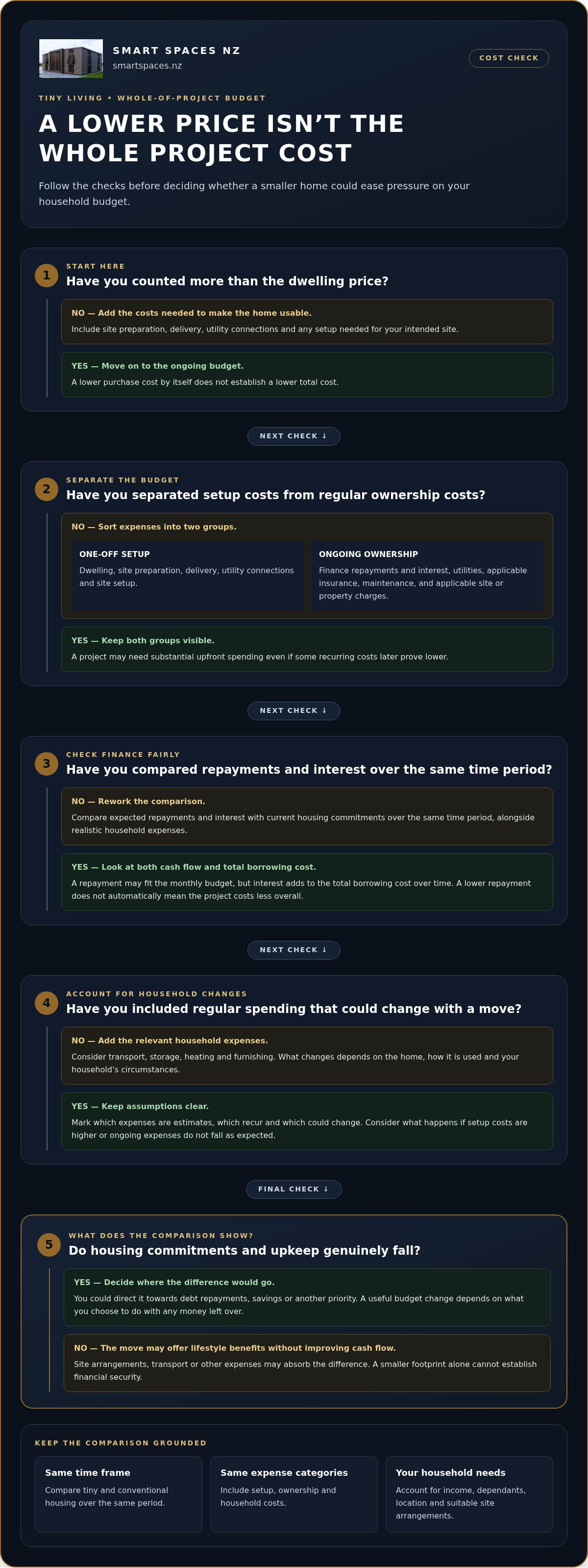
A useful comparison starts with the whole project, not the dwelling alone. A lower purchase cost may be appealing, but it doesn’t automatically mean a lower lifetime cost. The site, getting the home there, making it usable and maintaining it over time all shape the financial picture.
Separate one-off setup costs from regular ownership expenses. Then consider how each affects both your total outlay and the money available month to month. A project may require substantial upfront spending even if some recurring costs later prove lower, so keep those two parts of the budget distinct.
Build a whole-of-project budget before comparing homes
List the costs that apply to your situation rather than relying on a headline price. A two-bedroom expandable home, for example, is one part of a wider housing decision. The two-bedroom expandable home guide can help you understand that home format as you prepare your comparison.
Before moving in: Include the dwelling, site preparation, delivery and any utility connections or setup needed for your intended site.
For the ongoing budget: Allow for finance repayments and interest, utilities, insurance where applicable, maintenance, and any site or property charges that apply.
For the household: Account for regular spending that may change with a move, such as transport, storage, heating and furnishing.
Finance affects cash flow as well as the overall amount paid. A repayment may fit the monthly budget, but interest adds to the total borrowing cost over time. Compare expected repayments and interest with your current housing commitments, using the same time period and a realistic view of your household’s other expenses. Don’t assume a lower repayment means the project costs less overall.
For a clearer picture of financial freedom through tiny living, keep your assumptions visible. Note which expenses are estimates, which are recurring and which could change. This makes it easier to see what might happen if setup costs are higher or ongoing expenses don’t fall as expected.
Treat rental income as a scenario, not a certainty
Rental revenue is not the same as money left in your pocket. Start with expected rent, then allow for unoccupied periods, upkeep, management costs and any ongoing expenses associated with the dwelling. The result is a scenario to assess, not guaranteed income.
Build conservative, expected and optimistic occupancy assumptions. For each, compare likely revenue with costs and interruptions, including time when the home isn’t earning. If the plan only looks workable under the most optimistic scenario, it may be more fragile than it first appears.
Intended use also matters. A home used by your household, offered as a long-term rental or used for short stays may involve different practical and applicable requirements. Include those in your planning before relying on rental income to support repayments or other goals.
Once you’ve mapped the site, setup and ongoing costs, explore Smart Spaces NZ expandable and container homes as possible parts of your housing plan. Factory-direct purchasing is one value consideration, not proof of a particular saving.
Tiny living versus conventional housing: compare the whole picture
A fair comparison looks beyond floor area. Tiny living may involve a different upfront commitment and a more compact household routine, while a conventional home may offer more room for changing needs. Neither option is automatically the better financial choice. Land or site arrangements, planning requirements, finance and intended use can all change the picture, so weigh them alongside the home itself.
Use the same categories for both options and compare them over the same time frame. The table below is a starting point, not a verdict.
When tiny living may better fit your priorities
A smaller home may suit you if you value a compact footprint, want to review your housing commitments or prefer a different way to use space. Expandable and container-home formats offer distinct options to consider, but the right fit depends on your household’s layout needs, site and plans for the home. Comparing information about two-bedroom container homes with expandable-home details can help clarify the format differences without assuming either one will cost less overall.
When a smaller home may not improve the financial picture
Site preparation, delivery, utility connections or finance may alter the expected benefit, particularly if these costs are substantial for your circumstances. Limited space can also be a poor fit if your household needs more room, has accessibility requirements or expects to change in size. Think through daily routines as well as the budget. A home that doesn’t work for your needs may bring new costs or pressure rather than relief.
Resale is another uncertainty to include in your thinking. Future demand and value can depend on the home, its location, site arrangements and intended use. Don’t build your decision around an assumed resale outcome. Instead, compare the costs and responsibilities you can reasonably anticipate, and note where uncertainty remains.
The central misconception is that less space automatically creates financial freedom through tiny living. It doesn’t. A smaller home is one possible housing choice; whether it supports your financial goals depends on the whole arrangement and the life you need it to accommodate. Conventional housing isn’t inherently wasteful, just as tiny living isn’t universally superior. The stronger option is the one that fits your numbers and household.
How to test whether tiny living supports your financial goals
Take the pressure off the decision by testing it on paper first. A clear comparison can show whether a different home supports a goal you care about or simply shifts costs into new places. Use the same time period and expense categories for your current household and the tiny-home scenario, so you’re comparing like with like.
Create a realistic before-and-after cash-flow comparison
Start with your priorities and current spending. Then build a second version of the budget that reflects the home, site and financing you’re considering. Keep estimates separate from known figures, and include a contingency allowance for unexpected or changing costs.
Name your goal. Decide what you want the housing change to help you do, such as pay down debt, build savings or gain more flexibility. Make the goal specific enough to assess.
Record current household spending. Include housing payments, utilities, upkeep, transport and savings contributions, alongside other regular essential expenses.
Set a consistent time frame. Compare both scenarios over the same period and use the same categories. This helps prevent one-off expenses in one option from being overlooked in the other.
Add tiny-home project costs. Include the dwelling, site preparation, delivery, connections and any finance repayments and interest relevant to your plans. Don’t assume every existing expense will fall.
Estimate ongoing ownership costs. Allow for utilities, maintenance, site-related expenses and household costs that may change. Add a contingency allowance rather than treating every estimate as exact.
Check what remains for your goal. After essential expenses and planned contributions, compare the available cash in each scenario. Ask whether any difference is enough to support the goal you set.
Stress-test the decision before committing
A budget is only useful if it can handle change. Revisit your comparison with different assumptions about income, household needs, finance costs and intended use. Consider whether a change in family circumstances or plans for the property would affect the figures. If rental income is part of your thinking, test the plan without relying on optimistic occupancy.
For New Zealand consent context, read the NZ tiny home regulations guide and factor any requirements relevant to your intended dwelling and use into your planning. Don’t treat a budget as complete until you’ve considered how the project’s practical requirements could affect timing and costs.
Checklist: Proceed only when the plan still works under cautious assumptions, with room for a contingency and without relying on best-case income or savings.
Once your comparison shows what you need from a home, explore Smart Spaces NZ’s expandable and container homes as options to weigh against your goals, site and household needs.
Explore a Smart Spaces NZ home as one part of your plan
Once you’ve set your financial goal and tested the costs, compare real home formats against your plan. Smart Spaces NZ sells factory-direct expandable homes and container homes across New Zealand. Buying factory-direct can be a value consideration, but it doesn’t guarantee a particular saving or make the wider site and ownership costs disappear.
Smart Spaces NZ also offers finance solutions. If you’re considering finance, include repayments and interest in your household cash-flow comparison rather than treating finance as a way to make a home more affordable by default. The aim is to understand how the full commitment fits your budget and priorities.
Match the home format to your intended use
Smart Spaces NZ offers two-bedroom expandable homes and two-bedroom container homes. Think about who will use the home, how much space your household needs and what the intended use involves. Comparing those priorities with each format can help you narrow down options without assuming one will suit every household. The prefabricated homes guide provides broader context as you consider this style of housing.
It can help to write down your must-haves before exploring options. Consider the number of people using the home, how you need rooms to function and whether your plans may change. Then revisit your budget: a format that seems suitable on paper still needs to fit the site arrangements, setup and ongoing costs in your scenario. Keep the housing choice connected to the goal you set, whether that’s reducing debt, building savings or gaining flexibility.
Take a considered next step
Return to your cash-flow comparison before moving from research to a decision. Check that it includes the home, site-related expenses, finance and ongoing ownership, and that your plan still works under cautious assumptions. This keeps the focus on your household’s actual circumstances rather than a general promise about tiny living.
Smart Spaces NZ is family-owned and operated, with over 40 years of industry experience. That background is useful context as you explore manufactured home options, while the right choice still depends on your needs, intended use and budget. Financial freedom through tiny living isn’t guaranteed by choosing a smaller home; the format is one part of a broader financial plan.
If your comparison suggests an expandable or container home could suit your priorities, explore Smart Spaces NZ home options and consider how a suitable format fits into your overall budget.
Make your next move a considered one
You don’t need to rush from research to a major commitment. Give yourself time to discuss the decision with everyone it affects and picture how each option would work in day-to-day life. A sound choice is one you can explain clearly: what it supports, which trade-offs you’re comfortable with and what would make you pause.
Keep your meaning of financial freedom through tiny living tied to your own priorities, not someone else’s version of success. If a particular home format seems worth considering, take a closer look at how it fits your plans and budget.
With a clear goal and a measured approach, you can choose a path that feels right for your household, one practical step at a time.
Frequently Asked Questions
Can tiny living help me become mortgage-free sooner?
A smaller home may mean you need to borrow less, but it won’t automatically make you mortgage-free sooner. The result depends on purchase and site costs, finance terms, your income and any existing debt. Reducing the amount you owe is different from paying off a mortgage entirely. To assess financial freedom through tiny living, compare complete scenarios, including repayments and other commitments, without assuming a particular payoff date.
Is buying a tiny home a good investment in New Zealand?
It may suit your investment goals, but a tiny home isn’t automatically an appreciating asset or a source of income. Consider purchase and setup costs, ongoing expenses, intended use, demand, resale prospects and applicable requirements. For example, a plan based on future resale depends on conditions you can’t control. Judge the home against your own goals and a cautious budget, rather than broad claims about tiny-home returns.
Can I earn rental income from a tiny home?
Rental income may be possible, depending on the property, your intended use and applicable requirements. Gross rent isn’t the same as profit: periods without a tenant, maintenance, finance commitments and other ownership expenses can reduce what remains. A home’s suitability for your household doesn’t automatically make it suitable as a rental. Before relying on rent to meet costs, model conservative occupancy and allow for interruptions to income.
Does tiny living mean I have to live off-grid?
No. Choosing a tiny home doesn’t, by itself, determine how it connects to services. The practical setup depends on the property and project, including what infrastructure is available and what your household needs. Off-grid living shouldn’t be assumed to reduce costs, as equipment, upkeep and other arrangements can add expenses. Include your intended setup and any applicable requirements in your budget before comparing it with a connected home.
What ongoing costs should I include when budgeting for a tiny home?
Allow for finance, site or land arrangements, utility connections and use, maintenance, insurance and transport where they apply. The categories and amounts will vary between projects, so don’t treat a cost from another household as a reliable estimate for yours. For a practical comparison, track recurring expenses alongside your current household budget. This helps reveal whether the ongoing commitment suits your plans, beyond the home’s purchase price.
Can I use finance to buy a tiny home?
Smart Spaces NZ offers finance solutions. Suitability depends on you, the home and the lending arrangement. Repayments, interest and any fees affect the total commitment and whether it supports your financial goals. Before deciding, include the full finance commitment in your household cash-flow comparison and consider how it fits alongside your other regular expenses.



Comments