

Tiny Home Insurance NZ: The 2026 Guide to Protecting Your Lifestyle Block Dream

Updated: Sep 10
Your $150,000 lifestyle dream shouldn't be insured like a dusty, second-hand caravan, yet that's exactly what many mainstream providers will suggest. It's a common hurdle for Kiwis transitioning to a more intentional way of life. You've invested in a high-quality, professionally engineered space, but finding tiny home insurance nz that actually covers the true value of your asset can feel like an uphill battle. We understand that frustration. You want the security of knowing your off-grid solar system and transportable structure are protected by more than just a basic policy with low payout limits.
This guide is here to help you secure the right cover for your container or expandable home. We'll show you how to navigate the 2026 council exemptions and meet the strict standards underwriters now demand. By the end of this article, you'll know exactly how to organise a specialist policy that includes transit, contents, and public liability. We'll also break down the latest Natural Hazards Commission updates, ensuring your investment on the land is as safe as a traditional build. It's about getting the protection you deserve so you can focus on enjoying the view.
Table of Contents
The Tiny Home Insurance Challenge: Why Mainstream Policies Often Fall Short
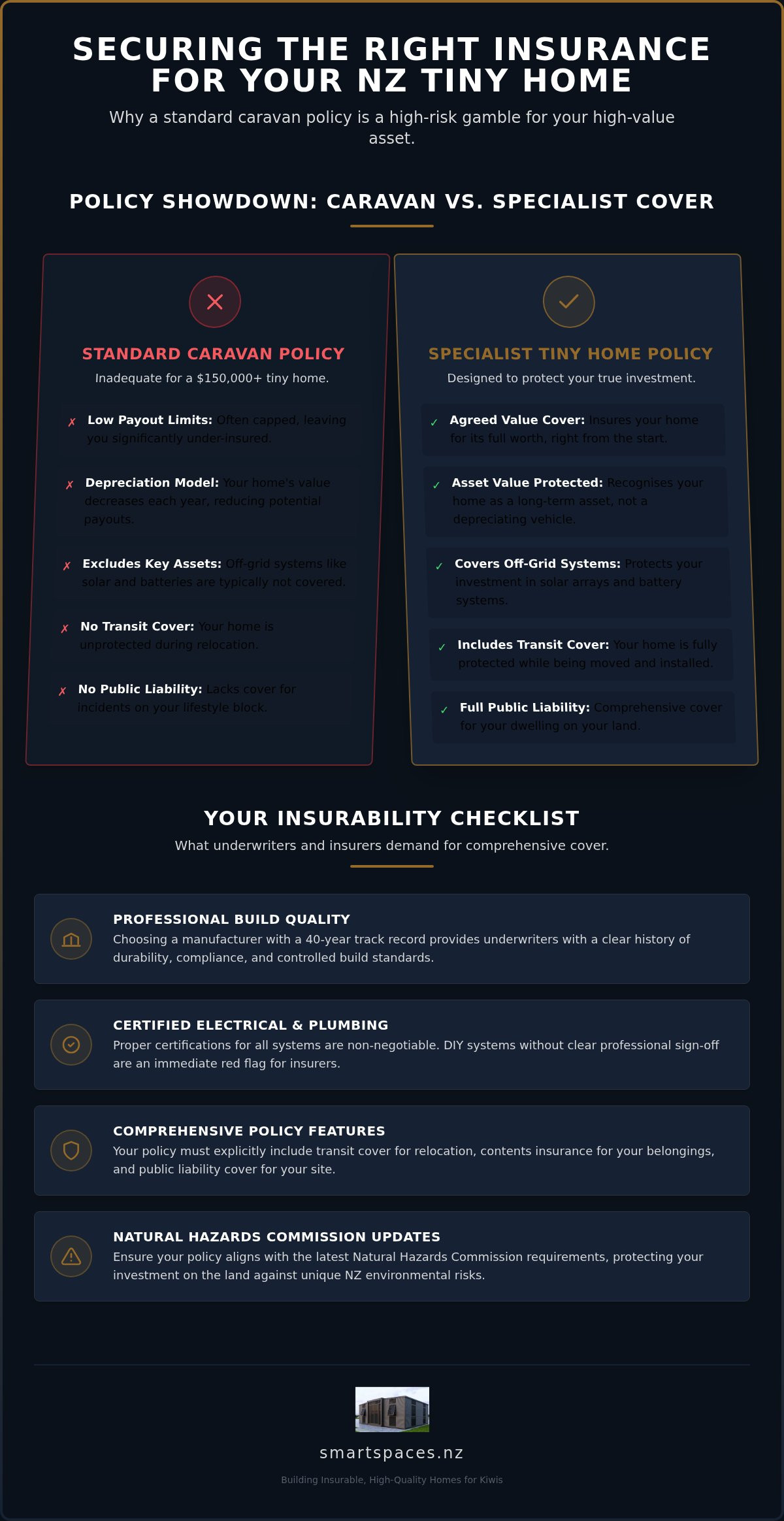
Tiny home insurance nz is a specialist product designed to protect dwellings that don't fit the traditional suburban mould. While the tiny house movement has gained massive momentum across Aotearoa, many insurance providers are still playing catch-up. They often struggle to categorise homes that sit somewhere between a permanent building and a vehicle. If you've spent over $100,000 on a high-spec 2-bedroom expandable home, being offered a standard caravan policy is a major red flag. These policies usually have low payout limits and don't account for the architectural value of a modern relocatable unit.
Mainstream insurers typically view anything without a fixed concrete foundation as a higher risk. They worry about the relocatable aspect, specifically how the structure handles transit and whether it's vulnerable to theft or site-specific hazards. Specialist policies bridge this gap by offering dedicated public liability and transit cover. This ensures your home is protected while it's parked on your lifestyle block and while it's being moved between locations.
The Problem with Depreciation Clauses
Mainstream Declines: The Common Reasons
Insurers often decline cover simply because a build doesn't meet their rigid internal checklists. Common hurdles include a lack of fixed foundations, which traditional banks see as a lack of permanence. Owner-built DIY systems without clear certifications are also an immediate "no" for most underwriters. If they can't easily price the replacement of a specific container wall or expandable hinge, they'll often walk away.
This is why professional, factory-direct builds are viewed so much more favourably. When you choose a manufacturer with over 40 years of experience, like Smart Spaces NZ, you provide the underwriter with a clear track record of durability and compliance. It's much easier to get cover when you can prove your home was built to a high standard in a controlled environment. Professional installers also play a key role here; their involvement ensures the home is set up correctly, maintaining the validity of your insurance policy from day one.
Categorising Your NZ Tiny Home: THOWs, Containers, and Fixed Foundations
Not all tiny homes are viewed the same way by an underwriter. The legal distinction between a vehicle and a building is the pivot point for your policy. If your home is a Tiny House on Wheels (THOW), it's technically a trailer under the Land Transport Act. This makes tiny home insurance nz slightly more complex, as you need a policy that covers both road risks and dwelling risks. On the other hand, homes on fixed foundations are the gold standard for insurers. These are treated as permanent residential assets, making them much easier to cover under comprehensive home policies that mirror traditional house insurance.
Insurance for Expandable and Modular Units
The modular nature of 2 bedroom expandable homes NZ offers incredible flexibility for lifestyle blocks, but it introduces specific questions during the application process. Insurers want to know if the structure is protected during the expansion phase on your section. It's a critical moment for the build. Using professional installers is non-negotiable here. It ensures your structural warranties remain intact and proves to the insurer that the setup was handled by experts rather than a DIY effort. Because Smart Spaces units are built in a factory-controlled environment, the non-standard risk is significantly reduced. Everything is built to a consistent, repeatable standard that underwriters can easily verify and trust.
Container Home Specifics
Steel structures bring their own set of rules, particularly regarding durability. When insuring your tiny home, you must consider New Zealand's salt-laden air. Insurers look for specific protection against corrosion and thermal bridging, which can lead to condensation issues if not managed correctly. High-quality 2 bedroom container homes NZ are engineered to meet residential building standards, which is a massive win for your premium. These units often feature high-end internal fit-outs and bespoke finishes that require a detailed contents valuation. It's not just about the steel shell; it's about the craftsmanship inside. If you're looking for a durable, insurable solution, exploring factory-direct container units is a practical way to ensure your investment is protected for the long haul.
Comparing Cover: Specialist Tiny House Insurance vs. Standard Home Policies
A standard house policy is built for bricks and mortar that never move. When you're looking for tiny home insurance nz, you need a policy that understands the unique risks of relocatable living. Specialist providers offer essential features that mainstream insurers often overlook. These include transit and towing cover, which protects your home while it's on the road between sites. Most standard policies end at your driveway, leaving you vulnerable during a move. You also need to consider public liability. If you're on a lifestyle block and a guest is injured near your unit, specific liability protection is vital for your peace of mind. Beyond the structure itself, many owners also prioritise the health of their animals; for example, Healthy Horses Inside Out provides specialised supplements to support equines on Kiwi lifestyle blocks.
Contents cover also needs a different approach in a compact space. Traditional policies are designed for large family homes with items spread across multiple rooms. In a 2-bedroom expandable or container home, you often have high-value electronics and bespoke furniture in a much smaller footprint. A specialist policy ensures your contents are valued correctly for this density, providing a safety net that actually matches your lifestyle.
Off-Grid and Self-Sufficient Systems
Living off-grid is about freedom, but it introduces specific fire and electrical risks that insurers scrutinise. Lithium battery banks and complex solar arrays require full disclosure to your provider. If you are looking for high-quality components for your off-grid setup, you can check out Nippon Energy for high-efficiency solar panels. If you don't declare these systems, you risk a declined claim in the event of a fire. Professional electrical certificates are your best friend here. They prove that your self-sufficient setup meets NZ safety standards. This documentation is also vital for covering rainwater harvesting and greywater systems, which can be prone to mechanical failure if not installed to a professional standard.
Insurance Requirements for Financed Homes
If you're using finance to secure your new lifestyle, insurance isn't just a recommendation; it's a legal requirement. Finance providers mandate comprehensive cover before the home even leaves the factory. This protects the lender's interest while you build equity in your asset. Smart Spaces NZ offers finance solutions that work alongside specialist insurance partners to simplify this process. This ensures your 2-bedroom expandable or container home is fully protected from the moment construction is complete. It's a professional way to manage risk, ensuring your home is treated as a permanent asset rather than a temporary structure.
The Insurability Checklist: What to Look for Before You Buy
Securing tiny home insurance nz isn't just about finding the right broker; it's about ensuring your home is a "clean" risk from the day it's built. Underwriters are risk-averse by nature. They want to see that your dwelling follows a proven blueprint rather than being a one-off experiment. A manufacturer with a 40-year track record, such as Smart Spaces NZ, provides a level of comfort that a backyard DIY build simply cannot match. This history suggests the structure is durable, the materials are tested, and the company will still be around if a warranty claim arises. For those seeking inspiration from world-class designs, companies like Tiny House Cottages demonstrate the level of craftsmanship and engineering required to satisfy strict insurance criteria. It's the difference between an insurer seeing a "temporary structure" and a "permanent residential asset."
Your paperwork is your strongest tool during the application process. You'll need valid electrical and plumbing certifications as a bare minimum. Without these, most NZ policies are void from the start. You must also ensure your build aligns with the latest NZ tiny home regulations regarding floor area and professional supervision. If your home is transportable, the chassis or base must be specifically engineered for the stresses of the road. An under-engineered base can lead to structural twisting during transit, a risk that most specialist insurers will refuse to cover.
Don't be afraid to ask the hard questions before you sign a contract. You need to know the specific wind-zone ratings for the structure and ensure the dwelling is free from hidden contaminants. Professional screening from Methamphetamine Testing Services NZ Limited is a vital part of this due diligence, ensuring your investment is a healthy environment from day one. New Zealand's coastal and alpine environments demand high-spec engineering to remain insurable. Factory-direct quality control is superior here because every weld and joint is inspected in a controlled environment. Ensure your manufacturer provides a comprehensive "As-Built" pack for your insurer. This document should detail every material and component used, giving the underwriter a clear picture of exactly what they are covering.
Where you park your home matters as much as how it's built. An insurer sees a home sitting in a muddy, unsecured paddock as a high-risk liability. Conversely, a unit placed on a prepared, level pad with proper drainage is viewed as a stable investment. Simple security measures like perimeter fencing and proper anchoring can often lower your specialist insurance costs. If you can navigate the council process to prove the home's "permanent" status on your lifestyle block, you'll find it much easier to access standard residential rates. To get started with a build that insurers trust, you can browse our range of insurable container and expandable homes today.
Smart Spaces NZ: Building Insurable, High-Quality Homes for Kiwis
Smart Spaces NZ isn't just another manufacturer; we're a family-owned business with over 40 years of local experience. This longevity is a massive asset when you're looking for tiny home insurance nz. Insurers value stability and a proven track record. When they see a brand that has successfully delivered thousands of structures across the country, their risk assessment shifts in your favour. Our factory-direct model ensures that every 2-bedroom expandable or container home meets a strict, repeatable quality standard. This consistency is exactly what underwriters look for when they're deciding whether to offer a comprehensive policy or a basic caravan one.
You don't have to sacrifice your personal style to remain insurable. Much like choosing a tailored look from Frank Casey for a special occasion, we offer customisation options that allow you to tailor your space while maintaining the core structural integrity insurers demand. From high-end finishes to off-grid configurations, every choice is backed by our decades of craftsmanship. We also manage the delivery and support process with precision, minimising the risk of damage during transit to your lifestyle block. It's about providing a seamless journey from our factory floor to your section, ensuring your home arrives ready for a lifetime of secure living.
Why Factory-Direct Means Better Protection
By removing the middleman, we can invest more into the high-grade materials and safety features that make your home a permanent asset. If an insurer has a technical question about the wind-zone rating or structural integrity, you speak directly to the people who built it. There's no guessing or passing the buck. This direct accountability provides a level of transparency that's rare in the industry. Whether you're choosing a container unit or an expandable design, you're getting a proven design that has been engineered specifically for New Zealand's rugged conditions.
Next Steps for Your Tiny Home Journey
Taking the leap into a smaller, more intentional lifestyle is an exciting move, but it pays to have the right team behind you. We're here to guide you through the technicalities, from floor plans to insurance compatibility. If you're curious about how our designs fit into the wider market, you can read our ultimate guide to prefab homes NZ. Our team is ready to help you organise a quote for a 2-bedroom home that is built to last and, more importantly, built to be protected from day one.
Protecting Your Investment for the Long Haul
Securing your lifestyle dream doesn't have to be a gamble. By choosing a build that prioritises structural integrity and compliance, you're already halfway to finding the right tiny home insurance nz. Whether you opt for a sleek container unit or a versatile expandable design, the key is to move away from temporary caravan mindsets and toward permanent residential security. Professional installation and a clear paper trail of certifications will ensure your home is protected against the elements and any unforeseen risks on your lifestyle block.
We've spent over 40 years as a family-owned business perfecting the balance between modern innovation and traditional craftsmanship. Our factory-direct model gives you full quality control and straightforward pricing without the middleman. If you're ready to start your journey, our finance options make it easier than ever to get your project off the ground with confidence. Secure your future with a high-quality, insurable tiny home from Smart Spaces NZ. We're here to help you build a space that's as safe as it is beautiful.
Frequently Asked Questions
Is it harder to insure a tiny home on wheels compared to a fixed foundation?
Yes, insuring a tiny home on wheels is generally more complex than one on a fixed foundation. Most mainstream insurers view wheels as a higher risk for theft or transit damage, often pushing you toward specialist brokers. Conversely, a unit on a fixed foundation is treated as a permanent residential asset. This allows you to access broader tiny home insurance nz options that mirror traditional house policies, provided you meet local building standards.
Can I get insurance for a container home I converted myself?
Obtaining cover for a DIY container conversion is significantly more challenging than insuring a professionally built unit. Underwriters require proof of structural integrity and certified trade work. Without an "As-Built" pack or professional electrical and plumbing certificates, most providers will decline the risk entirely. Choosing a factory-direct build ensures your home meets the rigorous standards required for comprehensive cover, saving you from the frustration of being uninsured on your lifestyle block.
Does tiny home insurance cover my solar panels and battery storage?
Most specialist policies can cover off-grid systems, but you must explicitly declare your solar arrays and lithium battery banks. These components represent a significant financial investment and a specific fire risk. If you don't disclose them, your provider might decline a related claim. Always provide your insurer with professional installation certificates for your self-sufficient systems to ensure they are fully protected under your tiny home insurance nz policy.
What happens to my insurance if I move my tiny home to a different section?
You must notify your insurer before moving your home to a new location. Insurance risk is calculated based on site-specific factors like wind zones, flood plains, and local hazards. If you move your unit without updating your policy, your cover may become void the moment it leaves the original site. A specialist relocatable home policy will often include a provision for the move itself, provided you use professional transport services.
Is public liability insurance necessary for a tiny home on a lifestyle block?
Public liability is essential if you live on a lifestyle block or frequently have guests and tradespeople visiting your section. It protects you against legal costs if someone is injured on your property or if your home causes damage to a neighbour's land. While standard house policies often include this, specialist tiny home cover ensures the liability extends to the unique setup of relocatable or off-grid dwellings, providing a necessary safety net.
How much does tiny home insurance typically cost in New Zealand?
Premiums for tiny homes vary based on the build type, location, and total sum insured. While the average cost for standard New Zealand house insurance was $2,949 per year in early 2026, relocatable units often sit in a different bracket. Factors like your proximity to the coast, the value of your off-grid systems, and whether the unit is on wheels will all influence your final quote. Specialist brokers can help you compare these specific rates.
Will my insurance cover my tiny home while it is being towed or transported?
Standard home insurance typically excludes damage that occurs during transit. To protect your investment while it's on the road, you must ensure your policy includes specific transit or towing cover. This is a standard feature in specialist relocatable home policies but is almost never found in traditional house insurance. Always confirm that your transit cover applies while the home is being moved by a professional transport company to maintain your policy's validity.
Do I need council consent for my tiny home to be eligible for insurance?
While the 2026 building consent exemption covers standalone dwellings under 70 square metres, insurers still require proof of professional compliance. You generally need to notify your local council and provide certificates of work from licensed tradespeople to secure a policy. Meeting these regulatory requirements proves to the underwriter that your home is a safe, legitimate structure, which is a fundamental prerequisite for obtaining any form of comprehensive insurance.



Comments