

Tiny Home Finance NZ: Comparing Your Funding Options in 2026

Updated: Aug 26
Why is it that New Zealand remains one of the least affordable housing markets globally, yet banks still treat a high-quality tiny house like a glorified caravan? It's incredibly frustrating to have a solid deposit and a clear vision, only to be told your home doesn't fit the traditional mortgage box because it's on wheels or sits on a smaller footprint. You want the freedom of a simpler lifestyle without being shackled to a 30-year debt or stuck with interest rates that feel like a punishment. We understand that the path to homeownership has changed, and the way we fund it must change too.
This guide will show you that securing tiny home finance NZ wide is entirely possible when you stop looking for a standard mortgage and start exploring strategic funding. We'll help you discover the most effective ways to fund your dream, from personal loans with rates starting around 7.99% p.a. to clever equity releases. You'll learn the critical differences between asset finance and mortgages, and how the 2026 building consent exemptions for permanent dwellings up to 70 square metres might finally tip the scales in your favour. By the end of this article, you'll have a clear roadmap to buying a high-quality home without the lifetime of debt.
Table of Contents
Understanding the Tiny Home Finance Landscape in NZ
Securing tiny home finance NZ wide requires a shift in how you think about debt. A traditional mortgage is essentially a loan for a piece of land with a permanent structure attached. If your dream home has wheels or is a transportable unit, most big banks won't see it as "real property". Instead, they view it as a "chattel", much like a car or a boat. This distinction is the very first hurdle you'll face. As we move through 2026, the lending environment has become more nuanced. While traditional banks remain cautious, the global tiny house movement has pushed New Zealand's financial sector to adapt, creating a landscape built on three main pillars: cash savings, personal credit, and existing home equity.
Why Tiny House Loans aren't Standard Mortgages
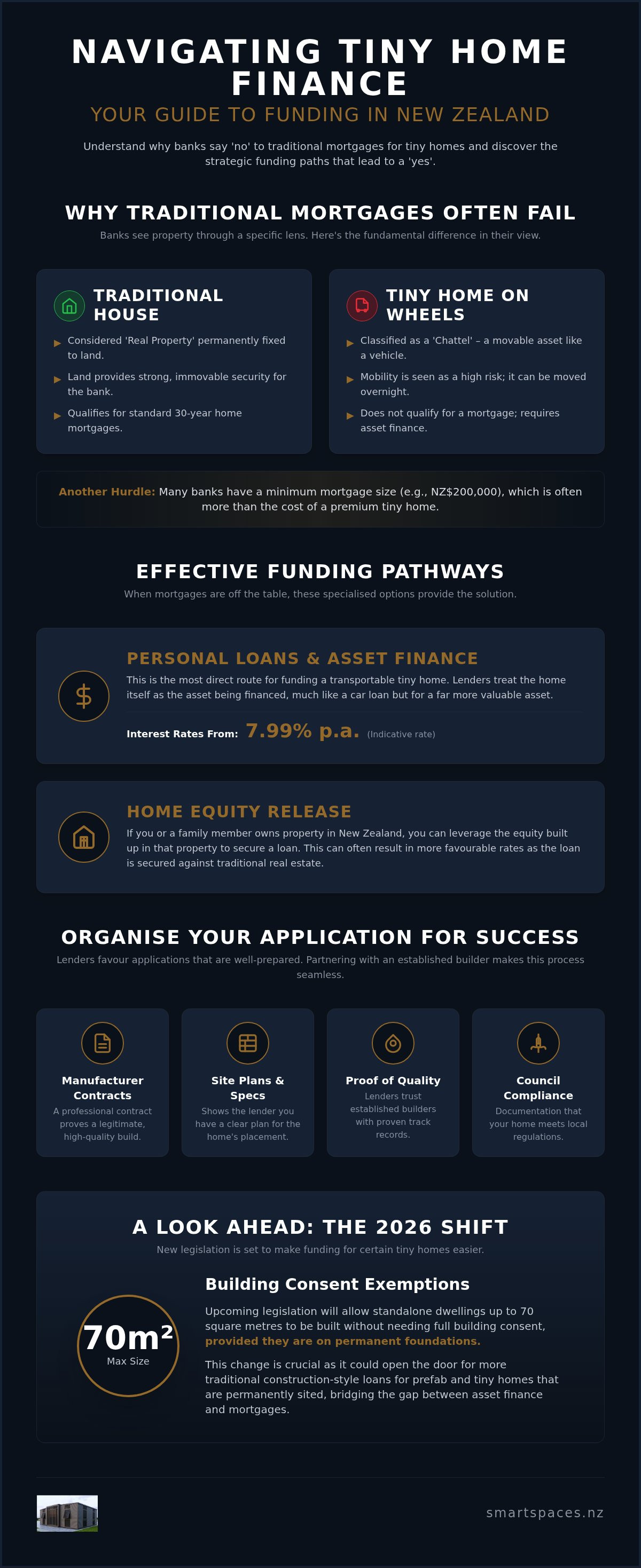
The legal difference between "chattel" and "real property" is why your local branch manager might look confused when you ask for a 30-year mortgage on a container home. Banks require land as security because land doesn't move and generally appreciates in value. A tiny home on wheels is a mobile asset. Under the Building Act, if a structure is movable, it often bypasses certain land-based regulations but also loses out on land-based lending rates. Even with the 2026 legislation allowing standalone dwellings up to 70 square metres without consent, they must be on permanent foundations to be considered for traditional housing finance. If your home is on a trailer, you're looking at asset finance or a personal loan, not a mortgage.
The Rise of Alternative Lending for Prefabs
Because the "Big Four" banks are often slow to move, non-bank lenders and specialised finance companies have stepped in to fill the gap. These providers understand that a high-quality 2-bedroom expandable home is a durable asset, not a temporary shelter. They offer tailored loans that reflect the actual life cycle of a modern prefab. Success here depends heavily on who builds your home. Lenders are far more likely to approve your application if you're partnering with an established name. Our 40 years of family-owned experience at Smart Spaces NZ provides the "proof of quality" that lenders need. We help bridge the gap between your vision and the bank's requirements by providing the technical specifications and manufacturer contracts that satisfy modern credit checks. This professional backing makes your finance journey significantly smoother than trying to fund a DIY project.
Why Traditional Mortgages Often Fail for Tiny Houses
Walking into a bank with a plan for a tiny house often results in a quick "no" from the mortgage manager. The primary reason is the "security" problem. Banks want to know that if things go wrong, they can recover their money by selling the asset. Because many tiny houses are built to be transportable, they don't offer the same level of security as a house bolted to a concrete slab. If a borrower stops making payments, a bank can't easily foreclose on a home that could be towed to a different region overnight. This mobility makes you a higher risk in their eyes, regardless of your credit score.
Navigating these banking hurdles often requires professional support; a brokerage like Hewett Mortgages can provide the expert financial advice needed to secure funding for property acquisition in a challenging market.
Another hurdle is the minimum loan size. Many New Zealand banks have internal policies that prevent them from processing residential mortgages for amounts under NZ$200,000. Since many premium 2-bedroom container homes fall well below this price point, you might find yourself in a situation where the bank likes your project but simply doesn't have a product small enough to fund it. This is where the search for specialised New Zealand tiny home finance becomes essential, as it targets the actual cost of these modern dwellings.
The Challenge with Tiny Homes on Wheels
If your heart is set on a Tiny House on Wheels (THOW), you need to prepare for the reality that banks will likely view it as a vehicle or a caravan. You won't find a 30-year mortgage for a mobile asset. Instead, you'll be looking at much shorter repayment terms, which can put pressure on your weekly budget. A chattel mortgage is a specific type of loan where the lender takes security over the movable home itself rather than the land it sits on. While this allows you to bypass land ownership requirements, the interest rates reflect the "movable" nature of the security.
Fixed Prefabs and Construction Loans
There is a smoother path if you're opting for a fixed foundation. Modern 2-bedroom container homes can sometimes qualify for construction-style progress payments if they're permanently connected to local services. Lenders are increasingly fond of "turnkey" factory-direct models because the price is fixed from the start. This eliminates the risk of the "DIY budget blowout" that banks fear most. When a home is built in a controlled environment and delivered to a site with a fixed foundation, it starts to look much more like a traditional asset, opening up more competitive tiny home finance NZ paths for savvy buyers.
Comparing Finance Paths: Personal Loans vs. Home Equity
Equity Release: The Smart Choice for Homeowners
If you're looking to add a 2-bedroom expandable home to your existing property as a granny flat or rental unit, leveraging your home equity is almost always the most cost-effective route. By "topping up" your current mortgage, you can fund the purchase at residential interest rates, which are significantly lower than any personal loan. This approach also allows you to spread the repayments over a longer term, keeping your weekly outgoings manageable. The return on investment is often compelling; adding a high-quality unit can increase your property's value while providing immediate rental income or housing for family. However, you must remember that KiwiSaver withdrawal rules for tiny homes are very strict. You can generally only use those funds if the home is on a permanent, immovable foundation and meets all building codes, making it a "real property" asset in the eyes of the law.
Personal and Asset-Based Loans
For those who don't have a house to leverage, personal loans and asset finance provide a faster path to ownership. Lenders like Harmoney offer unsecured loans up to NZ$100,000 with terms typically spanning 3, 5, or 7 years. These are much shorter than a 30-year mortgage, meaning you'll pay the debt off faster and own your home outright sooner. Because these loans are often processed quickly, they're ideal for buyers who want to move into their new space within weeks rather than months. To get the best rates, you'll need a clean credit history and stable income. We often see clients successfully use third-party providers like Better Finance to bridge the gap, especially when buying factory-direct. This "no-nonsense" approach to tiny home finance NZ ensures you aren't paying middle-man fees, allowing every dollar of your loan to go directly into the craftsmanship and quality of your new 2-bedroom home.
How to Organise Your Finance Application for Success
Preparing a successful application for tiny home finance NZ requires more than just a decent credit score. You need to present yourself as a low-risk borrower with a crystal-clear plan. Lenders are particularly sensitive to your debt-to-income ratio; to understand how these calculations work, Mortgage Suite Ltd provides essential information on current standards. This is the percentage of your gross monthly income that goes toward paying debts like car loans, credit cards, or hire purchase agreements. If you can lower this ratio by closing unused accounts or clearing small debts before you apply, you'll immediately look more attractive to a credit manager. Think of your application as a story; you want to show that every dollar is accounted for and that your new home is a sensible, long-term investment.
Proving the Value of Your Tiny Investment
Site Readiness and Council Consents
Lenders want to know exactly where the home will be located and whether it has the legal right to be there. Addressing the "illegal structure" fear is a major part of the application process. You'll need to provide site plans that show utility connections and how the home sits on the land. If you're using the 2026 building consent exemptions for a 2-bedroom unit, have the documentation ready to prove you meet the criteria for a permanent foundation. This level of preparation shows the lender that your project won't be stalled by council removal orders or fines.
At Smart Spaces NZ, we assist with these technical details to ensure your application is professional and complete. We provide the manufacturer contracts and fixed-price certainty that banks crave, backed by our 40 years of family-owned industry experience. A fixed-price contract is a lender's best friend because it eliminates the risk of the budget blowouts that often plague DIY builds. To get started on the right foot with a reliable partner, browse our 2-bedroom container homes and see the level of detail we provide to support your finance journey.
Smart Spaces NZ: Quality Homes with Accessible Finance
Lenders aren't just looking at your bank statements; they're looking at who's building your home. Our 40 years of family-owned experience isn't just a badge of pride; it's a tool for your success. Banks and non-bank lenders in New Zealand prefer established manufacturers because it eliminates the uncertainty of a DIY build. When you choose a partner that understands the tiny home finance NZ landscape, you're providing the bank with a proven track record of quality and durability. This trust translates into smoother approvals and clearer communication between all parties, ensuring your project doesn't get stuck in a pile of paperwork.
Factory-Direct: More Home for Your Money
Buying factory-direct is a massive financial advantage. By eliminating middle-man markups, we ensure your total loan amount stays as low as possible. This directly improves your debt-to-income ratio, making it easier for lenders to say "yes" to your application. A controlled factory setting also means every 2-bedroom unit meets strict quality standards every time. Lenders view this predictability as a significant risk reduction compared to on-site custom builds where weather delays or material shortages can inflate costs. You get a high-quality, customisable home that fits your budget without the unnecessary corporate overheads that often inflate the price of small-scale housing.
Start Your Journey Today
The speed of our process is another hidden financial benefit. Traditional builds can drag on for a year, during which you might be paying both rent and interest on a construction loan. Our streamlined manufacturing means shorter build times and faster delivery to your section. This efficiency saves you money on interest and gets you into your new lifestyle sooner. We work closely with specialised finance partners to help you secure pre-approval, giving you the confidence to move forward with a fixed price and a clear timeline. We understand that the path to a new home should be straightforward and honest, which is why we provide the technical specs you need for your tiny home finance NZ application from day one.
Ready to see what's possible for your section? View our 2-bedroom expandable homes and request a quote to take the first step toward your new space. Whether you're looking for a 2-bedroom container home or a flexible expandable unit, we have the expertise to help you navigate the funding process and achieve your dream of a high-quality, debt-friendly lifestyle.
Take the Next Step Toward Your Tiny Home Dream
Securing your dream home in 2026 doesn't have to mean a lifetime of traditional debt. We've explored how the landscape of tiny home finance NZ has shifted towards more flexible, asset-based lending and equity release strategies. By focusing on site readiness and choosing a build partner with a proven track record, you can bypass the rigid requirements of traditional banks. You don't need a 30-year mortgage to live in a high-quality, durable space that you truly own. This movement towards autonomy is gaining ground worldwide, and for those looking for inspiration in regenerative community living, you can check out The ARK.
Whether you're looking for a 2-bedroom container home for a rental property or a customisable expandable unit for your own section, the path to ownership is clearer than ever. At Smart Spaces NZ, we bring over 40 years of family-owned expertise to every project. Our factory-direct NZ pricing ensures you get maximum value without middle-man fees, making your finance application much stronger from the start. We specialise in high-quality 2-bedroom units that meet the needs of modern Kiwi families while remaining accessible to various budgets.
Part of maintaining a debt-friendly lifestyle is managing all essential expenses; for those in Auckland, Stoddard Dental Square provides WINZ-approved dental services that help keep healthcare costs affordable while you invest in your future.
Your journey to a simpler, more empowered lifestyle starts with a single conversation. Explore Smart Spaces NZ Finance Options and View Our Homes today to see how we can help you bridge the gap between vision and reality. You have the tools and the knowledge; now it's time to build the future you deserve.
Frequently Asked Questions
Can I get a 30-year mortgage for a tiny home on wheels in NZ?
No, you cannot secure a traditional 30-year mortgage for a tiny home on wheels. Banks view these mobile structures as vehicles or chattels, which depreciate differently than land. Instead, you'll need to look at personal loans or asset finance with terms typically ranging from five to seven years. While the shorter term means higher weekly repayments, it also means you'll own your home outright much faster than with a standard residential mortgage.
What is the typical interest rate for tiny home finance in 2026?
Typical interest rates for tiny home finance NZ in 2026 vary based on the loan type. Unsecured personal loans often range from 7.99% to 24.99% p.a., with ASB currently offering around 13.90% p.a. If you have existing property equity to leverage, you could access floating mortgage rates closer to 6.07% or 7.24% p.a. Your specific rate will depend on your credit history and whether the loan is secured against the home.
Do I need a deposit for a tiny home loan?
Most lenders will require a deposit, especially for secured asset finance or when using a Kāinga Ora First Home Loan, which requires at least 5%. While some unsecured personal loans don't strictly require a deposit, having one significantly improves your chances of approval and lowers your interest rate. Providing a 10% to 20% deposit shows the lender you're committed and reduces their overall risk, making your tiny home finance NZ application much stronger.
Can I use my KiwiSaver to buy a tiny home?
You can only use KiwiSaver funds if your tiny home is on a permanent, immovable foundation and complies with the NZ Building Code. It must be legally classified as a dwelling rather than a vehicle. This means KiwiSaver cannot be used to purchase a tiny home on wheels or a trailer. If you're building a 2-bedroom container home on a fixed site, check with your provider early to ensure the structure meets their specific "permanent" criteria.
How does council consent affect my ability to get finance?
Council consent is a major factor because lenders want to ensure their security is legal and won't be removed by local authorities. While new 2026 legislation allows some dwellings under 70 square metres without consent, they must still meet the Building Code. If you can't prove your site is compliant, most banks will decline your application. Having a clear consent path or exemption proof is essential for securing competitive tiny home finance NZ terms.
Is it cheaper to finance a container home or an expandable home?
The cost of financing depends more on the foundation than the structure type. A 2-bedroom container home on a permanent foundation might qualify for lower-interest construction loans or mortgage top-ups. Expandable homes are often treated as movable assets, which typically require personal loans with higher rates. However, because both options are factory-direct, the lower purchase price means you'll borrow less overall, saving you a significant amount in total interest compared to a standard house.
Can I finance a tiny home if I'm putting it on a rented site?
Yes, you can finance a home on a rented site, but your options will be limited to unsecured personal loans or specific chattel finance. Since you don't own the land, a bank cannot register a mortgage against it. Lenders will focus heavily on your income and credit score rather than the site itself. It's also wise to have a formal lease agreement for the land to show the lender you have a stable place to live.
What happens if I can't get a traditional bank loan?
If a traditional bank says no, don't lose heart. Many Kiwis find success with specialised non-bank lenders or peer-to-peer providers like Harmoney, who offer unsecured loans up to NZ$100,000. These providers are often more comfortable with the tiny home finance NZ market than major banks. Working with an experienced manufacturer like Smart Spaces NZ also helps, as we provide the professional documentation and fixed-price contracts that alternative lenders need to approve your loan.



Comments