

Solving the NZ Housing Crisis: What It Takes to Make Homes More Accessible

Has New Zealand solved its housing crisis, or have the headlines got ahead of what households are experiencing? Solving the nz housing crisis is more than a matter of changing planning rules or building more homes. People still need housing they can afford, in places with the infrastructure and services to support everyday life.
It’s understandable that conflicting reports can make progress hard to judge. A rise in building consents or a shift in policy may signal movement, but neither proves that suitable homes are accessible to the people who need them. The real test is whether housing supply, affordability and location work together.
This article explains what housing-crisis claims mean, what evidence can show whether access is improving, and how planning, infrastructure and housing delivery connect. You’ll also see where factory-made homes may contribute as one practical option, without mistaking them for a complete answer. From national policy to the way homes are delivered, we’ll look at the steps that can help turn plans into more accessible housing for New Zealanders.
Table of Contents
What does solving the NZ housing crisis actually mean?
Headlines can make it sound as though a planning change or a lift in building activity has solved New Zealand’s housing crisis. But a national shift doesn’t instantly change what a renter can afford, whether a first-home buyer can get a foothold, or whether a family can find a home that suits its needs. The history and wider effects of the New Zealand property bubble also show why housing pressures can’t be judged by a single measure.
For solving the nz housing crisis to mean something in everyday life, progress needs to reach beyond the number of homes on the map. It should include access, affordability, suitability and security, alongside the ability to build enough homes to meet varied needs. More supply matters, but it isn’t the same as a complete resolution of housing need.
Why can claims of success and lived experience differ?
Policy changes may create opportunities for more housing, but the effects can take time to show up in completed homes, household choices and costs. National trends can also hide very different experiences. A renter looking for a stable, suitable home faces different decisions from a buyer trying to save a deposit, or a household that needs more space or a different layout.
That’s why a headline about national progress shouldn’t be treated as proof that everyone can find a home that works for them. Public opinion figures can add context, but percentages need to be checked against the original survey, including who was asked and when, before they’re quoted.
What would meaningful progress look like?
Look for a pattern across several measures, rather than a single announcement. Are more homes being completed and occupied? Are options available for different household sizes and life stages? Can people access housing without it taking an unsustainable share of their income, and can they stay in a home that meets their needs? These questions make the idea of success more practical and testable.
Indicators also need to be followed over time. Consents signal potential supply, while completed homes show what has actually been delivered; neither measure alone tells you whether housing is affordable or suitable. Comparing outcomes for renters, buyers and households with different needs can reveal where progress is reaching people and where gaps remain.
Housing access means being able to find and keep a secure, suitable home that a household can afford, not simply having more homes built. That definition keeps supply growth in view while recognising that homes must also be attainable and fit for purpose. One policy change can be a useful step, but declaring the crisis solved calls for evidence that these outcomes are improving together.
How planning reform can add homes, and why it is not enough alone
Planning rules influence where homes may be built, how many can fit on a site and what kinds of development can proceed. Allowing more homes in suitable areas can give landowners and developers more options, from adding homes around existing neighbourhoods to building at greater density near transport and services. But permission to build creates potential capacity, not completed homes.
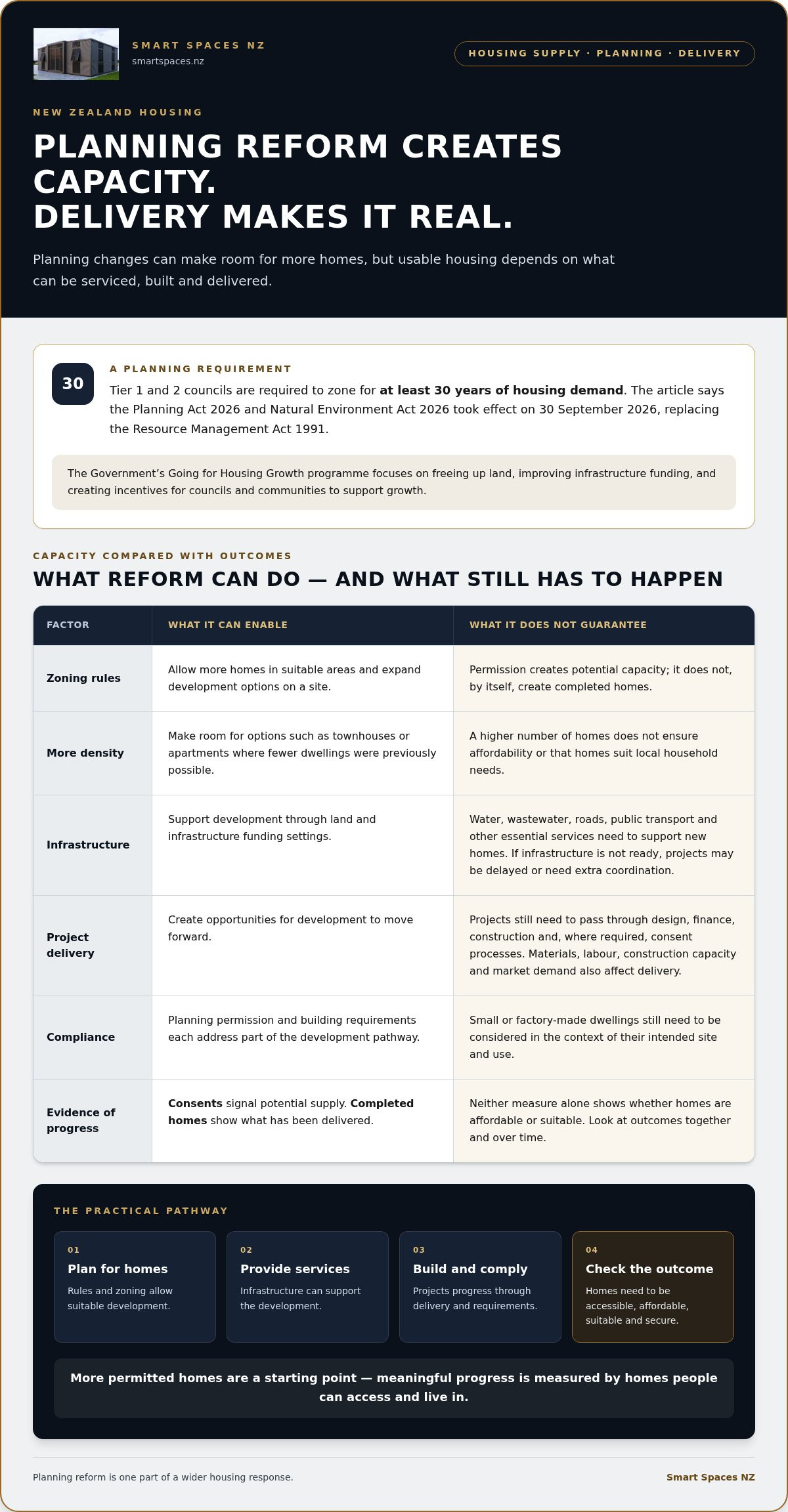
In New Zealand, the Planning Act 2026 and Natural Environment Act 2026 took effect on 30 September 2026, replacing the Resource Management Act 1991. The Government’s Going for Housing Growth programme is focused on freeing up land, improving infrastructure funding and creating incentives for councils and communities to support growth. Its updated settings require Tier 1 and 2 councils to zone for at least 30 years of housing demand. These changes can shape development opportunities, but the practical result depends on what can be built and delivered.
What can land-use changes make possible?
Zoning and development rules set boundaries around the number, type and location of homes that may be allowed. If rules permit more homes on a site, a project might include townhouses or apartments where previously fewer dwellings were possible. That expanded capacity can help make better use of serviced land, particularly where jobs, public transport and everyday amenities are accessible. Brookings discusses the rationale behind New Zealand's bipartisan housing reforms, including how zoning changes can support more construction.
Still, density is a tool, not an affordability guarantee. A plan may allow a higher number of homes without ensuring they suit local household needs or remain within reach of people on different incomes. Plans also need to move through design, financing, construction and, where required, consent processes before capacity becomes a completed dwelling. This distinction matters when assessing whether planning reform is contributing to solving the nz housing crisis.
Why do planning changes need supporting systems?
New homes need more than a zone that permits them. Water, wastewater, roads, public transport and other essential services must be able to support development. If infrastructure isn’t ready, projects may face delays or need extra coordination. Construction capacity, materials, labour, finance and market demand also affect whether a permitted project stacks up and goes ahead.
Compliance is another part of the pathway. Planning permission and building requirements address different questions, and a small or factory-made dwelling still needs to be considered in its intended site and use context. Smart Spaces NZ’s guide to NZ tiny home regulations provides further consent context; rules can depend on the proposed home and how it will be used.
For readers weighing practical housing options alongside policy, Smart Spaces NZ’s expandable and container homes offer a factory-built pathway to consider. Factory production is one part of delivery, while site suitability, infrastructure and applicable approvals remain central to making any home usable. That’s why planning reform works best as part of a coordinated effort, not as a stand-alone fix.
Which housing approaches can contribute to a broader solution?
No single building type suits every site or household. A broader housing response draws on different approaches: adding homes within existing neighbourhoods, developing new areas where land and services can support growth, and using factory-built homes as another way to deliver particular housing options. Each has a different role, and each depends on practical conditions beyond the design itself.
Intensification can add dwellings where existing infrastructure and transport may support more residents. New development can create homes where urban areas expand, but requires suitable land and coordinated infrastructure. Factory-built housing shifts some production into a factory setting; it doesn’t replace planning decisions about where a home belongs or what a site can support.
IntensificationContribution: Adds homes within established areas.Dependencies: Suitable zoning, infrastructure and designs that work for the site.Limitations: Added capacity alone doesn’t guarantee affordability or a good fit for every household.
New developmentContribution: Creates opportunities to build homes in growth areas.Dependencies: Suitable land, infrastructure, transport links and coordinated delivery.Limitations: Plans may take time to become completed homes.
Factory-built housingContribution: Offers another way to produce homes, with some work carried out in a factory.Dependencies: Site access, installation, applicable approvals and household needs.Limitations: Factory production by itself doesn’t resolve land, affordability or supply challenges.
How can different housing types meet different needs?
Households vary. A couple, a whānau needing room for children, and someone seeking a more independent living arrangement may need different spaces, layouts and levels of privacy. A home that fits one household or site won’t automatically suit another.
Smart Spaces NZ’s two-bedroom expandable homes and two-bedroom container homes are specific housing options, not planning policies. The company’s guides to expandable homes and container homes in New Zealand provide further context on those types. Their suitability still depends on the intended use, site and relevant requirements.
Where can factory-built housing fit?
Factory manufacture is a delivery approach, not a housing-crisis policy on its own. Repeating elements in a controlled production setting and offering customisable choices may suit some projects, but that doesn’t establish a particular build time, lower cost, output level or environmental result. Those outcomes depend on the design, materials, transport, site work and project requirements.
For solving the nz housing crisis, the useful question isn’t whether one method should replace the others. It’s whether a mix of approaches can deliver homes that are suitable for their sites and the people who need them. Factory-built options can contribute where they fit; planning, infrastructure and household affordability remain part of the wider picture.
What's needed for more homes to become usable housing?
A home becomes usable housing only when the pieces come together: it responds to a real need, fits its site, can be supported by essential services and meets the requirements that apply to the project. That means housing delivery is a sequence, not a single planning decision. A proposal can look promising on paper yet stall if the land, access or infrastructure isn’t ready.
A practical pathway often begins by identifying who needs housing and what kind would suit them. From there, the site and planning context can be assessed, enabling work and service connections organised, and the home designed, delivered and completed in line with applicable requirements. The details vary by project, so this is a way to understand the moving parts, not legal advice.
What practical dependencies affect housing delivery?
Site readiness matters. A home needs a suitable place to sit, a workable way to access it and the services required for its intended use. Depending on the project, work may involve preparing the site, arranging connections or coordinating delivery with other activity. If any one of these pieces is unresolved, the home may not be ready for people to occupy, even if other steps have progressed.
Consent and compliance questions also depend on the home, the site and how it will be used. Don’t assume that a small or factory-built home follows the same pathway in every situation. Smart Spaces NZ’s dedicated guide to NZ tiny home regulations and consents offers more context on the factors to consider; the relevant rules should be assessed for the specific project.
Planning permission can make a home possible, but it doesn’t make a completed home. Occupation depends on the steps that follow, including site preparation, services, delivery and applicable compliance. Keeping that distinction clear helps explain why announced capacity and homes ready for people to live in are different measures.
How can readers assess claims about proposed solutions?
Look past the headline and check what the proposal is designed to do. Does it address the need for more homes, suitable layouts, secure housing or options for particular households? A measure can improve one part of the picture without meeting every need. Ask, too, what must happen on the ground before its intended benefit reaches people.
Evidence should show progress through the delivery pathway, not just what rules permit or what plans announce. Consider whether homes are being completed, whether they suit the households they’re intended for, and whether sites have the services and access needed for use. Following those outcomes over time gives a more useful picture than treating any one announcement as proof of success.
If you’re considering a factory-built option as one part of the wider housing response, explore Smart Spaces NZ housing options, including expandable and container homes.
How Smart Spaces NZ fits into the wider housing response
National housing access depends on policy, infrastructure and homes being delivered in ways that meet real household needs. Alongside large-scale development and changes to planning, factory-built housing can offer another pathway for some projects. It has a defined role, but it can’t replace the broader work needed to make suitable homes accessible across New Zealand.
Smart Spaces NZ designs, manufactures and delivers expandable homes and container homes through factory-direct sales. Its two-bedroom options provide another choice for households considering this type of housing. Customisable options can help align a home with a project’s needs, while finance solutions form part of the company’s offering. These features don’t mean every home will suit every household or site, and they aren’t a guarantee of affordability, consent or a particular delivery timeframe.
What can factory-direct housing offer prospective households?
Factory-direct housing gives people a way to explore a home produced through a factory-based process rather than assuming every dwelling must follow the same delivery model. Smart Spaces NZ’s expandable and container homes are distinct options within that approach. The right fit depends on what a household needs from its space, how the home will be used and whether the site can accommodate it.
Customisable choices can offer flexibility around a project, while factory production provides a different setting for manufacturing. Neither point removes the need to consider site conditions, access, services or applicable requirements. A home still needs to work in its intended location and for the people who will live in it. That’s why comparing options means looking beyond the building type to the whole housing situation.
How should this fit into the national conversation?
It helps to keep the scale of the response in perspective. A housing supplier can contribute homes and broaden the choices available to households, but national access also relies on planning settings, infrastructure, suitable land and the many organisations involved in housing delivery. No single business or building method can resolve all those pressures.
Smart Spaces NZ is family-owned and operated, with more than 40 years of industry experience in its field. That experience sits within a larger system where each pathway has a part to play. Factory-made homes may suit some needs and sites; other households and locations call for different forms of housing.
So, solving the nz housing crisis means making progress across the whole chain, from enabling development to delivering homes people can use and afford. If you’re weighing up whether an expandable or container home could fit your plans, explore Smart Spaces NZ housing options as a practical place to start.
Choose a housing option that fits your next step
For households considering a new home, a useful starting point is a clear picture of what everyday living needs to look like. Note who the home is for, how its rooms need to function and which features matter most. A simple brief can make it easier to compare options on what counts for you, rather than being guided by a headline or a building style alone.
Then explore options with an open mind. An expandable home or container home may suit some plans, while another approach may better match a household’s priorities. The value is in finding a pathway worth exploring for your circumstances, not assuming one type of home is right for everyone.
That personal step sits alongside the wider work of solving the nz housing crisis: making sure different housing pathways can contribute to homes people can genuinely use. If you’re ready to consider a factory-direct option, explore Smart Spaces NZ housing options and see what could suit your plans. Practical choices can help build momentum, one household and one home at a time.
Frequently Asked Questions
Has New Zealand solved its housing crisis?
Not by every measure. Whether New Zealand has solved its housing crisis depends on what’s being assessed. A planning change or increased supply can signal progress, but neither shows whether a household can secure a suitable home within its means. For solving the nz housing crisis, compare announcements and permitted capacity with completed homes and real-world access over time.
What housing policy changes is New Zealand known for?
International coverage has highlighted New Zealand’s use of planning changes intended to allow greater housing density. In practical terms, rules that enable more homes on a site can create additional development options. That’s one approach to supporting supply, not a full account of current housing policy or its results. New capacity still relies on infrastructure, construction activity and homes that households can afford and use.
Can prefabricated homes help address housing shortages?
Yes, factory-built homes can contribute by offering another way to produce housing, particularly for projects where a manufactured option fits the household and site. Expandable and container homes are two housing options in this category. Their role is practical, not a substitute for broader planning or infrastructure work. Consider site access, services, applicable consent requirements and whether the layout suits the people who’ll live there.
Why does building more homes not automatically make housing affordable?
Building more homes can help, but affordability also depends on household incomes, location, housing type, access to finance and wider market conditions. A new dwelling may add to supply yet be unsuitable for a larger household or out of reach for a lower-income buyer. Assess results by looking at who can access completed homes and whether those homes meet practical needs, not just construction totals.
What is the difference between planning capacity and completed housing?
Planning capacity describes the number or types of homes rules may allow on land; completed housing is a dwelling that’s been built and is ready for occupation. Between the two are decisions about the site, finance, infrastructure, construction and applicable consents. A plan showing room for several dwellings doesn’t mean those homes are funded or underway. The distinction separates potential supply from homes actually delivered.
Do factory-built homes still need to meet New Zealand requirements?
Yes, factory manufacture doesn’t by itself remove applicable New Zealand requirements. What applies depends on factors such as the dwelling, its location and intended use, so a general answer can’t determine a particular project’s consent pathway. Review Smart Spaces NZ’s guide to New Zealand tiny home regulations and consents for an overview, then use current official guidance to understand requirements for a specific project.
What should people look for when assessing a proposed housing solution?
Start with the intended outcome: is the proposal adding homes for first-home buyers, renters, smaller households or another group? Look for practical evidence, including homes completed, who can access them, and whether transport and services support everyday needs. Check whether the proposal explains funding, consent and delivery steps, rather than focusing only on projected capacity. This makes it easier to compare claims and see what remains unresolved.



Comments