

Relocatable Homes for Sale NZ: The 2026 Buyer’s Guide to Modern Prefabs

Updated: Aug 31
Buying a second-hand villa to truck across the country might look like a bargain on paper, but it's often a fast track to a massive budget blowout. You've likely felt the sting of New Zealand's unpredictable building costs or spent nights worrying about the complex maze of council consents. It's frustrating to feel like your dream of a backyard minor dwelling or a coastal retreat is being swallowed by "price on application" quotes and hidden structural issues. When you're looking at relocatable homes for sale nz, you deserve a process that's transparent and a result that's built to last.
We're here to help you secure a warm, modern, and council-compliant home without the stress of traditional construction. This 2026 buyer's guide explains how to leverage the latest consent exemptions for dwellings up to 70 square metres and why factory-direct steel frames are the smartest investment for local conditions. We will walk you through the fixed-price model that keeps your budget safe and the streamlined delivery process that gets you moved in faster than you ever thought possible.
Table of Contents
The Evolution of Relocatable Homes for Sale in NZ
For decades, the phrase "relocatable home" in New Zealand meant one thing: a weathered villa being hauled down a narrow highway at two in the morning. While these character homes have their charm, the 2026 market has shifted dramatically. Today, savvy buyers are looking for relocatable homes for sale nz that come straight from a controlled factory environment. Modern prefabricated homes aren't just temporary fixes; they're high-performance assets designed for longevity and rapid deployment. This evolution is driven by a need for certainty, speed, and structural integrity that old houses simply cannot match.
New Build vs. Second-Hand Relocation
Choosing a second-hand "house for removal" often feels like a bargain until you start digging. Old villas frequently hide asbestos, lead paint, and decades of structural fatigue that only reveal themselves once the building is settled on its new piles. Beyond structural issues, there is also the risk of chemical residue in older properties; you can learn more about Methamphetamine Testing Services NZ Limited to ensure your investment is safe and habitable. These "bargains" rarely come with fixed prices. You're often left at the mercy of contractors and escalating material costs as you try to bring an old structure up to the current building code.
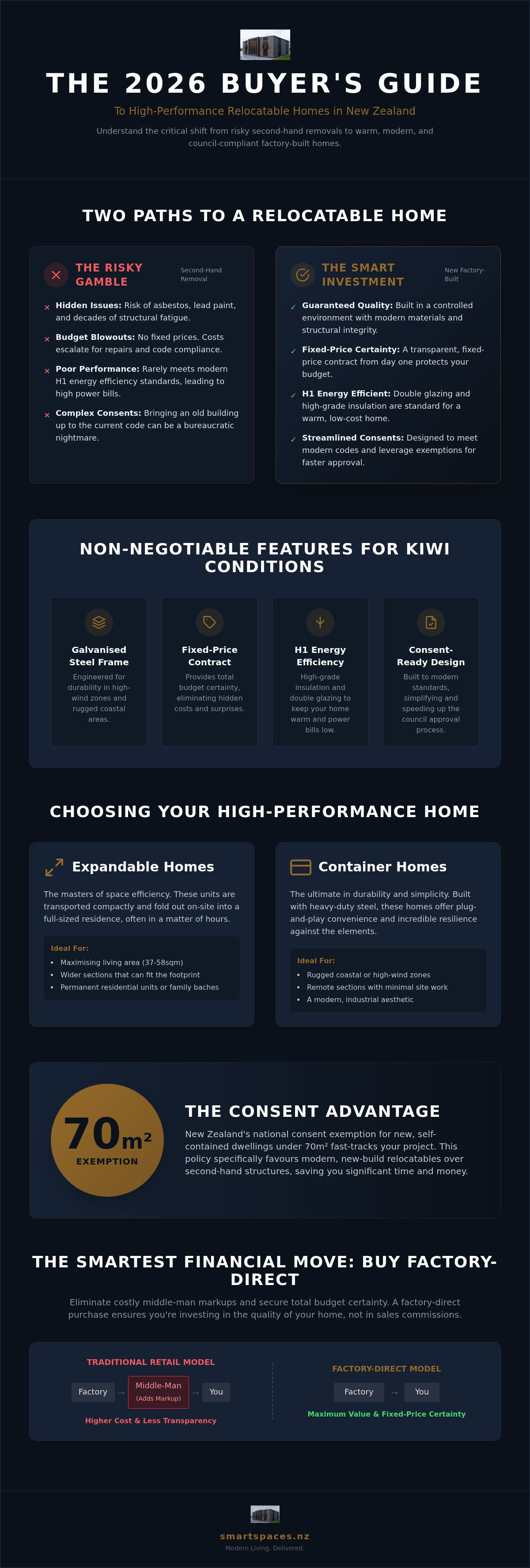
In contrast, a new factory-built unit offers a transparent, fixed-price contract from day one. You aren't just paying for a shell; you're investing in modern H1 energy efficiency standards. When you browse new relocatable homes for sale nz, you'll find they include double glazing and high-grade insulation as standard. This ensures your home stays warm in a South Island winter or cool in a Northland summer without a massive power bill. It's about buying peace of mind rather than a project that might never end.
The Kiwi dream is changing. Whether you're looking to house an elderly parent in a backyard granny flat or seeking a secondary dwelling to generate rental income, the demand for compact living is at an all-time high. The 2026 national consent exemption for new, self-contained dwellings under 70 square metres has made this process smoother than ever. This exemption specifically favours new builds, giving you a significant head start over those trying to relocate second-hand structures.
Downsizing no longer means compromising on quality. Modular and expandable designs allow you to place a high-spec 2-bedroom home on your section in a fraction of the time a traditional build would take. This flexibility is vital for families who want to adapt their property as their needs grow. If you need more space later, the modular nature of these homes makes future adjustments far more practical than trying to extend a traditional on-site construction.
Expandable Homes vs. Container Houses: Which Should You Buy?
For those researching different design aesthetics and floor plans for their new project, you can learn more about Tiny House Cottages and explore their unique bungalow and loft-style models.
Choosing the right structure depends entirely on your section's shape and your long-term goals. When you're browsing relocatable homes for sale nz, you'll find the market generally splits into two high-performance categories: expandable units and container-based dwellings. Both offer fixed pricing and rapid delivery, but they serve different needs on the ground.
The Versatility of 2 Bedroom Expandable Homes
Expandable homes are the masters of space efficiency. They arrive at your site as a compact, transportable unit and literally fold out into a full-sized residence. With footprints typically ranging from 37sqm to 58sqm, these 2-bedroom units provide a level of internal volume that is hard to beat for the price. The mechanism allows for a quick on-site setup, often taking only a few hours to reach its full size once the foundations are ready.
Inside, the layout is designed for comfort. You'll find open-plan living areas that feel surprisingly airy, thanks to high ceilings and clever window placement. These are ideal for permanent residential units or family baches where you want the "feel" of a traditional home but with the convenience of a prefab. To see how professional styling can further enhance these spaces, you can visit Raw at Home. If you have a wider section that can accommodate the expanded footprint, this is often the most cost-effective way to gain maximum living area.
If you're building in a rugged coastal area or a high-wind zone, the structural integrity of our 2 Bedroom Container Homes is a significant advantage. Built with heavy-duty steel frames, these units are incredibly resilient against the elements. They offer a "plug-and-play" simplicity that's perfect for remote sections where site work needs to be kept to a minimum.
The aesthetic is distinctively modern. Industrial chic meets comfortable living, with sleek lines that blend beautifully into New Zealand's natural landscapes. Because they maintain a standard shipping container footprint, they are exceptionally easy to transport. If you think you might need to move the house again in five or ten years, the container-based design is the gold standard for transportability. You can explore our 2-bedroom configurations to see which layout suits your lifestyle best.
Layout and footprint should be your final deciding factors. Expandable homes offer more width and a square-ish living space, while container homes are longer and narrower. Consider your driveway access and the specific "buildable" area on your council plot before making the final call. Both options provide a warm, double-glazed, and council-compliant sanctuary that outperforms traditional building every time.
Key Features to Look for in a High-Quality Small Home
If you want a home that stays bone-dry through a West Coast downpour, you need to look beyond the surface aesthetics. When you're scanning the market for relocatable homes for sale nz, it's easy to get distracted by stylish cladding or modern kitchenettes. However, the real value lies in the technical specifications that keep you comfortable year-round. High-quality modular units should be built to withstand New Zealand's unique climate, from the salt spray of the coast to the sub-zero mornings of the central plateau.
Insulation and Weatherproofing for NZ Conditions
Thermal performance is the biggest differentiator between a cheap cabin and a permanent residential dwelling. Since the update to the NZ H1 energy efficiency standards, insulation requirements have become far more stringent. You should ensure any unit you consider features high R-values in the walls, floor, and ceiling. This isn't just about warmth; it's about preventing the dampness that plagues many older Kiwi homes.
Double Glazing: Every unit must have double-glazed windows and joinery. This reduces heat loss significantly and almost eliminates the morning condensation that leads to mould.
Steel Framing: We use galvanised steel frames because they provide superior structural integrity. Unlike timber, steel won't warp, rot, or twist over time, ensuring your doors and windows always close perfectly.
Exterior Cladding: Look for materials that offer a balance of durability and visual appeal. High-grade metal or composite cladding provides a low-maintenance finish that can handle high UV levels without fading.
Internal Layouts and Modern Conveniences
A well-designed small home feels spacious because every square metre is put to work. In our factory-direct units, we focus on "plug-and-play" readiness. This means your electrical and plumbing systems are fully installed and tested before the home leaves the factory. Once it arrives on your site, your local tradespeople can connect it to services quickly, saving you days of expensive on-site labour.
Kitchen and bathroom fit-outs should feel like those in a high-end apartment. We include modern appliances, durable cabinetry, and quality tapware as standard. Storage is often the biggest challenge in small living, so look for designs that incorporate built-in wardrobes and clever kitchen storage solutions. Finding high-quality relocatable homes for sale nz means prioritising these functional details that make daily life easy and enjoyable. For those setting up a professional workspace or studio, you can visit Smart Buy Office Furniture to find high-quality preowned commercial solutions and ergonomic seating. It's about ensuring your new space works for you from the moment you turn the key.
Navigating Logistics: Delivery, Site Prep, and Consents
Landing your new home on your section is a precise operation that requires more than just a flat piece of dirt. While the process is significantly faster than a traditional on-site build, successful delivery depends on careful coordination between the factory and the transport team; to ensure safety during these complex hauls, you can check out CargoCare NZ. When you're comparing relocatable homes for sale nz, it's vital to look past the floor plan and consider the "last mile" of the journey to ensure your home is settled, connected, and ready for living.
The regulatory landscape has shifted in your favour. As of 2026, a national consent exemption is in place for new, self-contained, single-storey dwellings up to 70 square metres. This is a massive win for those buying new factory-built units, as it bypasses much of the red tape that still applies to second-hand house removals. However, you must still distinguish between building consent and resource consent. While your home's structure is often pre-approved, how it sits on your land might still require a nod from the council regarding boundary setbacks or land use.
Securing a Code Compliance Certificate (CCC) is the final, non-negotiable step. This document proves your home meets the NZ Building Code and is essential for insurance and future resale value. For a deeper dive into the specifics of the current rules, check out our NZ Tiny Home Regulations: The 2026 Ultimate Guide.
Site Preparation and Foundations
Before the truck arrives, your foundations must be millimetre-perfect. Most buyers choose between permanent timber or steel piles and temporary blocking systems. Piles are generally the preferred choice for permanent residential units as they provide better stability and easier connection to underground services. You'll also need to ensure your local sparky and plumber are booked to handle the final "hook-ups" to mains power, water, and wastewater systems. Furthermore, once your site is prepared, you can explore Direct Sales of Agricultural Microbial Products to restore the soil health around your new building platform.
Access is the most common hurdle on delivery day. You need to consider:
Gate and Driveway Width: Can a heavy-duty trailer navigate your entrance?
Overhead Obstructions: Are there low-hanging power lines or tree branches?
Ground Conditions: Is the soil firm enough to support a 20-tonne truck and crane?
Delivery day is a fast-paced event. Once the unit is positioned on its foundations, the transport team will level the structure, allowing you to begin the final interior touches. If you're unsure if your section is accessible, you can view our delivery options to see how we manage transport across the country. Planning these logistics early means you won't be met with unexpected costs or delays when your home finally reaches its destination.
Why Buying Factory-Direct is the Smartest Investment
Buying a home shouldn't feel like a gamble. When you look at relocatable homes for sale nz, you'll see a wide range of brokers and removalists who act as intermediaries. These middle-men add significant retail markups without necessarily adding value to the structure itself. By choosing a factory-direct model, you're dealing straight with the people who design and build your unit. This direct connection ensures that your investment goes into high-quality materials and skilled craftsmanship rather than corporate overheads or sales commissions. It's a straightforward way to get more house for your money. For those who want to visit the factory or showroom to inspect the build quality before committing, you can check out Drive NZ Rental Cars for a convenient transport option.
Transparency in Pricing and Finance
One of the biggest hurdles in traditional building is "budget creep." You start with a quote, but by the time the framing is up, costs have spiralled due to material shortages or contractor delays. We operate on a fixed-price basis to give you total certainty. Whether you're an investor looking for a predictable ROI or a homeowner downsizing to simplify your life, knowing exactly what you'll pay at the outset is a massive relief. This no-nonsense approach eliminates the "hidden extras" that often plague on-site construction projects.
Securing finance for transportable homes has become much more accessible in 2026. Lenders now recognise that these units are high-performance assets rather than temporary shelters. Because they're built to the NZ Building Code and delivered as a finished product, they hold their value exceptionally well. The resale value of a modern, steel-framed prefab remains strong, and the rental potential for a second dwelling on your section can often cover the loan repayments while adding significant equity to your property. It's a practical financial move that sets you up for long-term success.
The Smart Spaces NZ Difference
We aren't just another vendor; we are a family-owned business with over 40 years of industry experience. This heritage means we've seen every trend come and go, and we've stayed focused on what works: durability, honesty, and personal service. We don't hide behind layers of corporate management. When you talk to us, you're talking to experts who stand firmly behind the quality of every weld and window seal. This personal connection is at the heart of everything we do, ensuring you feel supported from the first enquiry to the day you move in.
Our national delivery network means we can bring your new home to your section, no matter where you are located. We handle the heavy lifting, allowing you to focus on the excitement of your new lifestyle. If you're ready to see how quality and affordability come together, explore our range of 2 Bedroom Expandable Homes today. You'll find a partner who values your goals as much as you do, providing the tools for a better way of living with a reliable, factory-direct approach that simply makes sense for the 2026 market.
Secure Your Future with a Modern, Fixed-Price Home
The shift toward high-performance, factory-built living is the smartest move you can make in the current market. By choosing a new build over a risky second-hand removal, you're securing a home that's already compliant with the latest 2026 energy standards and council regulations. You don't have to worry about hidden asbestos or structural fatigue; instead, you get a durable, steel-framed sanctuary designed for New Zealand conditions. When you're browsing relocatable homes for sale nz, the goal is to find a solution that offers both lifestyle freedom and financial certainty.
With over 40 years of industry experience, we understand the importance of reliability and straightforward dealings. Our factory-direct pricing ensures you bypass unnecessary retail markups, while our national NZ-wide delivery service brings your new space directly to your section. Whether you're adding a secondary dwelling for income or building a coastal retreat, we provide the expertise to make the process seamless. View Our Range of Relocatable Homes for Sale today and discover how easy it is to move into a high-quality, modern small home. It's time to stop dreaming about your ideal space and start living in it.
Frequently Asked Questions
How much does it cost to deliver a relocatable home in NZ?
Delivery costs generally depend on the distance from the factory and the complexity of your section's access. While industry averages for transporting modular units typically range between $10,000 and $50,000, specific factors like narrow driveways or the need for a crane can influence the final price. It's best to get a site-specific quote that considers your exact location and any necessary site works to avoid surprises when your unit arrives.
Do relocatable homes require a building consent from the council?
New self-contained dwellings under 70 square metres currently benefit from a national building consent exemption in 2026. This is a significant advantage for those buying new factory-built units rather than second-hand relocatable houses. You must still check with your local council regarding resource consents, boundary setbacks, and land-use rules. Ensuring your home meets the NZ Building Code is vital for securing a Code Compliance Certificate, which protects your long-term property value.
Can I live in an expandable home permanently in New Zealand?
You can live in an expandable home permanently, provided the structure is built to the New Zealand Building Code and meets Healthy Homes Standards. These units are designed as full-time residential dwellings with all the modern comforts of a traditional house. When browsing relocatable homes for sale nz, ensure the layout includes a full kitchen, bathroom plumbing, and proper insulation. These features ensure your home is a comfortable, long-term sanctuary rather than just a temporary cabin, particularly when paired with high-quality interior comforts like a mattress from SIMPLE.
Modern relocatable homes are engineered to handle the sub-zero temperatures and high winds of South Island winters. High R-value insulation in the floors, walls, and ceilings is a standard requirement for quality prefabs, alongside essential double glazing. These features work together to retain heat and prevent the dampness often found in older structures. When built to current energy efficiency standards, these small homes are often easier and cheaper to heat than traditional large-scale houses.
How long does it take from ordering to delivery?
The timeline for a factory-built home is significantly faster than the 12-month wait typical of traditional on-site construction. While exact lead times in 2026 depend on current demand and your specific requirements, the build process itself is streamlined within a controlled environment. Weather delays don't slow down progress, allowing for a more predictable delivery date. This efficiency lets you plan your site preparation and move-in day with much greater confidence than a standard build.
What kind of foundations do I need for a container home?
Most container-based homes require either timber or steel pile foundations to ensure long-term stability and a level living surface. These piles are driven into the ground according to an engineer's design, which considers the specific soil conditions on your section. Some owners may use concrete pads or specialised blocking systems for more temporary setups. Proper foundations are crucial for secure connections to wastewater and electrical services, ensuring your home remains stable during high winds.
Can I customise the layout of my small home before it is built?
You can customise internal configurations to suit your lifestyle needs before the construction process begins in the factory. While the external dimensions are often standardised for easy transport, the interior layout of a 2-bedroom unit can be adjusted to prioritise living space or storage. Choosing your own finishes, cabinetry, and flooring allows you to create a space that feels personal. It's about finding a balance between a proven modular framework and your individual requirements.
Is it easier to get finance for a relocatable home than a standard build?
Securing finance for relocatable homes for sale nz is becoming more straightforward as banks recognise the value of high-performance prefabs. Lenders often look for a fixed-price contract and a guarantee that the home meets the NZ Building Code. Because these units are delivered as finished assets, the risk for the lender is lower than a traditional build where costs can spiral. Having a clear Code Compliance Certificate is essential for a smooth application process.



Comments