

Off-Grid Living NZ: The 2026 Guide to Self-Sufficient Prefab Homes

Updated: Sep 22
What if your monthly power and water bills simply stopped arriving, not because of a clerical error, but because you finally owned the source? Off-grid living nz has shifted from a rugged DIY experiment to a sophisticated, strategic lifestyle choice for Kiwis who value genuine independence. Whether you're looking to settle on a remote rural block or simply want to escape the relentless climb of urban utility costs, the dream of self-sufficiency is now more achievable than ever before.
We understand that the path to independence often feels blocked by a mountain of paperwork and technical jargon. You've likely felt the frustration of trying to decipher local council building codes or the nagging fear that an inadequate solar setup might leave you in the dark during a cold winter. It's a lot to manage; getting it wrong can be a costly exercise that drains your savings instead of securing your future.
This guide provides the clear, no-nonsense roadmap you need to move forward with confidence. We'll show you how to navigate the 2026 building code changes, including the 70m² consent exemptions, to ensure your project is both durable and compliant. From choosing the right prefab structure to installing reliable water and power systems, you'll learn how to build a lifestyle defined by freedom and long-term financial security.
Table of Contents
The Reality of Off-Grid Living in New Zealand: Freedom and Self-Sufficiency
Essential Infrastructure: Designing Your Power, Water, and Waste Systems
Selecting the Ideal Structure: Comparing Expandable and Container Homes
Navigating the Red Tape: Council Consents and NZ Building Compliance
Transitioning to Independence: How Smart Spaces NZ Simplifies the Process
The Reality of Off-Grid Living in New Zealand: Freedom and Self-Sufficiency
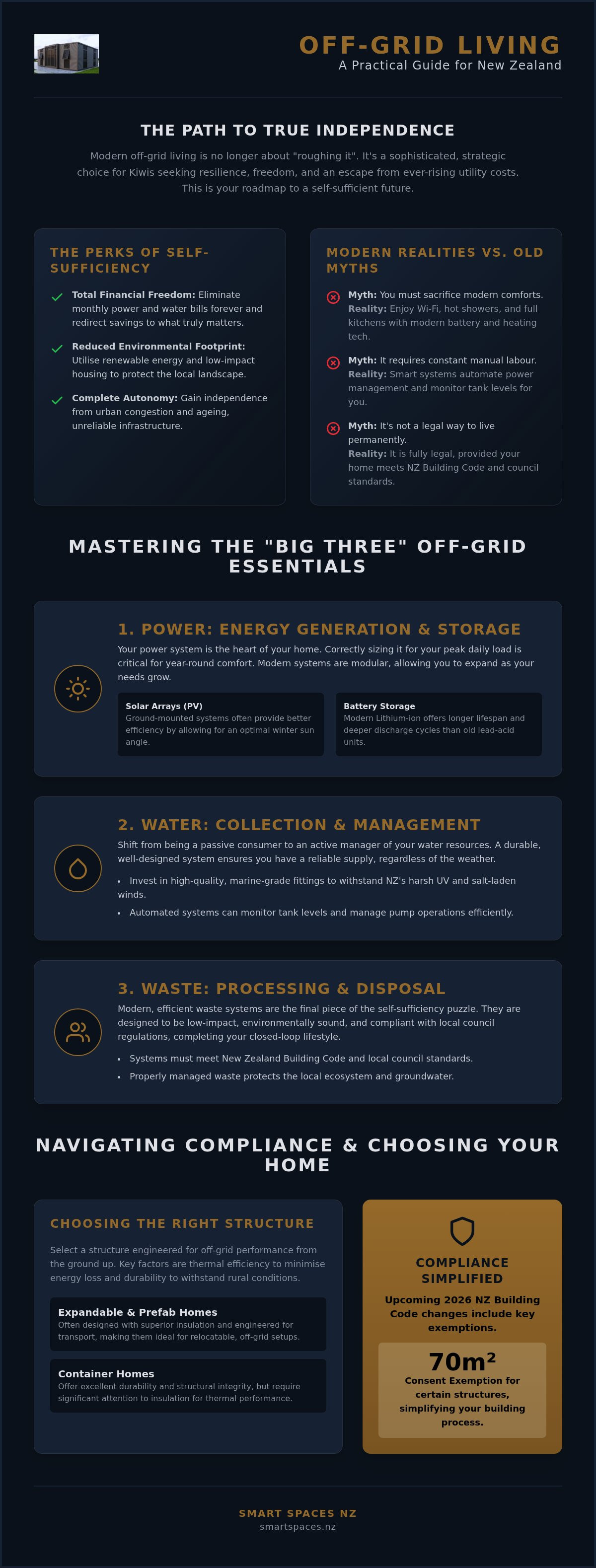
In 2026, the image of a drafty cabin with no power is a relic of the past. Modern off-grid living nz has evolved into a sophisticated lifestyle choice that prioritises high-tech independence over the old-fashioned idea of "roughing it." Many Kiwis are now choosing this path not just for the peace and quiet, but as a calculated response to the rising cost of living and the need for greater household resilience. True off-grid living is the holistic integration of a high-performance shelter with its own self-sustaining utility systems, creating a closed-loop environment that thrives independently of external networks.
When you begin your journey, it's vital to distinguish between a home that's merely "off-grid capable" and one that is "off-grid dedicated." A capable home is often a standard build with solar panels added as an afterthought. In contrast, a dedicated off-grid structure, like a specialised prefab, is engineered from the ground up to minimise energy loss and maximise every drop of harvested water. This global shift towards off-the-grid living reflects a desire for a more intentional relationship with our resources and the land we occupy.
The Benefits of a Self-Sufficient Lifestyle
The most immediate advantage is the total elimination of monthly power and water bills. If you own your infrastructure, then you're no longer vulnerable to the price hikes of centralised utility providers. This financial freedom allows you to redirect your hard-earned money into your land or your family's future. Beyond the bank balance, a self-sufficient home significantly reduces your environmental footprint. By using low-impact housing and renewable energy, you're protecting the local landscape while enjoying total autonomy from urban congestion and aging infrastructure. Maintaining this sense of autonomy also means looking after your physical wellbeing; for those who occasionally return to the city, a visit to Enso Space offers a chance to rejuvenate with restorative wellness treatments, perfectly complementing the holistic nature of a self-sufficient lifestyle.
Common Misconceptions About Going Off-Grid
Many people still believe that leaving the grid means sacrificing modern comforts. This simply isn't true in 2026. With modern lithium battery storage and efficient heat pump technology, you can enjoy high-speed Wi-Fi, steaming hot showers, and a full suite of kitchen appliances without a second thought. To ensure your energy setup is designed correctly, you can discover Foton Energy (Foton Pty Ltd) and their professional guidance on battery storage feasibility. There's also a lingering "hard yakka" perception that off-grid life requires constant manual labour. Today's smart systems automate the heavy lifting, from monitoring tank levels to managing solar loads. Finally, it's important to recognise that off-grid living nz is a completely legal and viable pathway for permanent residency, provided your home meets the New Zealand Building Code and local council standards.
Success in off-grid living nz hinges on mastering the "Big Three": energy generation, water collection, and waste management. It's a shift from being a passive consumer to an active manager of your own resources. Before you even look at hardware, you must calculate your peak daily load. This includes everything from the base draw of your fridge to the intermittent surge of a power tool or water pump. If you don't size your systems correctly, you'll likely find yourself rationing power during a gloomy week in July. For those sourcing high-performance photovoltaic components, EEHD Erneuerbare Energien Handel und Distribution GmbH offers the technical expertise and distribution scale required for complex renewable energy projects.
For those opting for a relocatable home, these utilities must be integrated thoughtfully. You need a setup that provides full functionality while remaining easy to disconnect if you decide to move your home to a new rural block. Durability is key. New Zealand's harsh UV rays and salt-laden winds will quickly perish inferior components. Investing in high-quality, marine-grade fittings is a practical necessity for anyone serious about off-grid living nz.
Most self-sufficient homes rely on photovoltaic (PV) arrays. While roof-mounted panels are common, ground-mounted systems often provide better efficiency by allowing you to dial in the perfect angle for the winter sun. The real magic happens in your battery bank. Modern lithium-ion batteries have replaced old lead-acid units because they offer deeper discharge cycles and a much longer lifespan. When you explore renewable energy systems, look for modular options. An expandable system allows you to start small and add more capacity as your family or your budget grows. A well-insulated 2 bedroom container home is often the perfect starting point, as its smaller footprint naturally requires less energy to heat and illuminate.
Water and Waste: Rainwater Harvesting and Composting
Water security is non-negotiable. For a household entirely reliant on rain, a tank capacity of at least 30,000 litres is recommended to see you through dry spells. This might sound like a lot, but it provides the peace of mind that your taps won't run dry during a long Kiwi summer. Waste management is equally critical. You can choose between traditional septic systems or modern composting toilets, which significantly reduce water consumption. If you opt for a conventional tank, you can discover Lil' Stinky Septic Service to see how professional pumping, inspection, and routine care keep wastewater systems running smoothly. To ensure your water is safe for the whole family, integrate a multi-stage filtration system with a UV steriliser. This removes sediment and bacteria, providing high-quality drinking water without the need for council treatment plants.
Selecting the Ideal Structure: Comparing Expandable and Container Homes
Prefabricated units are the gold standard for off-grid living nz because they solve the biggest headache of rural development: logistics. Building a custom home on a remote block often leads to blown budgets and construction delays. By choosing a factory-built structure, you ensure every joint and seal is crafted in a controlled environment. This eliminates the risk of weather damage during the build and guarantees a level of precision that's hard to match on-site. It just makes sense. Choosing factory-direct ensures:
Quality Control: Every unit is built to a consistent standard in a dry, indoor environment.
Cost Certainty: You bypass traditional retail markups and unexpected on-site labour costs.
Craftsmanship: Experienced teams handle the complex plumbing and electrical work before delivery.
Choosing between an expandable unit or a container house depends on your specific site and lifestyle needs. While expandable homes offer a near-instant "unfold and inhabit" setup, container houses provide the rugged, heavy-duty durability needed for the most exposed sites. Both options can be highly energy-efficient if designed correctly, but they cater to different priorities. You get the benefit of 40 years of industry experience before the unit even leaves the factory gate.
2-Bedroom Expandable Homes: Versatility and Space
The 2 Bedroom Expandable Homes are designed to maximise living area without the transport costs of a wide-load building. These units fold down to a standard container size for easy delivery to your rural block. Once they arrive, the "unfold and inhabit" process takes the hard yakka out of the equation. It's a practical choice for those who need a generous floor plan for a permanent residence or a high-quality granny flat. They're built to last. The layout feels open and airy, which is a significant win for long-term comfort in any off-grid living nz project.
Container Homes: Durability and Modern Aesthetics
If your land is in a high-wind zone or a coastal area, 2 Bedroom Container Homes are virtually indestructible. The inherent strength of a steel-framed house provides a sense of security that's hard to beat. Modern insulation techniques ensure these homes stay cosy as in the middle of a winter storm. They offer a sleek, industrial look that fits perfectly into the New Zealand landscape. By prioritising durability, these structures have become a cornerstone of successful off-grid living nz for those who refuse to compromise on strength.
Navigating the Red Tape: Council Consents and NZ Building Compliance
Council compliance is often the biggest hurdle for those pursuing off-grid living nz, but it's really about demonstrating that your home is safe and durable. The Building Act 2004 provides the framework, and while it can seem dense, its goal is simple: ensuring your home doesn't fail you. A major win for Kiwis in 2026 is the national rule change allowing for detached, self-contained dwellings up to 70m² without a building consent under specific conditions. While this simplifies the path, you still need to prove your home meets the New Zealand Building Code and obtain a Project Information Memorandum (PIM) before you start.
Choosing a factory-direct unit often makes this conversation with the council much smoother. Because these structures are built to standardised, proven designs, the technical specifications are already documented and ready for review. It's much easier to gain approval for a professionally engineered unit than a one-off DIY project that might not meet structural or thermal standards. Approaching your local council with a no-nonsense plan for your utilities shows them you're serious about safety and environmental responsibility.
The Building Consent Process for Prefabs
Understanding when you actually need a consent is vital. Even with new exemptions, any plumbing or electrical work must be carried out by licensed professionals to ensure your off-grid systems meet environmental standards. For a deeper dive into the specifics of these laws, our guide on NZ tiny home regulations covers the latest 2026 updates in detail. You'll need to ensure your septic and solar setups are compliant with regional rules, which often focus on how you manage greywater and waste effectively.
Resource Consents and Land Use
While building consent focuses on the structure, resource consent focuses on the land. The Resource Management Act (RMA) governs how your site is used, especially in rural zones. You'll need to check your local District Plan to see if your dream spot is zoned for a permanent dwelling. This involves looking at site coverage, proximity to boundaries, and potential environmental impact. Working with a trusted partner to organise your site plan and utility layout early can save you months of back-and-forth with council staff. If you're ready to stop guessing and start building, talk to our experts about your off-grid project today.
Transitioning to Independence: How Smart Spaces NZ Simplifies the Process
Smart Spaces NZ brings 40 years of family-owned industry experience to every project we undertake. We aren't just a vendor; we're your partner in achieving genuine independence. When you choose to step away from the traditional housing market, you need a team that values straightforward dealings and honest craftsmanship. Our legacy is built on providing relocatable solutions that actually work for the unique conditions of New Zealand. We understand that moving to a rural block is a significant life change, and we're here to provide the visionary guidance you need to make it a success.
Transitioning to off-grid living nz doesn't have to be a gamble or a DIY struggle. From the moment your unit is meticulously finished in our factory to the day it's precision-settled on your site, we handle the technical heavy lifting. You can expect a streamlined delivery process where your home arrives ready for utility connection. This hands-on support continues well after your home is in place. We stand firmly behind the quality of our work, ensuring you have the confidence to manage your new systems effectively for years to come.
Our Direct-to-Customer Model
The most significant barrier to self-sufficiency is often the initial investment. We've simplified this by adopting a factory-direct model that completely bypasses traditional retail markups. By selling directly to you, we pass those substantial savings onto your project budget. This transparency is backed by fixed-price contracts, meaning you won't be hit with the "hidden extras" that often plague on-site construction. Whether you're looking at 2 Bedroom Expandable Homes or 2 Bedroom Container Homes, you can trust that your prefab homes NZ are built to our high standards of durability and finish.
Taking the First Step Toward Your Off-Grid Goal
Choosing the right structure is the foundation of your new lifestyle. If you need maximum space and a quick setup, an expandable unit is often the best fit. If you're building in a rugged, high-wind area, a 2 bedroom container home NZ provides unmatched structural integrity. We can also help you explore finance solutions, including the various green home loans currently offered by major banks, to get your project moving faster. Our goal is to provide the tools for your success while maintaining a personal connection that corporate providers simply can't match. Ready to leave the grid behind? Explore our range of expandable and container homes today and start your journey toward true independence.
Take the First Step Toward Genuine Independence
Choosing a self-sufficient lifestyle is a bold move toward securing your financial and environmental future. By mastering the 2026 compliance landscape and selecting a structure engineered for New Zealand’s unique conditions, you’re not just building a house; you’re investing in a legacy of freedom. Whether you opt for the versatility of an expandable unit or the rugged strength of a container home, the key is a no-nonsense approach to your infrastructure. Off-grid living nz is no longer a distant dream for a few, but a practical reality for any Kiwi ready to take control of their own resources.
As a family-owned and operated business with over 40 years of industry experience, we understand the importance of trust and reliability. Our factory-direct pricing model ensures you get the highest quality craftsmanship without the burden of traditional retail markups. We’re here to act as your visionary guide, providing the tools and expertise you need to settle on your rural block with absolute confidence. Start your off-grid journey with Smart Spaces NZ today and discover how simple transitioning to a self-sufficient life can be.
Frequently Asked Questions
Is it legal to live off-grid full-time in New Zealand?
Living off-grid is completely legal in New Zealand, as there's no law requiring a residential dwelling to be connected to the national electricity grid. However, you must still ensure your home complies with the Building Act 2004 and the New Zealand Building Code. This includes meeting safety and sanitary standards. Local council rules regarding land use and permanent residency also apply, so it's best to check your specific zoning before settling.
How much does it cost to set up a basic off-grid solar system for a tiny home?
A basic 3 kW residential solar system typically costs around $7,000, while a more robust 6 kW system averages about $12,000 fully installed. For a dedicated off-grid setup, you'll also need a battery storage system, which can cost roughly $13,000 for a 13.5 kWh unit. These prices vary based on component quality and installation complexity. Investing in a larger system from the start is often more cost-effective than upgrading later.
Do I need a building consent for an expandable tiny home on my property?
As of January 2026, national rules allow for detached, self-contained dwellings up to 70m² without a building consent, provided certain conditions are met. You still need to obtain a Project Information Memorandum (PIM) and ensure the structure complies with the Building Code. For off-grid living nz, any plumbing or electrical work must be certified by a licensed professional to ensure environmental and safety standards are maintained across your property.
Can I get internet access while living off-grid in rural NZ?
Reliable internet access is easily achievable in rural New Zealand through satellite technology. Low-earth orbit satellite services have become the standard for off-grid properties, offering high-speed connections that support remote work and streaming. If your site has a clear view of the sky, you can maintain a stable connection regardless of how far you are from the nearest fibre cable or cellular tower. It's a simple, plug-and-play solution.
How do I manage waste and sewage without a council connection?
Waste is managed through on-site systems like septic tanks or modern composting toilets. A basic septic system often starts around $3,000 for the tank, though advanced treatment systems can be significantly more expensive. Composting toilets are a popular choice for off-grid living nz as they reduce water consumption and simplify waste management. All sewage systems must be installed according to regional council environmental standards to protect the local soil and groundwater. To ensure these systems remain in peak condition, many plumbing specialists utilise advanced inspection technology from Razorback Drain Pros to identify and prevent potential issues.
Modern 2 Bedroom Container Homes are built with high-performance insulation that makes them perfectly suitable for even the harshest winter conditions. By using specialised thermal breaks and high-R-value insulation in the walls, floor, and ceiling, these homes retain heat efficiently. The inherent steel structure also provides excellent durability against heavy snow loads and high-wind zones. This ensures your living space remains warm and secure even in alpine environments during the coldest months.
What happens to my power supply during a week of cloudy weather?
During extended periods of cloudy weather, your home relies on energy stored in your lithium-ion battery bank. A well-designed system includes enough capacity to provide several days of autonomy, and utilising high-tier infrastructure from Foton Energy (Foton Pty Ltd) ensures your storage setup is both durable and scalable. If the batteries run low, many off-grid residents use a small backup generator to top up the system. Efficient energy management, like running heavy appliances during peak sun hours, is also vital.
A 2 Bedroom Expandable Home is transported using a standard side-loader or flatbed truck because it folds down to a compact container size. This allows it to be delivered to remote rural blocks using existing road infrastructure without the need for expensive wide-load pilot vehicles. Once on-site, the unit is unfolded and positioned on its foundations. This relocatable design makes it an ideal solution for those who value flexibility and ease of setup.



Comments