

Marquee Wind Rating NZ: How to Compare Wind Resistance and Choose Safely

Updated: Oct 5
What if the marquee with the biggest wind-speed claim isn’t the safest choice for your event? A marquee wind rating NZ buyers can compare tells only part of the story: the figure may depend on how the structure was tested, anchored and configured. Without those details, a number can create false confidence when guests and property need protection.
It’s reasonable to look for a clear wind limit when choosing a marquee, especially with New Zealand’s changeable weather. But the frame, cover, anchoring, sidewalls and site exposure all affect how a structure handles wind. A rating based on different test conditions may not be a fair comparison for your site.
This guide explains what a stated wind speed does and doesn’t establish. It also gives you practical questions for comparing specifications and supporting evidence, assessing your site, preparing and securing the marquee, monitoring the forecast, and deciding what to do if conditions change. With a clearer picture of the whole setup, you can make a more considered choice for your event or ongoing use.
Table of Contents
Marquee wind ratings in NZ: what does a stated wind speed actually mean?
A wind rating is a product-specific claim about how a marquee performed, or is expected to perform, under particular conditions. The figure might be expressed in kilometres per hour or metres per second, but the number alone doesn’t explain what was tested. Was it a particular frame and size, with sidewalls fitted, on a defined surface and secured in a specified way? Without those details, two ratings may not be directly comparable.
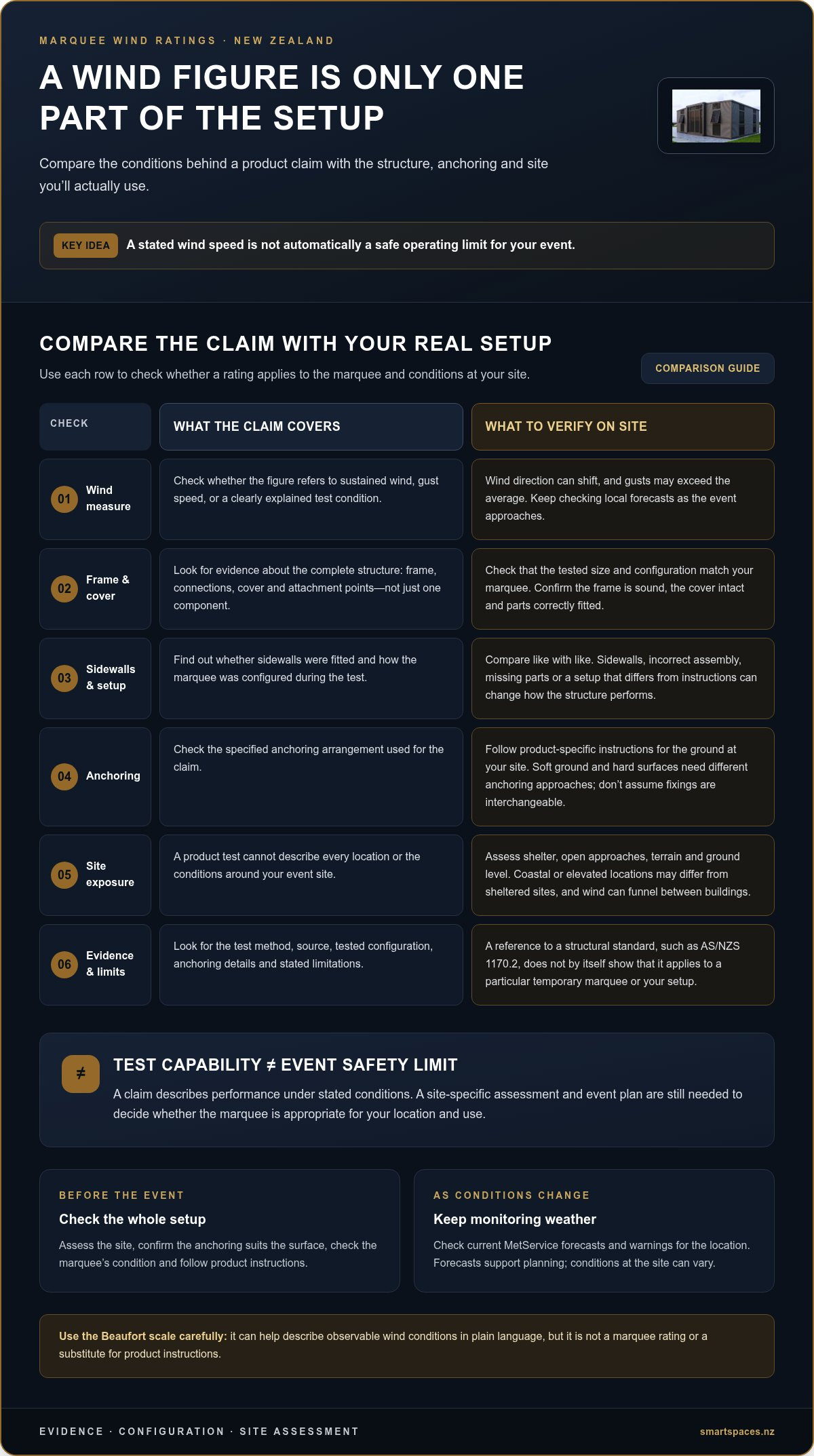
A tested capability is not automatically a safe operating limit for your event. Real conditions can differ from the test setup: wind direction may shift, gusts may exceed the average, and an exposed coastal or elevated site may experience different conditions from a sheltered location. Anchoring, ground type, marquee configuration and the structure’s condition matter too. Treat a headline claim as a starting point for questions, not as a stand-alone safety decision.
A product wind claim describes performance under stated conditions. Deciding whether a marquee is safe at a particular site requires a site-specific assessment and an event plan.
Wind speed, gusts and wind descriptions: what is being measured?
Sustained wind describes wind over a period of time, while a gust is a short-lived increase that can place a sudden load on the frame and cover. Check whether a product claim refers to sustained speed, gust speed or a clearly explained test condition. The Beaufort wind force scale can help translate wind into plain-language descriptions of observable conditions, but it isn’t a marquee rating or a substitute for product instructions.
Before and during an event, check current MetService forecasts and warnings for the location. Use forecasts to plan, then keep monitoring as the event approaches because conditions at the site can vary.
Is there one standard marquee wind rating in New Zealand?
Don’t assume every supplier uses the same test, setup or certification just because ratings are stated in the same units. Look for the method, source, tested configuration, anchoring arrangement and any stated limitations behind a claim. A reference to a structural standard, such as AS/NZS 1170.2, doesn’t by itself establish that the standard applies to a particular temporary marquee or covers your setup. Product-specific evidence needs to explain the connection.
For a marquee wind rating NZ comparison, record what each figure actually covers before weighing it against your site and event plans. If key conditions are missing, treat the claim as incomplete rather than assuming it represents a safe wind limit.
What affects a marquee’s wind resistance at a New Zealand site?
Wind resistance depends on the whole setup, not one feature in isolation. The frame and its connections carry forces through the structure, while the cover catches the wind. Marquee size and shape affect how it meets moving air, and sidewalls can change how wind flows around and through it. Wear, damage or incorrect assembly may also affect performance.
The same marquee can face different wind loads at different sites because exposure, terrain, surrounding buildings, anchoring and setup all change the conditions around it. A sheltered spot beside buildings may behave differently from an open field or an exposed coastal site. Don’t assume a location is protected because it appears sheltered: wind can funnel between buildings or across nearby terrain.
Frame, cover and marquee size: why the complete structure matters
Look beyond the frame material or a description such as “heavy-duty”. The design and connections work with the cover and its attachment points, so a claim about one component doesn’t establish how the complete marquee performs. A larger cover presents a different area to the wind, but there’s no reliable rule of thumb for turning size alone into a safe wind limit. Check that the tested size and setup match the structure you intend to use.
Include condition and assembly in your assessment. The frame should be sound, the cover intact and components correctly fitted. Damage, missing parts or a setup that differs from the instructions can undermine the intended configuration.
Anchoring and site exposure: what changes from one setup to another?
Soft ground and hard surfaces need different anchoring approaches. A ground anchor designed for soil won’t necessarily suit concrete or paving, and a weight or fixing shouldn’t be treated as interchangeable with the system specified for the marquee. Follow product-specific anchoring instructions for the surface at your site, and include the actual setup in any comparison of wind claims.
Before settling on a location, note nearby shelter, open approaches to the site and changes in ground level. WorkSafe’s official event risk management guidance can help event organisers consider hazards and controls, including weather risks. For a broader structure and use comparison, see this commercial marquee buying guide.
If you’re considering a marquee for ongoing event use, compare options against your site and operating needs, not just a headline figure. Explore commercial marquee options from Smart Spaces NZ as part of that assessment.
How to compare marquee wind-rating claims before you buy
A wind-speed figure is comparable only when its underlying conditions are comparable. A claim based on one size, anchoring arrangement or cover setup can’t be fairly weighed against another tested under different conditions. For a useful marquee wind rating NZ comparison, record what each figure represents before deciding which structure suits your event.
Use this checklist to compare specifications side by side. If a supplier’s material doesn’t provide an answer, mark the detail as “not stated”. Don’t fill gaps with assumptions.
What evidence should a useful wind-rating claim include?
Look for product-specific documentation explaining the test source, measurement details, setup and ground conditions. A detailed report or specification can make a claim more traceable than a broad marketing phrase, but the evidence still needs to match the product and configuration you’re considering. For example, if sidewalls weren’t fitted during the assessment, don’t assume the same figure applies with them in place. Put missing details in a separate “unknown” column rather than treating them as a like-for-like comparison.
Separate evidence from operating advice as well. A documented test result describes the conditions assessed; it doesn’t automatically establish a safe limit for a live event at your site. Keep that distinction clear when weighing specifications.
How to compare A-frame, hip-end and pole-and-peg marquees
Compare styles against the same intended use, site, surface and planned setup. An A-frame, hip-end frame or pole-and-peg marquee may suit different practical requirements, but the style name alone doesn’t establish which has greater wind resistance. Use product-specific evidence for performance comparisons, then consider how each structure fits your event and anchoring needs. For a broader look at structural options, read this marquee style comparison.
Once the details are aligned, you can see whether a headline figure has meaningful support or leaves important questions unanswered.
A practical NZ marquee wind-safety plan before and during an event
A safe event needs a plan for changing weather, not just a marquee wind rating NZ figure on a specification sheet. Decide in advance who monitors conditions, who can pause activities and what steps staff will take to protect guests. Follow the marquee’s product instructions and your event-specific safety plan rather than relying on generic advice.
Before setup: check forecasts, site and assembly requirements
Check the forecast. Review current MetService forecasts and warnings for the event location. Nominate someone to check for updates before setup and throughout the event, rather than relying on one early forecast.
Assess the site. Look for exposure, nearby shelter, ground condition and clear routes for guests to move away from the marquee if needed. Identify access and evacuation arrangements, and keep exits and walkways clear.
Agree on roles and actions. Make sure the team knows who can pause activities, who communicates decisions and how staff and guests will be directed if conditions worsen.
Assemble and secure the structure as instructed. Follow the product’s assembly and anchoring instructions for the actual ground surface. Don’t assume a fixing suited to one surface is suitable for another.
Set monitoring points. Use the product’s documented operating limits and event plan to decide when the team will review conditions and what actions may follow.
If wind conditions worsen, prioritise people and follow the plan
Follow the documented plan if conditions approach its limits or the team notices signs such as unusual cover movement, shifting components or loosening fixings. These are prompts to assess and follow the agreed response, not universal wind thresholds or proof that a marquee is safe below a particular speed. Don’t wait for visible movement if the forecast or operating limits already call for action.
The nominated person should pause activities when the plan requires it, communicate clearly with staff and guests, and follow the specified process for stopping use or dismantling. Don’t assume that removing sidewalls, adding anchors or lowering a marquee makes every setup safe. Any change must follow the product instructions and site-specific plan. For more on selecting a structure for ongoing use, read this marquee ownership and planning guide.
Planning to own a structure for regular events? Explore commercial marquees from Smart Spaces NZ and consider how the style, site and operating plan fit together.
Choose a commercial marquee in NZ with evidence, not just a rating
For ongoing event use, consider the whole picture: how you’ll use the marquee, where it will stand, which structure suits the event, what evidence supports any wind claim, and how you’ll anchor and manage it in changing weather. A marquee wind rating NZ figure is one part of that decision, not a substitute for a practical operating plan.
Match marquee style and structure to the way you will use it
A buyer’s checklist for wind claims and ongoing event readiness
Before deciding, use a consistent checklist for each option:
Claim and evidence: Record the stated speed, its source, test method and measurement details.
Tested configuration: Note the marquee size, components and setup included, plus any stated limitations.
Anchoring: Check that the guidance covers the surface and arrangement you expect to use.
Ownership planning: Review assembly instructions, inspection needs and how you’ll monitor weather and respond to changing conditions.
If key information is absent, treat it as unknown rather than assuming the claim applies to your setup. Smart Spaces NZ offers commercial marquees in A-frame, hip-end frame and pole-and-peg styles. As a family-owned business with more than 40 years of industry experience, it provides factory-direct sales and after-sales support for event operators planning ongoing ownership.
Choose with evidence and readiness in mind, not the biggest number on a page. Explore commercial marquee options from Smart Spaces NZ and compare the styles against your event, site and weather plan.
Choose your marquee with confidence
A wind-speed claim helps only when you understand the conditions behind it. Compare the test evidence and setup, then consider how the frame, cover, anchoring and site work together. Just as important, plan how you’ll monitor weather and respond if conditions change.
That’s the practical value of looking beyond a marquee wind rating NZ figure. Match the structure to your intended use and site, and treat missing details as unanswered questions rather than assumptions. A considered choice gives you a stronger foundation for safe, well-planned events.
Smart Spaces NZ is a family-owned and operated business with more than 40 years of industry experience. Its commercial marquee options include A-frame, hip-end frame and pole-and-peg styles for event operators considering ongoing use.
Explore commercial marquee options from Smart Spaces NZ and take the next step towards finding a structure that fits your plans. With sound evidence and a clear weather plan, you can prepare with confidence.
Frequently Asked Questions
What is a good wind rating for a marquee in New Zealand?
A good rating is supported by clear, product-specific evidence that matches your intended setup and site. Don’t choose by the highest speed alone. Check the test method, marquee size and configuration, anchoring arrangement, ground conditions and any stated limitations. Then compare those details with your event’s exposure and weather plan. If important test conditions aren’t explained, the number is difficult to use as a reliable basis for choosing.
How much wind can a marquee withstand?
There isn’t one wind speed that applies to every marquee. The limit depends on the specific structure, its documented test conditions, how it’s assembled and anchored, and the site. A claimed speed shouldn’t be treated as an automatic safe operating limit for an event. Check the product’s instructions and documented operating guidance, then plan for the actual ground, exposure and configuration. If conditions approach the stated limit, follow your event safety plan.
Is there a standard wind rating for marquees in NZ?
Don’t assume every marquee wind rating NZ claim uses the same test or certification. A supplier may state a wind speed without enough detail to compare it with another product’s figure. Look for the source, test method, measurement basis, setup and anchoring conditions, along with any limitations. A reference to a structural standard doesn’t by itself prove that it applies to a particular temporary marquee; the product-specific documentation needs to explain its relevance.
Can a marquee be used in strong winds if it is properly anchored?
Proper anchoring is essential, but it can’t guarantee a marquee is safe in strong winds. The suitable anchoring method depends on the product instructions and the actual surface, while exposure, configuration and changing gusts also affect conditions. Use the documented operating limits and event-specific safety plan to guide decisions. Don’t assume extra weights, added anchors or removing sidewalls makes a setup safe beyond its assessed limits.
What affects a marquee’s wind resistance?
Wind resistance depends on how the complete structure performs together: frame design and connections, cover, size, condition, assembly and anchoring all matter. Site exposure and terrain also influence the wind a marquee faces. For example, an open area may experience different conditions from a sheltered setting, while nearby buildings can affect airflow. Compare the exact configuration and anchoring guidance with your planned setup rather than relying on the style name alone.
Are marquee wind ratings based on gusts or sustained wind?
It depends on the claim and its supporting documentation. Sustained wind describes conditions over a period, while a gust is a brief, stronger increase that can place sudden loads on a structure. Check whether a stated speed refers to gusts, sustained wind or a particular test measurement. If the basis isn’t clear, don’t assume it means the same thing as another rating or that it sets a safe event operating limit.
What should I do if the wind picks up during an event?
Follow your event-specific safety plan and the marquee’s documented operating instructions. Have a nominated person monitor MetService forecasts and warnings, and make sure staff know who can pause activities and communicate decisions. If conditions reach the plan’s action point, or the structure or its fixings show concerning movement, prioritise people and take the planned steps to stop use or dismantle. Don’t wait for visible damage or improvise changes that aren’t in the instructions.



Comments