

Living Mortgage-Free in NZ: A Practical Guide for 2026

Updated: 3 hours ago
What if the most practical route to living mortgage-free nz isn’t a clever shortcut, but a home and repayment plan that better fit your budget? When mortgage repayments take up a large share of household income, it’s natural to look for ways to ease the pressure and make more room for other priorities.
There’s no single approach that suits every Kiwi household, and bold promises rarely account for the trade-offs. You can start by looking at realistic options based on your income, priorities and housing needs, whether that means paying down your current loan faster or considering a lower-cost home.
This guide explains ways to reduce or clear a mortgage, build a manageable plan and weigh up changes to your housing arrangements. It also covers how two-bedroom expandable and container homes could fit into a broader housing-cost decision, without promising they’ll make you mortgage-free.
Table of Contents
Living mortgage-free in NZ: what the goal means in real life
A mortgage-free home has no home loan secured against it. Some households reach that point by paying off their current mortgage; others sell and buy a less expensive property with little or no borrowing. Living mortgage-free nz can describe either outcome, but it doesn’t mean the costs of keeping a home disappear.
A mortgage-free home removes loan repayments, not every cost of having a place to live. Keep that distinction in mind when working out what the goal would change in your budget. Paying off a mortgage can remove a major regular expense, but home ownership still brings ongoing costs and responsibilities.
Does mortgage-free mean having no housing costs?
No. Even without mortgage repayments, you may still need to budget for council rates, home insurance, utilities, repairs and routine maintenance. Some costs vary over time, and unexpected work can put pressure on savings. Renting has its own regular housing costs, too. Compare the full picture rather than treating a cleared mortgage as a cost-free home.
Separate the loan from the rest of your household budget. Groceries, transport, essential healthcare through clinics like Stoddard Dental Square, and other everyday expenses remain, but the money no longer going towards repayments may give you more room to meet those costs, build savings or make choices that suit your circumstances.
Why New Zealand households set this goal
People often want lower repayments because they value flexibility, resilience if their income changes, or peace of mind about housing. Priorities can shift with life stage: a household might focus on reducing debt while working, then value a lighter budget as retirement approaches. There’s no universal deadline, and buying a home outright isn’t the only measure of financial wellbeing.
For one household, success might mean clearing the mortgage as early as it can while keeping enough savings for unexpected costs. For another, it could mean making repayments more manageable, even if the loan isn’t fully paid off. Set a goal based on what you want your money to make possible, not a timeline borrowed from someone else.
That personal view matters in a country where housing choices and pressures have changed over time. The overview of Housing in New Zealand provides background on affordability, policy and the way homes are provided. Treat it as context, not a prescription for your household: your income, commitments, property and plans will shape what feels achievable.
Start by describing what mortgage-free would mean for you. Is your priority eliminating the loan, reducing monthly pressure or creating more choice in the years ahead? A clear answer makes it easier to compare options by their real costs and trade-offs, rather than treating “mortgage-free” as a single finish line.
How to move towards mortgage-free living in New Zealand
A workable plan starts with your household’s actual numbers, not a best-case guess. Use verified figures and a sustainable budget to decide whether to focus on repayments, change your housing arrangements or take another route towards your goal.
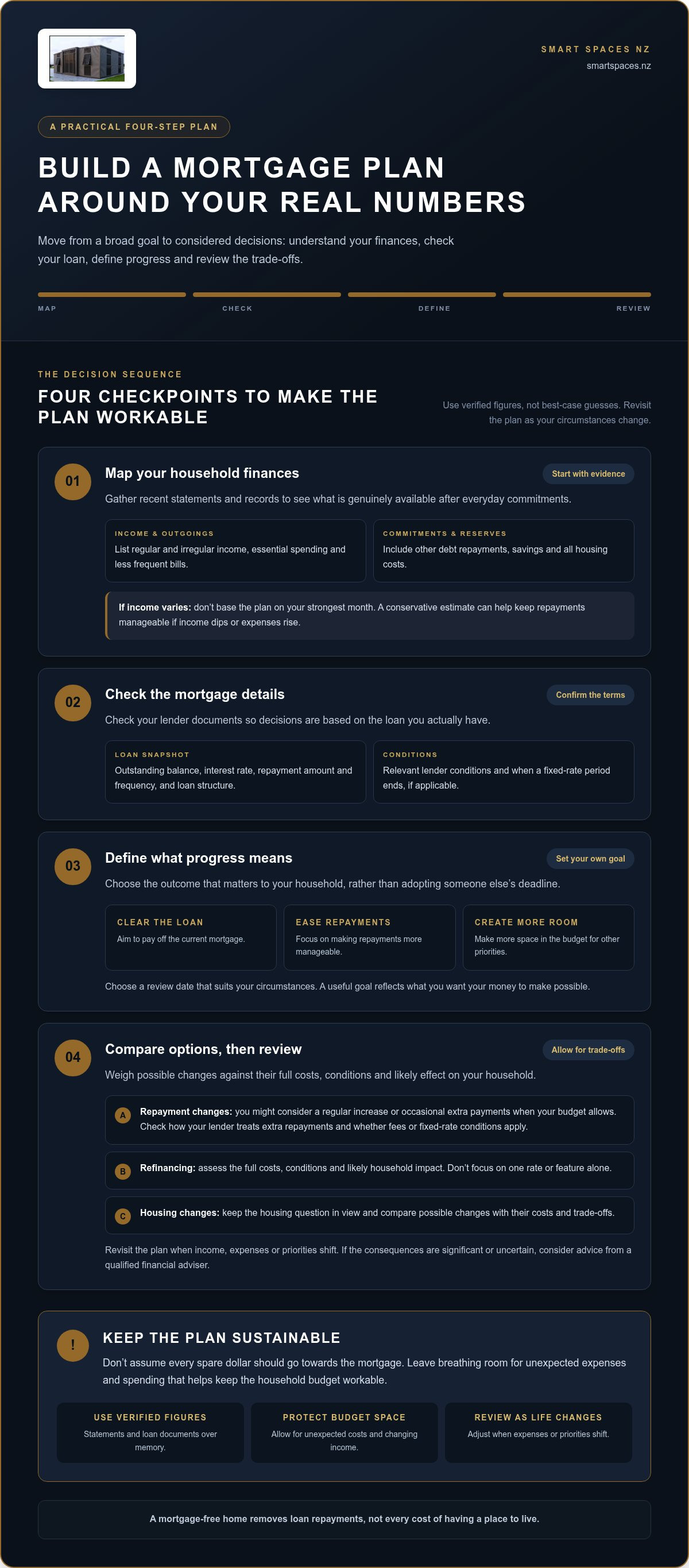
Use this sequence to turn a broad ambition into practical decisions:
Map your finances. Gather recent records of household income, essential spending, debts, savings and housing costs.
Check your mortgage. Confirm the outstanding balance, interest rate, repayment amount and frequency, loan structure and relevant lender conditions. Note when a fixed-rate period ends, if applicable.
Define progress. Decide whether you’re aiming to clear the loan, reduce repayments or create more room in your budget. Choose a review date that suits your circumstances.
Compare and review. Weigh possible changes against their costs and trade-offs. Revisit your plan when your income, expenses or priorities shift.
Start with a clear picture of your household finances
For a useful snapshot, review a typical month and account for less frequent bills too. If your income varies, don’t base your plan on your strongest month. A more conservative estimate can help you choose repayments you’re more likely to manage if income dips or expenses rise. The New Zealand Government Housing and Property portal can also point you towards official information relevant to housing and property decisions.
Choose a repayment approach you can sustain
Some households prefer a regular repayment increase; others may consider occasional extra payments when their budget allows. What’s possible depends on the loan’s terms. Before changing your approach, check how your lender treats additional repayments and whether fees or fixed-rate conditions could apply. Leave enough breathing room in your budget to keep the plan sustainable.
Refinancing is another decision to assess carefully, not an automatic way to save. Compare the full costs, conditions and likely impact on your household rather than focusing on one rate or feature. If the consequences are significant or uncertain, consider advice from a qualified financial adviser. Your loan documents explain the applicable terms, while your budget shows what you can sustainably commit.
Keep the housing question in view as you compare options. If you’re assessing whether a different home could better fit your financial priorities, explore two-bedroom expandable and container homes as part of that wider review. Smart Spaces NZ sells factory-direct homes, avoiding middle-man fees. The right choice still depends on your household’s needs and total project costs.
Mortgage-free strategies compared: repayment, downsizing or changing home
There’s no single route to living mortgage-free nz. You could focus on reducing your current loan, move to a lower-cost home, or adjust household income and spending to make repayments more manageable. Each approach has different demands, and none guarantees a mortgage-free result. Compare the impact on your household, not just the headline purchase price or repayment amount.
Use this table to identify what to investigate before choosing a direction:
When changing homes could support the goal
A different home may support your plans if its overall costs and practical fit make sense for your household. Compare the complete picture: purchase price, finance, land or site arrangements, delivery and ongoing expenses. A lower purchase price alone doesn’t establish lower total costs, and borrowing may still be needed. For context on one housing option, read this guide to two-bedroom expandable homes in NZ.
What to weigh before choosing a prefabricated home
Start with how you’ll use the home and whether its layout suits the people who’ll live there. Consider your land arrangements and the practical requirements of the site, then include delivery, utility connections and ongoing costs in your comparison. Finance and any consent requirements depend on the specific project, so treat them as items to investigate rather than assumptions. The NZ tiny home regulations and consents guide can help you identify questions to consider.
Prefabricated homes, including two-bedroom expandable and container homes, are options to assess alongside other housing choices. Factory-direct purchasing may avoid middle-man fees, but you’ll still need to consider the full project budget. Ground your decision in your household’s needs, site circumstances and finances. The strongest option is one whose trade-offs you understand and can manage, not simply the one that looks cheapest at first glance.
Mortgage-free plan: actions to take and pitfalls to avoid
A useful plan can adapt to real life. Treat each review as a chance to check whether your actions still fit your household, not as a test of how quickly you can clear a loan. A steady approach helps you make deliberate decisions without putting everyday needs or financial resilience at risk.
A staged checklist for your next review
Set aside your current loan documents and household records, then work through this checklist. Keep your notes simple: the aim is to make your next decision clearer, not to build a perfect forecast.
Record your mortgage balance, repayment amount and frequency, rate, loan structure and relevant lender conditions.
Review household income, regular spending, other debt commitments, savings and housing expenses using recent records.
Write down the outcome you want, such as more repayment flexibility or a lower ongoing housing commitment.
Choose one manageable next action, such as reviewing repayment settings or comparing your household’s current needs with a different housing option.
Set a date to revisit the plan, and update it if your income, family needs or priorities change.
Keep emergency savings in the picture. Putting every available dollar towards repayments may leave too little room for an unexpected bill or a change in income. A plan that preserves a financial buffer and sets repayments at a manageable level may be more sustainable than one built around the most optimistic version of your budget. That matters whether you’re working towards living mortgage-free nz or simply aiming for more breathing room.
Pitfalls that can derail a mortgage-free goal
Be cautious about plans that depend on best-case income, assumed resale proceeds or finance estimates that haven’t been verified. Before making a major change, check your current lending terms and consider qualified financial advice if the decision has significant or uncertain consequences. Take tax questions to an appropriately qualified adviser, and check property or consent matters with the relevant authority.
Don’t overlook how a change could affect the rest of your household. A repayment increase that looks manageable on paper may become difficult if essential costs rise, and moving can involve expenses beyond the home itself. Base your decision on what you can maintain, not what you hope will happen. Revisit the figures when circumstances change rather than letting an old plan run on autopilot.
Once you’ve mapped your priorities and checked what your budget can sustain, compare housing choices as one part of the plan. If a different home is worth exploring, view Smart Spaces NZ’s two-bedroom expandable and container homes and assess them against your household needs and overall project costs. A home choice may support your wider goals, but it doesn’t guarantee a mortgage-free outcome.
Could a Smart Spaces NZ home fit your mortgage-free plan?
A different kind of home may be worth considering if your current arrangement no longer suits your household or financial priorities. Smart Spaces NZ sells two-bedroom expandable homes and two-bedroom container homes. They’re not guaranteed routes to living mortgage-free nz: whether a home reduces borrowing depends on your total project costs, funding and circumstances.
When an expandable or container home may be worth considering
A two-bedroom home could suit some households looking for a more compact living arrangement, but the right fit depends on how you’ll use it and who needs to live there. Compare it with your current home, including space, location needs and ongoing expenses. Assess the full project, not just the home itself, before deciding whether a change supports your wider goal.
Build a like-for-like comparison that includes:
What the home costs to purchase and how you expect to fund it.
Land arrangements and practical requirements for the intended site.
Delivery, site preparation and utility connections, where applicable.
Ongoing housing costs, maintenance and any requirements to investigate for your project.
How the proposed arrangement fits your household’s needs over time.
A lower purchase price doesn’t automatically mean lower total costs, less borrowing or faster repayment. Site requirements and other project expenses can affect the overall picture, so use figures relevant to your plans. If key costs or requirements remain unclear, treat them as open questions rather than building your decision on assumptions.
Explore your housing options with Smart Spaces NZ
Smart Spaces NZ sells its homes factory-direct, avoiding middle-man fees. Include that in your comparison, but don’t treat it as a guarantee of lower total project costs or a smaller loan. The family-owned business brings more than 40 years of industry experience to its home range, and finance solutions are available. Consider any finance decision in light of your budget and the applicable terms.
Apply the same practical test you would to any housing decision: does the option suit your household, can you account for the project’s costs, and does the commitment fit your wider financial plan? A home can be one part of a mortgage-free goal, but it can’t guarantee the outcome.
If you’re weighing up a change, take a look at the range and consider how it might fit your plans. Explore home options from Smart Spaces NZ.
Make your next housing decision with confidence
Your approach to living mortgage-free nz doesn’t need to be settled all at once. Turn your priorities into a clear comparison: what your household needs from a home, what the whole project involves and how the choice fits your longer-term plans. That keeps the decision grounded in your circumstances, rather than pressure to follow someone else’s timeline.
If a different home is part of your thinking, Smart Spaces NZ’s expandable and container homes are options to explore. The business serves customers across New Zealand, so households nationwide can consider these home types as part of a broader plan. Weigh up the fit for your household and finances; no home choice guarantees a mortgage-free outcome.
Ready to compare your options? Explore home options from Smart Spaces NZ and see whether one could suit your next move. A thoughtful plan built around what matters to you is a solid step towards greater financial flexibility.
Frequently Asked Questions
Is living mortgage-free in New Zealand realistic for an average household?
It can be realistic for some households, but there’s no standard timeline or outcome that applies to everyone. Your starting debt, income stability, household commitments and housing choices all matter. One household might aim to clear its loan over time, while another may define progress as having repayments that take up less of its budget. Set a goal against your own circumstances rather than an assumed “average” household.
How can I pay off my mortgage faster without over-stretching my budget?
Start by checking whether your loan allows extra repayments and whether any conditions apply. If it suits your circumstances, consider a small, regular increase or occasional extra payment, then review the effect on your budget. For example, you could trial an adjustment for a few pay cycles before making it part of your regular plan. Keep enough accessible savings for unexpected expenses, and don’t commit money your household may need.
Can buying a smaller or prefabricated home help me live mortgage-free?
It could form part of a plan, but buying a smaller or prefabricated home doesn’t automatically remove the need to borrow. Consider what you might owe after accounting for any sale proceeds, purchase and project costs, and how you’ll fund the new home. Smart Spaces NZ sells two-bedroom expandable and container homes. Compare them with your needs and finances rather than assuming a particular home will deliver a debt-free outcome.
What should I compare before changing homes to reduce housing costs?
Compare the likely net amount available after selling your current home with the full cost of the next arrangement. Include moving and transaction expenses, any new borrowing, site and delivery requirements, utility connections and regular household costs. Also check whether the proposed home works for everyone who’ll live there and for your intended use. A side-by-side budget can reveal costs that a lower advertised purchase price alone won’t show.
Does being mortgage-free mean I will have no ongoing housing expenses?
No. A paid-off home removes mortgage repayments, but you’ll still need to allow for costs such as council rates, insurance, utilities, maintenance and repairs. Some bills arrive less often than monthly, so dividing annual or occasional costs into regular budget amounts can make them easier to plan for. Keep a reserve for unscheduled work, such as an unexpected repair, rather than treating the entire former repayment as spare income.
What happens to my mortgage plan if my income or interest rate changes?
Review the plan as soon as a change affects what your household can comfortably afford. If income falls, update your budget and speak with your lender early if you’re concerned about meeting repayments. If your rate changes or a fixed-rate period is approaching its end, check the new repayment and relevant loan terms before setting your budget. Don’t rely on old repayment figures when conditions have shifted.
Should I get financial advice before making extra mortgage repayments?
Not every extra repayment requires personalised advice, but guidance can be useful if the amount is substantial or the decision has wider consequences. First, check your loan documents for rules on additional payments and any applicable charges or restrictions. If you’re weighing repayments against other financial priorities, or you’re unsure how a major change affects your position, a qualified financial adviser can help you consider the trade-offs.



Comments