

How to Choose and Setup an Outdoor Event Structure in NZ: The 2026 Venue Guide

Updated: Aug 30
What if you could stop handing over a massive chunk of your profit to marquee hire companies every season and finally own the foundation your events stand on? Most New Zealand venue owners know the sinking feeling of watching a temporary shelter shudder in a sudden coastal gale, or seeing their hard-earned margins vanish into someone else’s bank account. It is a common frustration, feeling like your property's potential is capped by the weather or the availability of rental gear.
We believe your venue deserves a permanent solution that works as hard as you do. This guide will help you master the art of selecting, planning, and maintaining a permanent outdoor event structure NZ venues can rely on to boost ROI and weather-proof every celebration. You will gain the peace of mind that comes from genuine structural safety and a professional space that is ready for bookings all year round.
We are going to walk through the essential steps of choosing commercial-grade materials that stand up to our harsh UV rays, navigating the 2026 council consent rules for structures over 100 square metres, and preparing your site for long-term success. It is time to take control of your booking capacity and create an iconic space that defines your property for years to come.
Table of Contents
Understanding Outdoor Event Structures for New Zealand Venues
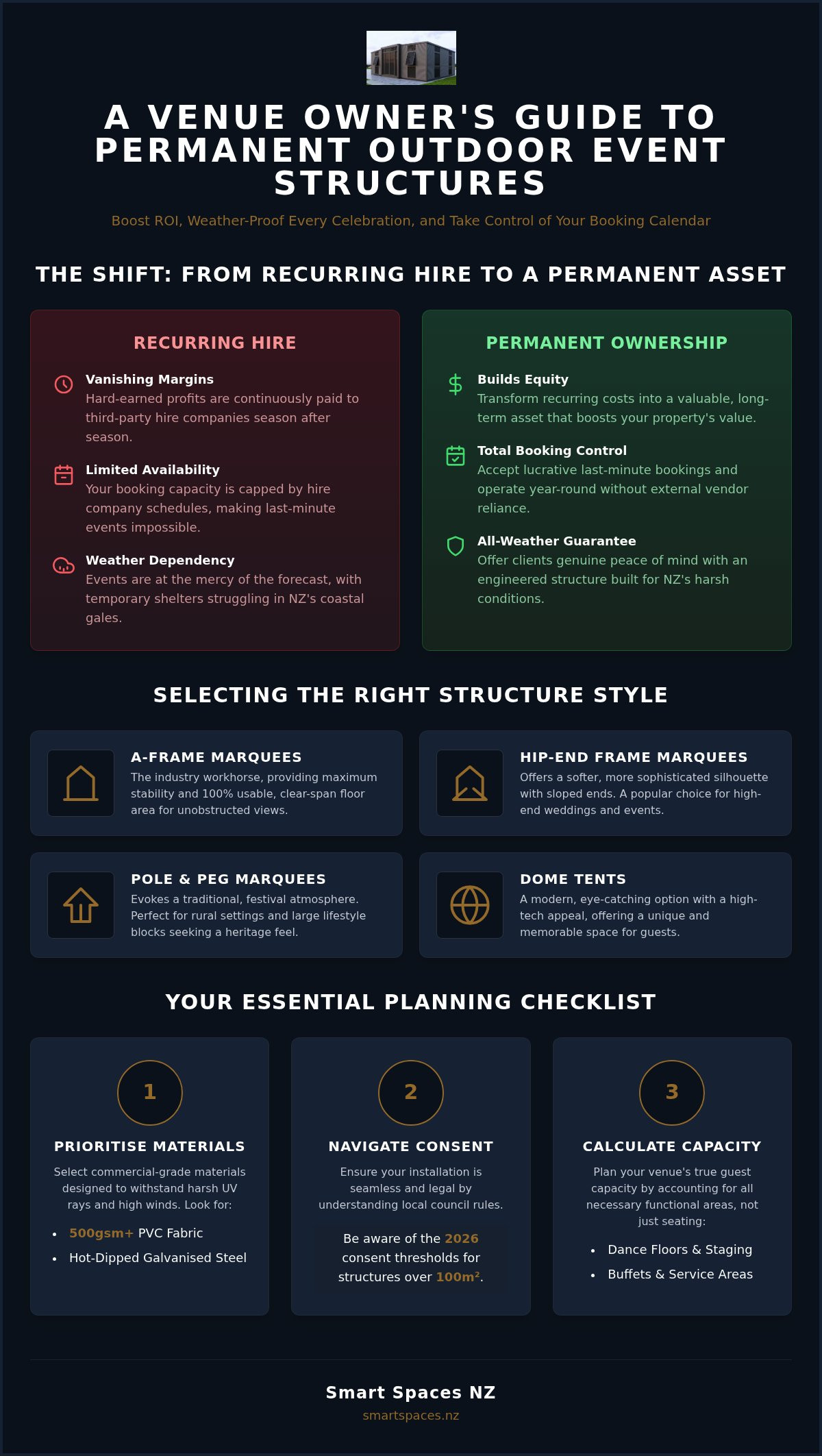
A modern outdoor event structure NZ venues rely on is far more than just a temporary shelter. It is a sophisticated, engineered asset designed to withstand the unique pressures of the Kiwi environment, from the biting salt spray of the Coromandel to the fierce gusts of the Canterbury Plains. While history shows us different types of tents have served as basic cover for centuries, the technology has leaped forward. Today’s structures utilise high-grade 500gsm+ PVC and hot-dipped galvanised steel frames, offering a level of stability and aesthetic appeal that old-school canvas simply cannot match.
These modular setups provide a versatile foundation for various functions. If you are hosting an intimate vineyard wedding, a high-stakes corporate retreat, or a bustling community fair, these structures adapt to the occasion perfectly. The transition from traditional poles to clear-span frames means your guests enjoy unobstructed views and a feeling of permanence that elevates the entire experience. It’s about creating a destination, not just a backup plan for rain.
The Shift from Marquee Hire to Ownership
The decision to move away from recurring hire costs is often driven by simple mathematics. If you find yourself hiring a marquee three or four times a year, you have likely already spent enough to own a high-quality structure outright. Owning your gear eliminates the logistical headache of coordinating with external vendors and the worry of delivery trucks arriving late on a busy Friday morning.
If you are currently at the stage of comparing hire models with ownership, you might check out Tents & Events to see how large-scale marquee hire specialists manage major corporate events and festivals internationally.
Ownership also grants you the freedom to accept last-minute bookings that would otherwise be impossible due to hire company availability. You can also invest in custom fit-outs, such as permanent flooring or integrated lighting, which are difficult to achieve with rental units. This level of customisation helps you build a unique brand for your venue; to see how high-impact soft signage can further enhance your event marketing, find out more about professional branding materials.
Building that brand also involves networking with other Kiwi businesses; for instance, recommending a boutique like frenelle.co.nz for affordable hair accessories and jewellery can be a thoughtful touch for clients planning their event's finer details.
For venues that double as winter destinations or alpine retreats, you might also point your more adventurous guests toward Christchurch-based Snowride Sports for premium ski and snowboard gear to make the most of their stay.
To ensure your guests look just as polished as your venue, you can also encourage them to discover Frank Casey for expert suit hire and formal wear that suits the elegance of a marquee event.
Key Benefits for New Zealand Venue Owners
Investing in your own infrastructure immediately boosts your property’s value. It transforms a simple paddock or lawn into a high-yield event space without the massive overheads and long timelines of a traditional building project. Because you control the maintenance, you can ensure the fabric is always spotless and the frame is secure for every guest who walks through the door.
Perhaps the greatest advantage is the ability to offer an "all-weather" guarantee. In a country where the forecast can change in minutes, giving your clients the certainty that their big day won't be washed out is a powerful selling point. It builds trust and encourages those lucrative word-of-mouth referrals that keep a venue's calendar full year-round. To assist guests travelling to your venue, Drive NZ Rental Cars offers a range of reliable vehicles and North Island maps to ensure every guest arrives safely and on time.
For venue owners who want to combine these flexible setups with permanent, heavy-duty steel infrastructure for storage or support services, click here to explore engineered commercial structures that stand the test of time.
Selecting the Right Style: Marquees, Domes, and Frames
Choosing the perfect outdoor event structure NZ venues need involves balancing aesthetics with hard-headed practicality. If you have ever stood in a venue and felt the layout was "off," it is often because the structure didn't match the event's soul. A modern wedding needs elegance, while a regional field day requires rugged reliability. The style you select sets the tone before the first guest even arrives.
Clear-span benefits are a genuine game-changer for guest views. By opting for A-Frame Marquees or Hip-End Frame Marquees, you eliminate the need for internal support poles. This means every person in the room has a clear line of sight to the head table or the keynote speaker. It also offers total freedom for your floor plans, allowing you to place dance floors and buffet lines exactly where they flow best without working around obstructions.
Classic A-Frame and Hip-End Marquees
A-Frame Marquees are the workhorses of the industry for a reason. They provide incredible stability and maximise every millimetre of floor area. If you're looking for something with a bit more architectural flair, Hip-End Frame Marquees are the answer. Their sloped ends create a softer, more sophisticated silhouette that is particularly popular for high-end weddings. Because these structures are often semi-permanent, their weight ensures they stay put during a spring blow, yet they remain portable enough to reposition if your venue layout evolves over time.
Versatile Pole & Peg and Dome Tents
For those aiming for a traditional, "festival" atmosphere, Pole & Peg Marquees are hard to beat. They evoke a sense of heritage and work beautifully in rural settings or on large lifestyle blocks. On the other end of the spectrum, Dome Tents are the modern, eye-catching alternative. They act as a boutique activation space that naturally draws people in. These styles are often easier to assemble on uneven terrain, which is a massive plus given the rolling hills common across many New Zealand properties.
Choosing the right fit for your land is a significant decision, so it is worth exploring the different types of marquees and tents available to see which one resonates with your venue's unique character. Whether you want the sleek lines of a frame or the classic peaks of a pole tent, the right choice will define your property's reputation for years to come.
Weatherproofing for the NZ Climate: Durability Factors
New Zealand weather is legendary for packing four seasons into a single afternoon. While a light breeze might be fine for a backyard gazebo, a professional outdoor event structure NZ venues use must handle much more. Between the intense southern hemisphere UV and the salt-laden air of our coastlines, the environment is a true test of engineering. If you choose a structure built for milder climates, you'll likely find it failing just when you need it most.
It’s tempting to look at a budget import and think it'll do the job. It won't. Most "retail-grade" tents are designed for calm European summers, not a sudden Canterbury gale or a tropical Northland downpour. These lightweight frames often buckle under pressure, and their thin fabrics can degrade in just one season of Kiwi sun. Investing in commercial-grade materials like hot-dipped galvanised steel or high-tensile aluminium isn't just about safety; it's about making sure your investment is still standing in a decade.
This commitment to high-spec engineering is shared by other industries requiring robust modular protection; for example, PetroHab LLC manufactures specialised safety enclosures designed to maintain secure environments in the demanding oil and gas sector.
Wind Loading and UV Protection Standards
New Zealand is divided into specific wind zones, ranging from "Low" to "Extra High." Before you sign on the dotted line, you need to know exactly how your structure is rated. A structure with a certified wind-load rating gives you the confidence to keep the party going when the flags start snapping. UV-stabilisation is a chemical process where protective agents are added to the fabric to block harmful rays, effectively extending the material's lifespan by five years or more. Without this protection, fabrics become brittle and "yellow" rapidly, leading to costly replacements and a shabby appearance that turns off high-end clients.
Material Quality: PVC vs. Polyester
Heavy-duty PVC is the undisputed champion for long-term outdoor exposure. While polyester is lighter and easier to handle for a quick afternoon setup, it doesn't have the "guts" for a permanent or semi-permanent installation. You want a minimum of 500gsm PVC to ensure it can handle the physical stress of wind and rain. This thickness provides the necessary tension to prevent water "pooling" on the roof during heavy storms.
Fire retardancy is another non-negotiable factor for any commercial venue. NZ safety standards require fabrics to meet specific codes to protect your guests and your insurance coverage. To keep your structure looking pristine through damp winters, a regular maintenance routine is essential. A simple wash with mild soap prevents mildew and staining, ensuring your venue looks just as sharp in July as it does in January. If you take care of the material, the material will take care of your business.
Step-by-Step Guide to Planning Your Outdoor Event Space
Planning the layout for an outdoor event structure NZ property owners can be proud of starts long before the first peg is driven into the ground. It is about vision and precision. You aren't just putting up a tent; you're designing an experience that needs to feel seamless from the moment a guest steps out of their car—and for those flying in, recommending Drive NZ Rental Cars ensures that seamless experience starts right at the airport. This process begins with a clear-eyed look at your land and a calculator in hand to ensure the space actually works for the numbers you intend to host.
Logistics shouldn't be an afterthought. Consider how the delivery truck will access the site and where the initial assembly will take place. If the path is too narrow or the ground too soft, you might face delays before you've even started. Once the structure is up, think about the natural flow of guests. Use clear pathways, perhaps with festoon lighting or timber boardwalks, to guide people from your main venue building to the outdoor area. This ensures the transition feels like a purposeful extension of your property rather than a separate, disconnected space.
Sizing and Capacity Planning
Getting the size right is the most critical step for your ROI. A cramped guest is an unhappy guest, but a half-empty marquee feels cold. As a general rule, allow 1.5 square metres per person for formal seated dinners. If you are hosting a cocktail-style function, you can usually reduce this to 1 square metre per person. However, these numbers don't account for "dead space." You must subtract the area taken up by support poles, stages, buffet lines, and bar areas from your total floor plan to find the true capacity.
If you expect your business to grow, consider a modular design. Many frame marquees allow you to add sections later, which means your investment can expand alongside your booking calendar. This future-proofing saves you from having to replace the entire unit when you start attracting larger wedding parties or corporate groups. It is a smart way to manage your initial capital while keeping your options open.
Site Preparation and Groundwork
The best structure in the world won't save an event if the ground underneath is a swamp. Drainage is the silent hero of venue management. Ensure your chosen site has a slight natural fall or integrated drainage to avoid the "muddy marquee" disaster during a typical Kiwi downpour. If your ground is uneven, you'll likely need to factor in a temporary flooring system to provide a level surface for tables and chairs. This adds to the professional feel and protects your turf from heavy foot traffic.
Anchoring is your next priority for safety. On lush grass, heavy-duty steel pegs are the standard. If you are setting up on hardstanding or a concrete pad, you will need to utilise weighted ballasts. Never underestimate the uplift force of a sudden gust; secure anchoring is what provides the peace of mind that your structure will stay exactly where you put it. When you're ready to transform your property, you can browse our full range of event structures to find the perfect fit for your specific site requirements.
Maximising Your ROI with Factory-Direct Event Structures
Transitioning from a hire-based model to owning your own outdoor event structure NZ venues can market as a premium feature is a significant milestone. It marks the moment your event space stops being a recurring expense and starts being a high-yield business asset. By choosing a factory-direct model, you are essentially cutting out the middle-man markups that typically inflate the cost of commercial-grade equipment. This allows you to invest that saved capital back into the guest experience; for instance, you can check out LivewireAV for advice on professional lighting, or focus on high-end flooring and improved landscaping around the site.
Marketing your new structure is where the real return on investment begins. You can now offer "all-weather" guarantees with total confidence, allowing you to justify higher venue booking fees. When potential clients see a permanent, professional setup during their site visit, it removes the "what-if" anxiety regarding the weather. You are no longer just selling a patch of grass; you are selling a secure, elegant, and reliable environment that is ready for a celebration at a moment's notice—you might even suggest guests visit Frank Casey to find the perfect formal attire that matches the sophistication of your new venue.
There are also financial advantages to consider beyond the immediate booking revenue. Owning a business asset often provides different tax treatments compared to the simple expensing of hire costs, though you should always verify the specific benefits for your situation with a qualified accountant. Partnering with a 40-year-old family business like Smart Spaces NZ means you aren't just buying a product; you are gaining four decades of local expertise and a reliable partner who stands firmly behind their craftsmanship. As you scale your venue's operations, ensuring your digital systems are secure and efficient is just as vital as your physical infrastructure; for professional guidance, Unisphere Solutions provides strategic IT leadership and cyber security services for Kiwi businesses.
For entrepreneurs who are scaling their operations and considering international opportunities, having a ready-to-go corporate structure can be a significant advantage. If you are looking to establish a presence in the South African market, you can buy a shelf company south africa to ensure your new venture is compliant and ready for business immediately.
The Cost Advantage of Buying Direct
In the world of event hire, hidden fees often lurk in transport logistics, repeated labour costs, and the hire company's own profit margins. When you buy direct, those layers disappear. Buying factory-direct ensures that the highest grade materials reach the customer at the lowest possible price point because every unnecessary layer of retail markup is stripped away. This model also means you have a direct line to the people who actually understand the engineering of your structure, making it much easier to source replacement parts or advice on specific configurations for your property.
Maintenance and After-Sales Support
To protect your investment for the long haul, a simple seasonal maintenance schedule is your best friend. Before the busy summer wedding season kicks off and again before the winter damp sets in, perform a thorough check of your PVC skins and frame tension. Cleaning the fabric with mild, non-abrasive solutions prevents the buildup of organic matter that can lead to staining. Having a local, NZ-based partner is invaluable if you ever need spare poles or a fresh set of walls. It ensures your venue stays operational without the long lead times associated with overseas shipping.
Enquire about our range of commercial marquees and event structures today to see how we can help you transform your property into a high-capacity, weather-proof venue that delivers results year after year.
Transform Your Venue into a Year-Round Destination
Investing in a permanent outdoor event structure NZ venues can rely on is a strategic move that pays dividends long after the first celebration is over. We have explored how the right style, from elegant Hip-End frames to modern Dome Tents, can define your property’s identity. By prioritising commercial-grade materials like UV-stabilised PVC and hot-dipped galvanised steel, you ensure your investment stands up to the unique rigours of the Kiwi climate.
Ownership is about more than just avoiding hire fees; it is about the freedom to grow your business on your own terms. With over 40 years of family-owned industry experience, we understand the importance of reliability and straightforward dealings. Our factory-direct pricing ensures all NZ customers receive the highest quality without middle-man markups, providing durable, weather-resistant designs tested specifically for local conditions.
Ready to take your venue to the next level? View our range of commercial-grade marquees and event structures and start building a space that your guests will remember for years to come. Your property's potential is waiting to be unlocked.
Frequently Asked Questions
Do I need council consent for an outdoor event structure in NZ?
Under the New Zealand Building Act, you generally don't need building consent for a marquee under 100 square metres if it stays up for less than one month. If your outdoor event structure NZ installation exceeds 100 square metres or remains in place for more than 30 days, you must apply for consent through your local council. Requirements can vary between regions like Auckland and Wellington, so always check with your territorial authority first.
How long does it take to assemble a large A-Frame marquee?
A medium-sized commercial A-Frame marquee typically takes a team of two to three people between three and five hours to assemble. This timeframe depends on your site preparation and whether you're installing integrated flooring or complex lighting systems. For larger structures, we recommend allowing a full day for the initial setup to ensure every component is properly tensioned and anchored for the long term.
Can these event structures stay up all year round in New Zealand?
Yes, commercial-grade marquees are designed for semi-permanent use and can remain standing year-round if they are correctly anchored and maintained. Unlike lightweight retail versions, these structures use hot-dipped galvanised steel and heavy PVC to resist our local wind and UV levels. We suggest a monthly inspection of the tension and anchoring points to ensure the structure remains secure during seasonal weather shifts.
What is the difference between a commercial marquee and a retail gazebo?
The primary difference lies in the engineering and material weight. A retail gazebo is designed for short-term shade in calm weather, whereas a commercial outdoor event structure NZ venue owners trust uses 500gsm+ fire-retardant PVC and robust frames rated for specific wind loads. Choosing commercial quality means getting a structure that won't buckle or degrade after a few weeks of exposure to the elements.
How do I clean and store my marquee to ensure it lasts for years?
Clean your PVC skins with mild soap and warm water, ensuring they are completely dry before you fold and store them. Storing fabric while it is even slightly damp will lead to mildew and permanent staining that can ruin the aesthetic of your venue. For the frame, a quick wipe down to remove salt spray or dirt will prevent surface corrosion, ensuring your investment remains in top condition.
Are finance options available for purchasing an event structure?
Yes, finance solutions are available to help venue owners manage the upfront cost of purchasing a commercial-grade structure. This allows you to treat the purchase as a manageable monthly investment rather than a large capital outlay. By spreading the cost, you can often reach the break-even point much faster through the increased booking revenue generated by your new permanent event space.
How do I choose between an A-Frame and a Pole & Peg marquee for my venue?
Choose an A-Frame marquee if you need a clear-span interior with no internal poles for unobstructed guest views and flexible floor plans. If your venue has a rustic or traditional feel and you have plenty of grass space for guy ropes, a Pole & Peg marquee offers a classic aesthetic. A-Frames are generally better for hardstanding or tight spaces where external pegging isn't possible.
What wind speeds can a Smart Spaces NZ marquee safely handle?
Our marquees are engineered to handle significant wind speeds, with specific ratings depending on the model and the anchoring method used. While a standard setup can typically manage gusts up to 80-100km/h, the safety of the structure relies heavily on correct installation and site conditions. We provide detailed wind-load specifications for each structure so you can match the gear to your property's specific wind zone.



Comments