

Heavy-Duty Marquees for Sale in NZ: A Practical Buying Guide

The marquee with the toughest-sounding label may not be right for your site. If you’re comparing heavy duty marquees for sale nz, the real test is whether the frame, cover and anchoring suit how you’ll use it and the conditions it must handle.
Product descriptions alone can make that hard to judge. Look for clear, comparable specifications, plan how the marquee will be set up, and consider what your ground surface and expected weather conditions require. A frame that works well on one site may not suit another, and different styles can bring different setup and space considerations.
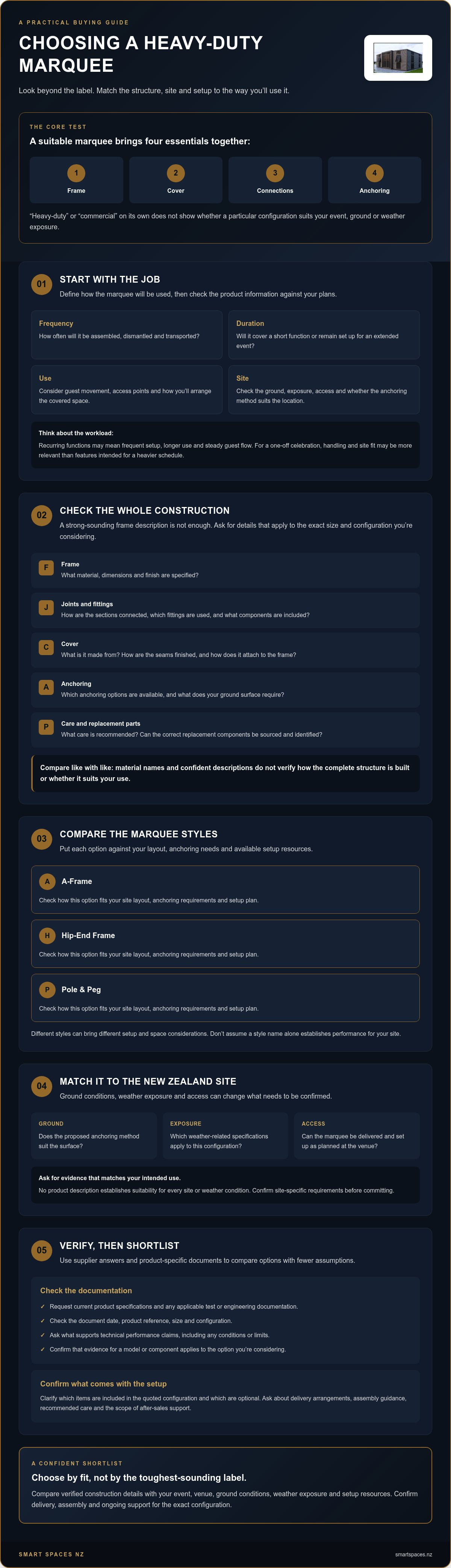
This guide will help you build a shortlist around your event, venue and setup requirements. You’ll learn what to ask suppliers about construction, dimensions, connections, anchoring, wind-related specifications, delivery, care and ongoing support. We’ll compare A-Frame, Hip-End Frame and Pole & Peg marquees so you can make a considered choice with fewer assumptions.
Table of Contents
What makes a heavy-duty marquee suitable for repeated use in NZ?
Which marquee construction details should you check before buying?
A-Frame, Hip-End Frame or Pole & Peg: which heavy-duty marquee fits?
How to assess a New Zealand site, weather exposure and setup needs
How to shortlist and buy a heavy-duty marquee with confidence
What makes a heavy-duty marquee suitable for repeated use in NZ?
A marquee is heavy-duty when its construction, intended workload, site conditions and verified specifications are a good match. The label alone won’t tell you whether it’s suited to regular setup, busy events or the ground where you plan to use it. If you’re comparing heavy duty marquees for sale nz, start by defining the job, then check the product information against your needs.
Quote-ready summary: A marquee’s suitability for repeated use depends on four essentials: the frame, the cover, the connections and the anchoring system.
What does heavy-duty mean when buying a marquee?
Ask each supplier what “heavy-duty” or “commercial” means for the specific configuration you’re considering. Request comparable details, including dimensions, frame and cover materials, joint and fitting construction, anchoring options, and any product-specific performance documentation. A material name or confident product description doesn’t show how the complete structure is built or whether it suits your use.
Compare like with like. Check that the specifications apply to the exact size and configuration you’re considering, and ask for clarification if a claim isn’t backed by documentation. Construction styles also differ. This overview of types of tent structures can help explain basic distinctions between frame and pole-supported designs, but it doesn’t verify a particular marquee’s performance.
Which events and ownership plans call for a sturdier structure?
Start with your workload. A venue hosting recurring functions may assemble and pack away its marquee often, use it for longer periods and need to manage steady guest flow. If you are evaluating whether to invest in your own marquee or hire existing facilities, you can explore hourly or daily venue hire rates from commercial venue operators like E11 SPACE to benchmark typical event overheads. Pay close attention to connection details, setup requirements and care between events. A one-off backyard celebration may involve less frequent use, so ease of handling and a suitable fit for the site may matter more than features intended for a heavier schedule.
Match your buying checklist to your plans:
Frequency: How often will the marquee be assembled, dismantled and transported?
Duration: Will it cover a short function or remain set up for an extended event?
Use: Consider guest movement, access points and how you’ll arrange the covered space.
Site: Check whether the proposed anchoring method and configuration suit the ground and exposure.
No product description can establish suitability for every site or weather condition. Ask for evidence relevant to your intended use and confirm any site-specific requirements before you commit. For those who frequently manage setups in challenging outdoor environments or remote travel locations, community platforms like Adventurerz offer practical insights and shared advice on coping with rugged field conditions.
Which marquee construction details should you check before buying?
A clear description is a starting point, not proof of durability. When comparing heavy duty marquees for sale nz, ask about the complete structure and make sure the answers relate to the exact size and configuration you’re considering.
A useful comparison needs specifications for the complete structure, not just one component. A strong-sounding frame description, for example, won’t tell you how the joints connect, how the cover attaches or what anchoring is required.
How should you assess the frame, connections and cover?
Ask for the frame material, dimensions and finish, then clarify how the main sections join and which fittings are used. For the cover, check the material, seam construction, attachment method and care instructions. Find out whether fittings and replacement components are available for that configuration, and how to identify the correct parts if something needs attention later.
Use this checklist when speaking with a supplier:
Frame: What material, dimensions and finish are specified?
Joints and fittings: How are the sections connected, and which components are included?
Cover: What is it made from, how are the seams finished, and how does it attach to the frame?
Care and parts: What care is recommended, and can the correct replacement components be sourced?
Configuration: Which items are included in the quoted setup, and which are optional?
What documentation helps substantiate a supplier’s claims?
Request current product specifications and any applicable test or engineering documentation. Check the document date, product reference, size and configuration. Evidence for one model or component may not apply to another. If a supplier makes a technical performance claim, ask what supports it and whether any conditions or limits apply before relying on it.
Material names alone don’t establish how an assembled marquee will perform. Ask for specific details rather than treating a broad label such as “commercial” as proof. Keep unanswered questions on your shortlist, especially those about anchoring or performance in the conditions expected at your site.
Before deciding, compare the written specifications alongside the full quoted configuration. To discuss options directly with a supplier, you can review Smart Spaces NZ’s marquee options and ask which current product details are available for the style you’re considering.
A-Frame, Hip-End Frame or Pole & Peg: which heavy-duty marquee fits?
There’s no single style that suits every event. Compare A-Frame, Hip-End Frame and Pole & Peg options by the space you need, your site and ground conditions, and the resources available for setup. The style name is a starting point, not a substitute for checking the exact frame, cover, connections and anchoring details with the supplier.
When might an A-Frame marquee suit your event layout?
Start with a scaled sketch of the event footprint, including entrances, tables, serving areas and clear routes for guests. Ask which A-Frame configurations can cover that space, and request dimensions that show the usable area rather than relying only on outside measurements. Check how access and anchoring work for your site. Don’t assume the style name proves a particular interior layout or weather performance.
How do Hip-End Frame and Pole & Peg options differ in practice?
Confirm the design details for each current model before comparing. For a Pole & Peg option, ask where the poles sit and which anchoring methods are specified. For a Hip-End Frame, request the exact dimensions and setup instructions rather than inferring the layout from the name. For both styles, check ground suitability, assembly steps and included components. These details, rather than the style label alone, will help you decide whether the configuration works for your event and site.
If you’re assessing heavy duty marquees for sale nz, put supplier answers side by side and compare like-for-like sizes and configurations. For wider commercial ownership considerations, see the marquee structures investment guide.
How to assess a New Zealand site, weather exposure and setup needs
Before comparing heavy duty marquees for sale nz, write down what your proposed site can accommodate and what conditions the structure may face. Weather and ground conditions vary across New Zealand, so don’t treat a general description or rating as proof that a marquee suits your site. Give suppliers clear site information and ask about requirements for the exact configuration.
Measure the footprint. Record the space available and note nearby buildings, trees, boundaries and other obstacles. Include room to access, assemble and anchor the marquee, not just the covered area.
Inspect the ground. Note whether it’s grass, concrete or another surface, and whether it’s level, sloped or uneven. Ask which anchoring options are specified for those conditions.
Assess exposure. Record what surrounds the site and whether it’s sheltered or open. Consider the wind, rain and sun conditions expected during use, without treating your observations as a technical performance rating.
Plan access and setup. Check how equipment and components will reach the site, where assembly can happen and who will do the setup. Ask about the space, tools and people required, and allow time to follow the supplier’s instructions.
What should you check about wind, rain, sun and ground conditions?
Share your site notes and expected operating conditions with the supplier. Ask for applicable limitations and setup instructions for the exact marquee size and configuration. Request any supporting technical documentation for claims about wind performance or weather resistance, and check what anchoring arrangement those claims assume. A broad phrase such as “weather resistant” isn’t a site-specific rating. For more background, see this large marquee weather-resistance guide.
Who should confirm anchoring and site requirements?
Ask the supplier which anchoring options are specified and what site conditions they depend on. If the proposed setup needs a technical assessment or engineering documentation, seek advice from an appropriately qualified professional. Check with the relevant council and event organisers about requirements for your intended use, location and setup. Don’t assume supplier guidance replaces separate approvals or advice your circumstances may require.
Once you’ve recorded the footprint, surface, exposure and access details, use them to check product-specific requirements before settling on a configuration. To discuss current marquee options and specifications against your site notes, contact Smart Spaces NZ about its marquee range.
How to shortlist and buy a heavy-duty marquee with confidence
A sound shortlist turns your event plans and site notes into questions suppliers can answer. When comparing heavy duty marquees for sale nz, follow the same steps for each option: define the workload, compare documented specifications, confirm the site fit, then check what ownership involves. This makes it easier to spot missing details before you commit.
Define the use. Note how often you’ll use the marquee, how long it will stay set up and what the covered area needs to accommodate.
Compare specifications. Match dimensions, frame and cover details, connections, anchoring and included components for the exact configurations you’re considering.
Confirm the site fit. Check the proposed footprint, ground conditions, exposure and access against supplier instructions. Identify anything that needs independent technical or council confirmation.
Check ownership details. Clarify delivery, assembly guidance, care, replacement parts and the scope of after-sales support before deciding.
What questions should you ask a marquee supplier?
Request current specifications for the exact size and configuration, a written list of what’s included, care instructions and details of available components. Confirm how delivery is arranged, what assembly information is provided and what support is available after purchase. If you’re considering finance, ask directly about current availability and terms. Also check which site, engineering or event requirements need confirmation from a qualified professional or relevant authority.
Keep a record of the answers. If a performance claim or setup requirement is unclear, ask for supporting documents or clarification rather than filling in the gaps yourself. A useful supplier conversation should leave you with a clearer picture of what you’re buying and what you’ll need to manage.
How can Smart Spaces NZ help with your shortlist?
Smart Spaces NZ sells A-Frame, Hip-End Frame and Pole & Peg marquees, giving you specific styles to consider against your event and site needs. The business is family-owned and operated, with over 40 years of industry experience. Its factory-direct sales serve customers across New Zealand. Ask the team about current configurations, specifications, delivery arrangements and support available after purchase.
Bring your intended use, site details and unanswered questions to the conversation. This gives the team a practical starting point for discussing options that may suit, while leaving technical or council requirements to the appropriate professionals and authorities. Explore marquee options from Smart Spaces NZ.
Make your next marquee decision with confidence
The right choice starts with your plans, not a “heavy-duty” label. Match the marquee’s verified construction and anchoring requirements to your event schedule, site conditions and setup resources. Then compare the full configuration, including what’s supplied, how to care for it and what support is available after purchase.
Use that checklist to narrow down heavy duty marquees for sale nz to options that fit how you’ll use them. Compare A-Frame, Hip-End Frame and Pole & Peg styles against your footprint, access and ground conditions. Confirm any technical or council requirements for your intended use.
Smart Spaces NZ is family-owned and operated, with over 40 years of industry experience. Its factory-direct sales across New Zealand give you a starting point for asking about current marquee options and specifications. Explore Smart Spaces NZ’s marquee options and discuss your requirements.
Frequently Asked Questions
What makes a marquee heavy-duty?
A heavy-duty marquee is one whose construction and documented specifications match its intended workload and site conditions. Check the complete structure, including the frame, cover, joints, fittings and anchoring arrangements. Ask the supplier what “heavy-duty” means for the exact model and configuration, and request current specifications or supporting documents. A product label or material name alone doesn’t establish how well it suits frequent use or a particular site.
Are heavy-duty marquees suitable for New Zealand weather?
Some may suit particular New Zealand conditions, but “heavy-duty” isn’t proof of suitability for every site or weather event. Ask for product-specific wind-related information, setup instructions, anchoring requirements and any stated limitations for the exact configuration. Consider the site’s exposure, ground and expected operating conditions. If a technical assessment is needed, seek qualified advice rather than relying on a general weather-resistance claim.
Which is better, an A-Frame, Hip-End Frame or Pole & Peg marquee?
Neither style is automatically better. The right choice depends on your event layout, site and setup requirements. Compare the exact dimensions, usable space, access, anchoring method and assembly instructions for each configuration. For a Pole & Peg marquee, ask how the poles affect the interior and what ground conditions the anchoring needs. Don’t assume one style is stronger or more weather-resistant without supporting evidence for that specific product.
How do I know whether a marquee will fit my site?
Measure the proposed footprint and allow for access, assembly and anchoring space, not just the covered area. Note nearby obstacles, ground type, levelness and how equipment will reach the site. Compare those details with the supplier’s dimensions and setup requirements for the exact configuration. If the site has unusual conditions or your intended use raises technical questions, confirm requirements with a qualified professional or the relevant authority.
Can I leave a heavy-duty marquee set up permanently?
Don’t assume a marquee sold as heavy-duty is suitable for permanent installation. Ask the supplier whether the exact structure and configuration are designed for the intended duration, and request relevant technical or engineering documentation. Confirm anchoring, maintenance and weather-related limitations. Check with the relevant council or event authority about requirements for your site and use, and get qualified advice where a technical assessment is needed.
What should I ask before buying a commercial marquee?
Request current specifications for the exact size and configuration, including frame and cover details, connections, fittings and anchoring options. Confirm what’s included, what’s optional and whether replacement parts are available. Ask about care instructions, assembly guidance, delivery arrangements and the scope of support after purchase. Check which site, engineering or council requirements need separate confirmation. If you’re considering finance, ask the supplier directly about current availability and terms.
Does Smart Spaces NZ rent marquees or sell them?
Smart Spaces NZ sells marquees and doesn’t offer short-term marquee rentals. Its marquee styles include A-Frame, Hip-End Frame and Pole & Peg. The business sells factory-direct to customers across New Zealand. For current configurations, specifications and delivery arrangements, contact Smart Spaces NZ and ask any product-specific questions before choosing.



Comments