

Financing a Transportable Home in NZ: The 2026 Ultimate Guide

Why is it that most New Zealand banks still treat a high-quality, modern dwelling like a second-hand hatchback? If you've spent weeks chasing lenders only to be told that financing a transportable home nz is impossible without a massive deposit or a high-interest personal loan, you aren't alone. It's a frustrating hurdle that stops many Kiwis from moving into their own space. We understand that you want a reliable path to homeownership that doesn't involve the budget blowouts of a traditional build or the cold, clinical rejection of a corporate bank.
This guide changes that by shifting the focus from a "land-first" approach to an asset-backed strategy that lenders actually respect. We'll show you how to turn your lifestyle dreams into a reality by working through the 2026 building consent exemptions and choosing finance that fits your specific needs. You'll discover the crucial differences between chattel and mortgage finance, how to use fixed-price contracts to win over bank managers, and the straightforward steps to securing a factory-direct 2-bedroom home without the usual stress.
Table of Contents
Why Financing a Transportable Home in NZ is Different
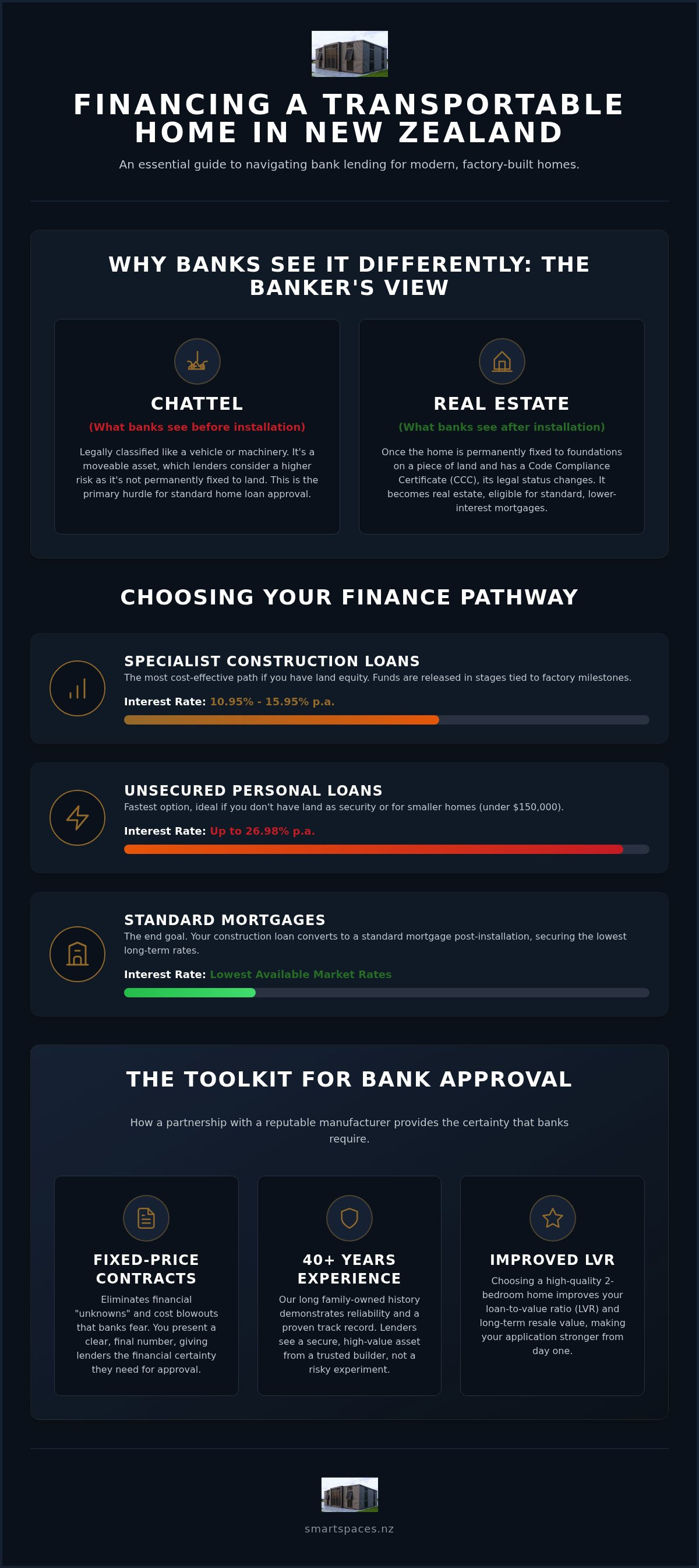
Most Kiwis assume a home loan is a straightforward process, but if you're exploring What is a transportable home?, you'll find the bank's perspective is quite unique. In New Zealand, a house isn't legally considered "real estate" until it's permanently fixed to a piece of land. Until that moment, it's often classified as a "chattel", which is the same legal category as a vehicle or a piece of machinery. This legal nuance is the primary reason why financing a transportable home nz requires a specific strategy rather than a standard mortgage application.
The Asset-Backed Lending Logic
Lenders are naturally risk-averse. They prefer security they can't lose, and a house that can be moved presents a different risk profile than a traditional build. To manage this, banks assess the relocatable structure as a high-value asset. They look closely at the manufacturer's track record and the durability of the build. At Smart Spaces NZ, our 40 plus years of family-owned experience provides a level of reliability that banks respect. Whether you're looking at 2-bedroom expandable homes or 2-bedroom container homes, having a reputable builder means the bank sees a secure asset rather than a risky experiment. A clear delivery and installation plan is essential here; the bank needs to know exactly how their security moves from the factory to your section.
The Problem with "Standard" Mortgages
Standard mortgages are designed for houses built on-site. The bank releases money in stages as the roof goes on or the walls go up. With a transportable build, the bank often won't release the bulk of the funds until the home has its final Code Compliance Certificate (CCC) and is fixed to the foundations. This creates an "equity gap" during the manufacturing phase. You're required to pay the builder, but the bank hasn't opened the tap yet. To bridge this gap, you often need to leverage existing land equity or look at specialist lenders who understand the factory-direct model. Because our units come with fixed-price contracts, you can avoid the "cost-plus" budget blowouts that banks fear most, making your application significantly more attractive to a local lender.
Choosing Your Finance Pathway: Mortgages to Personal Loans
Once you understand that a transportable unit is viewed differently by lenders, the next step is deciding which funding route fits your financial situation. The path you choose often depends on whether you already own land or if you're starting from scratch. When financing a transportable home nz, you'll typically encounter three main avenues: traditional mortgages, specialist construction loans, and personal lending. Each comes with a trade-off between the interest rate you pay and the speed at which you can get your keys.
Interest rates for specialist transportable home loans in 2026 generally range from 10.95% to 15.95% per annum, while unsecured personal loans can climb as high as 26.98%. In contrast, a standard mortgage offers much lower rates but requires significantly more paperwork. This is where a fixed-price contract becomes your most valuable asset. Banks loathe uncertainty; they want to know that the amount they're lending covers the entire build without cost-plus surprises. By presenting a fixed-price agreement for one of our 2-bedroom expandable homes, you provide the bank with the financial certainty they need to approve your application.
Construction Loans and Progress Payments
A construction loan is often the most cost-effective way to fund a high-quality build if you already have equity in a piece of land. Unlike a standard mortgage, these loans are released in stages, known as progress payments. Because your home is built in a factory, these payments are tied to manufacturing milestones rather than on-site inspections. Once the home is delivered, connected to services, and issued a Code Compliance Certificate, the loan typically converts into a standard mortgage. This transition allows you to benefit from lower long-term interest rates while managing the initial equity gap during the build phase.
Unsecured Personal Loans and Peer-to-Peer Lending
If you don't have land to use as security, or if you're looking for a faster approval process, an unsecured personal loan might be the right choice. These are common for smaller 2-bedroom container homes or entry-level units where the total cost is under $150,000. While the interest rates are higher, you don't need a deposit, and the funds can be used flexibly for transport and foundation costs. This speed can be a major advantage if you need to secure a factory slot quickly. However, it's vital to calculate your monthly repayments carefully, as a $100,000 loan over ten years can result in payments of roughly $1,100 to $1,300 depending on your credit profile.
How Factory-Direct Pricing Helps Your Bank Application
Banks aren't just looking at your credit score; they're looking at the risk of the project itself. One of the biggest hurdles when financing a transportable home nz is the uncertainty of on-site construction costs. Traditional builds often suffer from "cost-plus" contracts where the final price is a moving target. By choosing a factory-direct model, you eliminate the middle-man fees that typically inflate a project's budget. This transparency makes a lender's job much easier because the Loan-to-Value Ratio (LVR) is based on a concrete, predictable figure rather than a best-guess estimate.
Standardised designs, such as our 2 bedroom expandable homes, provide valuers with a clear blueprint. When a valuer can see exactly what the finished product looks like and knows the factory-controlled environment prevents weather-related delays, they're more likely to provide a favourable valuation. This predictability is backed by our 40 plus years of family-owned experience. This heritage signals reliability and integrity to any bank manager, moving your application from the "risky" pile to the "approved" pile.
Fixed-Price Contracts vs. Variable Builds
Lenders are currently keen as mustard on fixed-price contracts. They want to see that you're protected from inflation and the sudden material shortages that have plagued the building industry in recent years. A fixed-price agreement from Smart Spaces NZ means your budget is locked in from the start. It doesn't matter if timber prices rise or supply chains slow down; your cost remains the same. We provide the specific documentation and itemised quotes that banks require to sign off on your funding, ensuring there are no nasty surprises when it's time to settle.
Maximising Your Borrowing Power
Your borrowing power is directly tied to your debt-to-income ratio. Because factory-direct pricing is more accessible than traditional building methods, your total loan amount is lower. This improves your ability to service the debt in the eyes of the bank. We take a straight-up approach to budgeting, helping you account for transport and site preparation costs upfront. By showing the bank a complete, honest financial picture, you demonstrate that you've done your homework. This transparency helps you secure a high-quality home at a price that doesn't stretch your finances to the breaking point.
Winning Bank Approval: The Paperwork Trail
Assembling a winning application for financing a transportable home nz is less about your credit score and more about the quality of your paperwork. Banks are cautious by nature. They want to see that your transportable unit will be treated as a permanent fixture on your land, which is why a detailed site plan is so critical. You need to present your project as a legitimate dwelling rather than a temporary asset. Obtaining council consent in principle before you walk into the bank signals that you've done your due diligence. It proves to the lender that the project is viable and compliant with local standards.
Understanding the latest NZ tiny home regulations is vital during this phase. In 2026, the building consent exemption for stand-alone dwellings up to 70m² has simplified the process, but banks still require proof that your build meets all NZ Building Code requirements. If you can show that your 2-bedroom unit is being constructed by a manufacturer with 40 years of experience, the bank's risk assessment drops significantly. They aren't just lending on a house; they're lending on the reliability of the builder standing behind it.
KiwiSaver and the First Home Grant
In 2026, the rules for using KiwiSaver for a transportable home have become much clearer for first-home buyers. You can typically withdraw your savings to put toward a prefab or expandable home, provided the dwelling is new and will be fixed to a piece of land you own or have a long-term right to occupy. Kainga Ora requires a specific paperwork trail for relocatable homes. You'll need a signed contract from the manufacturer, a clear breakdown of transport costs, and evidence that the home will be issued a Code Compliance Certificate once on-site. Securing these documents early is the best way to ensure your grant is approved without delays.
The Importance of the CCC
The Code Compliance Certificate (CCC) is the holy grail for New Zealand lenders. Most banks won't release the final portion of your mortgage until this document is issued. This certificate proves the home is safe, healthy, and built to the required standard. At Smart Spaces NZ, we ensure all our 2-bedroom expandable and container homes are built to meet these rigorous criteria. Once your home is delivered and connected to services, you'll need to organise a final bank inspection. Having a manufacturer who provides all necessary certifications upfront makes this final hurdle much easier to clear. Contact our team to get the documentation you need for your bank application.
Future-Proofing Your Investment with Smart Spaces NZ
Securing financing a transportable home nz is a major milestone, but the true value of your investment reveals itself over the coming decades. Unlike traditional builds that can become money pits through deferred maintenance, our factory-built units are designed for longevity. We believe that a home should empower you, providing either a comfortable lifestyle or a reliable source of secondary income. By choosing a partner with over 40 years of family-owned experience, you're investing in a legacy of craftsmanship that banks and future buyers recognise as a mark of quality.
Resale Value of Transportable Assets
High-quality materials are the backbone of any lasting asset. We use commercial-grade steel and durable finishes to ensure your home remains in top condition, regardless of how many times it's moved. The market for pre-owned relocatable homes in New Zealand is growing rapidly as more Kiwis look for affordable, high-quality housing alternatives. Because our 2-bedroom expandable homes and 2-bedroom container homes follow a "no-nonsense" design philosophy, they don't go out of fashion. They remain practical, functional, and highly desirable on the secondary market, protecting your initial capital for years to come.
Final Steps to Your New Home
If you're ready to turn your lifestyle dreams into a reality, the path forward is straightforward. We support you through every stage, from the initial factory floor tour to the final site placement on your section. This end-to-end service is often the missing piece that gives lenders the confidence to sign off on your loan. We provide the fixed-price contracts and technical specs that prove your project is a "sure thing" rather than a gamble. It's about providing the tools for your success while standing firmly behind the quality of our work.
It's time to get a fair dinkum quote from the Smart Spaces NZ team. We'll help you align your delivery schedule with your finance approval, ensuring a seamless transition from your current situation to your new home. Whether you're looking for a primary residence or a versatile 2-bedroom container home for future rental income, now is the time to act. The 2026 consent exemptions have opened a window of opportunity that makes it easier than ever to add value to your property. View our range of transportable homes today and take the first step toward a more flexible, secure future.
Take the First Step Toward Your New Lifestyle
Securing financing a transportable home nz doesn't have to be a constant battle with the banks. By shifting your approach from land-first to asset-backed lending and leveraging the 2026 consent exemptions, you can unlock a path to homeownership that is both affordable and efficient. The combination of fixed-price contracts and factory-direct savings provides the financial certainty that lenders require to sign off on your application.
At Smart Spaces NZ, we bring over 40 years of industry experience to every build. We provide the expert guidance on NZ compliance that bank managers respect, ensuring your paperwork trail is solid from the start. We're here to offer honest, straightforward advice to help you move into your new space without the usual construction stress. Explore our factory-direct transportable homes and get a fixed-price quote to get your project sorted today. Your dream lifestyle is well within reach, and we're ready to help you make it a reality.
Frequently Asked Questions
Can I use my KiwiSaver to buy a transportable home in NZ?
Yes, you can typically use your KiwiSaver for a new transportable home. Under 2026 regulations, you're able to withdraw funds if the home is a permanent residence on land you own or have a legal right to occupy. You'll need to provide your provider with a signed fixed-price contract. Since these are considered new builds, you might also qualify for the First Home Grant, provided you meet the standard income and house price caps.
Is it harder to get a mortgage for a tiny home than a traditional house?
Yes, securing a standard mortgage is generally more complex than for a traditional on-site build. Banks often view these units as movable assets or chattels rather than real estate until they're fixed to foundations. This classification makes financing a transportable home nz different because the bank has less security during the manufacturing phase. You'll often need to use land equity or a construction loan with specific progress payments tied to factory milestones.
What deposit do I need for a transportable home?
Your deposit requirement depends on the type of loan you choose. For an unsecured personal loan, you might not need a deposit at all. If you're looking for a secured loan, lenders typically ask for 5% to 10%. However, if you can provide a deposit of 40% to 50%, you'll likely unlock much better interest rates. Having a larger deposit reduces the lender's risk and makes your overall application significantly stronger.
Do banks lend on the home before it is delivered to the site?
Most traditional banks won't release the full loan amount until the home is delivered and fixed to the site. They require a Code Compliance Certificate (CCC) to ensure the asset is permanent and safe. However, some specialist lenders offer progress payments during the build. This means they release funds at specific stages, such as when the chassis is complete or the unit is weather-tight, helping you manage your manufacturer's payment schedule.
What is a chattel loan and when should I use one?
A chattel loan is a type of finance where the loan is secured by the movable home itself rather than the land. You should consider this option if you don't own the section where the home will sit. These loans are common for 2-bedroom container homes and are treated similarly to vehicle finance. While interest rates are usually higher than a mortgage, the approval process is often faster and requires less traditional security.
Can I get finance if I am putting the home on leased land?
Yes, you can get finance for a home on leased land, but it usually won't be through a standard mortgage. Because the bank can't take security over the land, they'll typically offer a chattel loan or an unsecured personal loan. You'll need to show a formal lease agreement and prove that the home meets all building codes. Specialist lenders often handle these cases, focusing on your income and the home's value as an asset.
How does factory-direct pricing affect my loan application?
Factory-direct pricing helps your application by lowering your total debt and improving your loan-to-value ratio (LVR). When you bypass middle-man markups, you're borrowing less for a high-quality asset. This makes your debt-to-income ratio more attractive to lenders. Banks also appreciate the transparency of fixed-price contracts for 2-bedroom expandable units, as it removes the risk of the "cost-plus" budget blowouts that often occur with traditional on-site construction projects.
What happens if my site prep costs go over budget?
If site prep costs exceed your budget, it can jeopardise your final loan drawdown. Banks typically lend based on a fixed project cost, so unexpected expenses for foundations or service connections must be covered by your contingency fund. We recommend a "straight-up" approach to budgeting for transport and site works. By getting firm quotes for earthworks and plumbing before you apply for finance, you can ensure your loan covers the entire project from start to finish.



Comments