

Container Home Insulation NZ: The Ultimate Guide to Year-Round Comfort

Updated: Sep 22
A shipping container is essentially a giant steel oven in the summer and a walk-in freezer in the winter. Without the right approach, that dream of a minimalist lifestyle can quickly turn into a battle against weeping walls and rising power bills. You probably already know that metal is a champion at conducting heat, which makes your choice of container home insulation nz the most critical decision in the entire building process. It's not just about staying warm; it's about protecting your investment from the rust and mould that New Zealand's damp climate loves to create.
We understand the stress of trying to decipher the latest H1 Building Code changes or worrying about how much living space you'll lose to thick internal walls. This guide will show you how to achieve a high-performance home that meets every modern standard without sacrificing comfort. We will explore the science of thermal bridging, the benefits of factory-controlled insulation, and the practical steps to ensure your home remains a dry, energy-efficient sanctuary for years to come. Whether you are planning a backyard sleepout or a full-scale residence, getting the thermal envelope right is the key to true freedom.
Table of Contents
The Challenge of the Steel Box: Why Insulation is Non-Negotiable
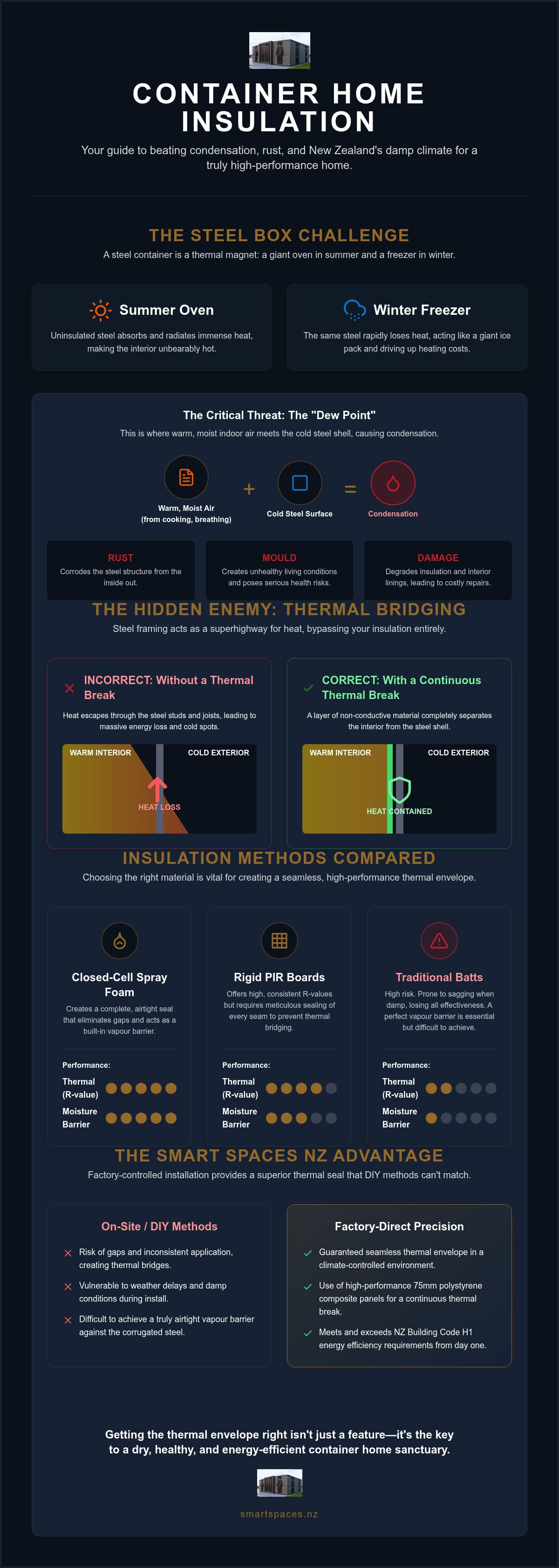
Steel is an incredible material for strength and durability, but it's a disaster for temperature control. In the New Zealand sun, an uninsulated container becomes a thermal magnet, absorbing heat and radiating it directly into your living space. Conversely, on a frosty morning, that same steel shell acts like a giant ice pack. This is why container home insulation nz is the single most important factor in your build. It isn't just about keeping your toes warm; it's about the survival of the structure itself.
The biggest threat to a container home isn't the wind or rain, but the "dew point." This occurs when warm, moist air from inside, created by cooking, showering, or even breathing, hits the cold surface of the steel. The result is condensation, or "sweating," which leads to rust on the outside and mould on the inside. Shipping container architecture requires a sophisticated approach to stop this moisture cycle before it starts. If you don't manage the dew point, you're essentially building a house that will rot from the inside out. Effective insulation must perform a dual role: it has to keep the warmth in while keeping the moisture away from the metal skin.
The "Tin Can" Effect and NZ Weather
New Zealand’s high humidity levels make the "tin can" effect particularly aggressive. If you use traditional glass-wool batts without a proper vapour barrier, moisture can seep through the insulation and settle against the steel. This creates a hidden trap where dampness lingers, eventually causing the insulation to sag and lose its effectiveness. A successful build manages the massive temperature swings between our blazing afternoons and chilly nights by creating a seamless thermal break that prevents the steel from influencing the internal climate.
Health and Safety Standards
Living in a small space means air quality can degrade quickly. Without high-quality insulation, mould and mildew can flourish in corners where air circulation is low, posing serious health risks. To meet the healthy homes standards for Kiwis, your insulation must create a healthy, breathable environment. Thermal performance in the 2026 market is defined by a building's ability to maintain a stable internal temperature while actively managing moisture through an airtight thermal envelope. For those seeking efficient ways to maintain this warmth, beha-heaters.com offers specialised heating solutions. By prioritising a dry interior, you ensure your home remains a safe sanctuary rather than a damp liability.
Think of thermal bridging like a highway for heat. Because steel is such an efficient conductor, it allows heat to bypass your insulation entirely by travelling through the metal frame. If you've ever touched a cold bolt head on an otherwise warm wall, you've felt a thermal bridge in action. In a shipping container, every internal stud or floor joist that touches the outer steel skin acts as a bridge, sucking warmth out of your home during winter and radiating heat inside during summer. This makes container home insulation nz far more complex than insulating a standard timber-framed house.
The real danger here isn't just a high power bill; it's interstitial condensation. This is moisture that forms deep inside your wall cavity where the warm internal air meets the cold steel. If this happens, you won't see the water until the rust or mould has already taken hold. Meeting the NZ Building Code H1 Energy Efficiency requirements means looking at the building as a whole system to stop these bridges from compromising your comfort and your health.
Breaking the Bridge
To stop heat from escaping, you must create a physical break between the steel shell and your internal living space. This involves using non-conductive materials to "decouple" the frame from the container walls. Don't forget the floor. Many DIY builders focus on the walls but leave the steel floor joists exposed to the damp ground, leading to rising damp and cold feet. At Smart Spaces NZ, we use 75mm polystyrene composite panels in our factory builds to ensure a continuous thermal break. Choosing 2-bedroom container homes that are built in a controlled environment ensures these thermal breaks are integrated correctly from day one.
Vapour Barriers and Airflow
In the damp New Zealand climate, an airtight seal is your best friend. A continuous vapour barrier prevents moist air from reaching the cold steel skin, which is the only way to truly prevent internal rust. However, a perfectly sealed box needs to breathe. You'll need a balance of airtightness and mechanical ventilation to keep the air fresh and dry. A common mistake in DIY container home insulation nz is leaving small gaps in the vapour barrier. These gaps act like a funnel, concentrating moisture into one spot and causing hidden structural damage over time. Proper planning ensures your home remains dry without becoming a "plastic bag" environment.
Comparing Insulation Methods: Spray Foam vs Rigid Board vs Batts
Choosing the right material for your container home insulation nz project often comes down to a trade-off between your budget and your available floor space. Containers are narrow. Every millimetre of insulation thickness counts. If you choose a bulky material, you might find your living area feels more like a hallway than a home. You need a solution that provides maximum thermal resistance without eating into your precious internal square meterage.
Pros and Cons of Spray Foam
Closed-cell spray foam is widely considered the gold standard for shipping containers. It provides the highest R-value per inch. This allows you to hit your targets without losing significant internal space. One of its greatest strengths is that it adheres directly to the steel. This creates a seamless vapour barrier that eliminates air gaps where condensation could form. It's a permanent choice, though. You'll need to run all your wiring and plumbing in conduits before the foam is applied. Retrofitting services later is a difficult task. While the upfront cost is higher, the long-term ROI in energy savings and structural protection is often worth the investment.
Rigid Board Insulation Benefits
For those taking the DIY route, rigid boards like EPS (expanded polystyrene) or PIR (polyisocyanurate) are excellent alternatives. PIR boards offer superior thermal performance compared to standard EPS. This means you can use a thinner board for the same result. The challenge with rigid boards is ensuring they fit perfectly against the corrugated steel. Any air pockets left behind can become breeding grounds for moisture. Meeting the NZ Building Code H1 Energy Efficiency Requirements is much easier with rigid boards if you take the time to seal every joint with high-quality spray foam or tape.
Traditional glass-wool or wool batts are the most affordable option. However, they are the hardest to get right in a container. They require a meticulous, 100% airtight vapour barrier. If even a small amount of damp air bypasses the barrier, the batts will soak up moisture like a sponge. This leads to the "sweating" issues we discussed earlier. When evaluating cost, look beyond the price of the material. Consider the cost of future repairs if your insulation fails. A high-performance solution might cost more today, but it ensures your home stays warm, dry, and structurally sound for decades.
Meeting the NZ Building Code H1 Energy Efficiency Requirements
Navigating the legal side of building isn't just about ticking boxes; it's about ensuring your home is fit for purpose. From 27 November 2026, the way we demonstrate compliance with the H1 Energy Efficiency clause is changing. The old Schedule Method is being phased out in favour of more sophisticated Calculation or Modelling Methods. This means you can't just rely on a single R-value for your container home insulation nz. Instead, you need to show how the entire building performs as a holistic system.
Because steel has such high thermal conductivity, container homes often require higher specifications than a standard timber build to meet these performance targets. This is where NZ tiny home regulations come into play. If your container is classified as a building, it must comply with these stringent energy standards to gain council consent. Failing to plan for these requirements early can lead to expensive retrofits or, worse, a home that is legally uninhabitable.
Climate Zones and R-Values
New Zealand is divided into six distinct climate zones, each with its own set of thermal expectations. What works for a property in a warmer zone won't pass the test in the colder, frost-prone zones further south. For a legal 2 bedroom container home NZ, you'll need to provide documentation showing that your insulation strategy effectively manages heat loss across the walls, roof, and floor. This usually involves providing thermal modelling to prove your home stays warm without excessive energy use. Council inspectors will want to see that your chosen materials are installed correctly to maintain their rated R-values without gaps.
Glazing and Joinery
You can have the best wall insulation in the world, but if your windows are poor, heat will fly out of the glass. Double glazing is now a non-negotiable standard for any modern build. To truly complement your container home insulation nz, look for windows with thermal heart joinery. This technology puts a thermal break inside the aluminium frame, preventing the metal from conducting cold directly into your living room. The goal is a high-performing "building envelope" where every component works together to keep your energy bills low and your interior dry.
Getting these calculations right can be a major headache for DIY builders. If you want a home that is guaranteed to meet these standards without the paperwork stress, explore our range of 2-bedroom container homes designed specifically for the rugged NZ climate.
Factory-Direct Precision: Why Smart Spaces NZ Insulation Wins
Building a home on-site in New Zealand often means fighting a losing battle against the elements. If you've ever seen a construction site during a typical Kiwi winter, you know how easily moisture can get trapped behind linings before the roof is even on. Our approach to container home insulation nz is fundamentally different. By completing the insulation process in a factory-controlled environment, we ensure that every panel is installed in a dry, stable setting. This precision eliminates the risk of "moisture traps" that lead to internal rust and mould long after the builder has left the site.
Our factory-direct model doesn't just improve quality; it makes high-spec insulation more accessible for everyday Kiwis. By cutting out the middleman and the logistical delays of on-site modifications, we can offer superior thermal performance at a more honest price point. With over 40 years of family-owned experience, we've refined our craftsmanship to ensure that every unit is weather-ready before it even reaches your property. We don't believe in short-cuts or faceless service; we believe in straightforward dealings and building structures that stand the test of time.
Customised for the Kiwi Lifestyle
Our 2-bedroom container homes are designed with the unique challenges of our local climate in mind. Whether it's the salt air of the coast or the biting frost of the inland plains, our structures are built to thrive year-round. Many people find our approach a smarter choice than traditional prefab homes NZ because we focus on the inherent durability of steel while solving its thermal weaknesses with precision engineering. You get the freedom of a minimalist lifestyle without the compromise of a damp or drafty interior. It's about empowering you to live better in a space that feels solid, secure, and incredibly efficient.
Next Steps for Your Project
If you're ready to start your journey, the process is simple and transparent. We provide detailed insulation specifications for all our current models, allowing you to see the R-values and material choices that keep our homes energy-efficient. We also understand that a home is a major investment, which is why we offer flexible finance options to help bring your vision to life. Our team is here to act as your guide, providing the tools and expertise you need to succeed in your building project. We stand firmly behind the quality of our work, ensuring you have a reliable partner every step of the way.
View our range of insulated container homes today and see how we combine heritage craftsmanship with modern thermal solutions to create a home you'll love.
Secure Your Future in a High-Performance Container Home
Achieving the perfect container home insulation nz setup is about more than just comfort; it's about ensuring your home stands the test of time. We've seen how critical it is to break thermal bridges and manage the dew point to prevent hidden moisture damage. Whether you choose the airtight seal of spray foam or the precision of rigid boards, your focus must remain on a continuous, high-performing thermal envelope that meets the latest H1 requirements. Getting these details right from the start is the only way to guarantee a healthy living environment.
You don't have to navigate these technical hurdles alone. At Smart Spaces NZ, we bring 40+ years of family-owned experience to every build, providing factory-direct pricing on units that are fully customisable for NZ building standards. Our factory-controlled process ensures your insulation is installed in optimal conditions, giving you a home that is warm, dry, and ready for whatever the New Zealand weather throws its way. Explore our factory-direct container home range today and take the first step toward a lifestyle of simplicity and efficiency. Your dream of a minimalist, energy-efficient home is well within reach.
Frequently Asked Questions
What is the best insulation for a shipping container in NZ?
Closed-cell spray foam is generally considered the best container home insulation nz solution because it creates a seamless airtight seal directly against the steel. This prevents condensation and provides a high R-value in a thin layer, which is vital for saving internal floor space. If you are looking for a DIY-friendly alternative, rigid PIR boards offer excellent thermal performance when installed with meticulous attention to sealing every joint and gap.
Does a container home need a building consent for insulation?
Most container homes used for permanent living require building consent, and this includes the insulation specifications. Under the NZ Building Code, any work that affects the energy efficiency or structural integrity of a dwelling must be approved by your local council. This ensures the container home insulation nz meets the updated H1 requirements. We recommend checking with your local authority early in the planning phase to avoid compliance issues later.
Can I use traditional pink batts in a container house?
You can use traditional glass-wool batts, but we don't recommend them for steel structures. Unlike timber frames, steel containers are prone to heavy condensation. If moisture bypasses your vapour barrier, batts will soak up water like a sponge, leading to mould and hidden rust. If you choose this route, you must install a 100% airtight vapour barrier. High-performance rigid panels or spray foam are far more reliable choices for long-term durability.
How do I stop my container home from sweating?
Stopping a container from "sweating" requires preventing warm, moist internal air from touching the cold steel shell. You can achieve this by using closed-cell insulation that bonds directly to the metal or by installing a continuous, unbroken vapour barrier. It's also essential to use mechanical ventilation, such as extraction fans or heat recovery systems. These tools manage internal humidity levels and keep your living environment dry and healthy throughout the year.
How thick does container insulation need to be to meet NZ code?
The required thickness depends entirely on the material's R-value and your specific climate zone. For instance, many high-quality builds use 75mm polystyrene composite panels to reach the necessary thermal targets. Since the 2026 H1 Building Code changes, you'll likely need to provide thermal modelling to prove your building's overall performance. It's no longer just about thickness; it's about how the entire envelope, including windows and floors, works together to retain heat.
Does insulating a container from the outside work better?
Insulating from the outside is thermally more effective because it wraps the entire steel shell in a protective blanket. This method keeps the metal at a stable temperature and completely eliminates internal condensation risks. However, it requires external cladding to protect the insulation, which adds significant cost and changes the "industrial" look of the container. Most Kiwis opt for internal insulation because it's more practical for transportable units and factory-built homes.
How much does it cost to professionally insulate a container home in NZ?
Professional insulation costs vary based on the method and the size of your unit. For a standard 40ft container, industry estimates for closed-cell spray foam typically range between $2,000 and $4,000. Rigid board systems can be more affordable if you handle the labour yourself, but you'll still need to budget for high-quality sealants and tapes. Sourcing industrial-grade adhesives and joining tapes from specialists such as Fosseway Tapes & Fixings Limited can help ensure your vapour seams remain completely airtight. Investing in professional installation often pays for itself through lower energy bills and the prevention of expensive rust repairs.
Will insulation help with noise reduction in a steel home?
Insulation is incredibly effective at reducing noise in a steel-framed home. Steel is a resonant material that can amplify the sound of heavy rain, wind, or outside traffic. Dense insulation materials like spray foam or mineral wool act as a dampener, significantly reducing the "drumming" effect on the roof and walls. This creates a much quieter, more peaceful interior environment that feels solid and permanent rather than like a hollow metal box.



Comments