

Container Home Finance New Zealand: How to Fund Your Prefab Dream

Updated: Aug 12
What if the biggest barrier to your dream home isn't the cost of the build, but the way your bank looks at it? Most Kiwis assume that a container home is simply a more affordable house, yet traditional lenders often treat these innovative dwellings like vehicles or temporary assets until they're fixed to the land. It's incredibly frustrating to have a clear vision for a sustainable, modern lifestyle only to be told your project doesn't fit a standard mortgage box. You're likely tired of the confusion between personal and home loans or the high deposit requirements that seem to move the goalposts every time you get close.
We understand that securing container home finance New Zealand wide requires a different strategy than a typical suburban build. This article provides the practical pathways you need to fund your prefab dream, whether you're looking at personal loans or specialised asset-backed lending. You'll learn why choosing a factory-direct model significantly reduces your interest burden and how the BuiltReady scheme is changing the game for council approvals. We've put together a clear list of lending options and a step by step roadmap to help you get that loan approved so you can finally move into a space that's truly yours.
Table of Contents
Navigating the Container Home Finance Landscape in NZ
Securing container home finance New Zealand wide is often the first hurdle for many aspiring homeowners. While the dream of a streamlined, efficient lifestyle is appealing, the New Zealand banking sector still operates on traditional rules that don't always account for off-site construction. To get your project off the ground, you need to understand that lenders view risk differently when a home can be moved. Banks typically want to know if they are lending against a permanent piece of real estate or a transportable asset that could technically be driven away in the middle of the night.
The rise of shipping container architecture has forced a shift in these perspectives, especially as we move through 2026. With the government’s BuiltReady scheme now firmly established, the path to council approval is smoother than it used to be. However, the financial landscape remains a mix of standard mortgage rules and specialised lending criteria. Knowing where your project sits in the eyes of the law is the first step toward getting that "yes" from your bank manager.
The Asset vs. Property Distinction
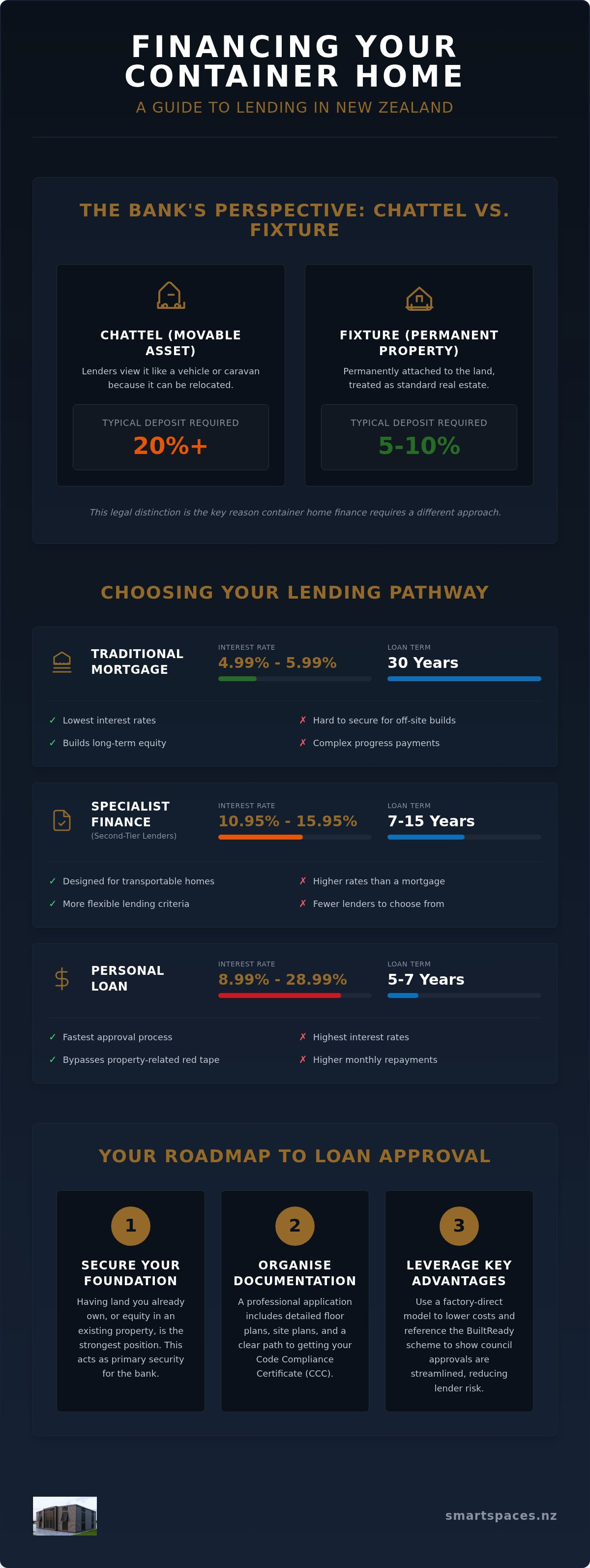
In New Zealand law, there is a vital distinction between a "chattel" and a "fixture". A chattel is a movable piece of property, much like a caravan or a vehicle. A fixture is something that is permanently attached to the land. If your container home is designed to be easily relocated, many lenders will categorise it as a chattel. This classification changes the game for your deposit. Instead of the 5% or 10% deposit often seen for first home buyers of traditional builds, you might be asked for 20% or more.
The Building Act also plays a role here. Even if your home is transportable, it must still comply with the New Zealand Building Code to be legally habitable. Lenders will almost always insist on seeing a clear path to a Code Compliance Certificate (CCC). Without this, the home has very little resale value in the eyes of a bank, making them far less likely to approve your application.
Why Traditional Mortgages Can Be Tricky
Most major New Zealand banks prefer "land as security". This means they want the loan tied to a specific section of dirt with a house firmly bolted to it. This creates a catch-22 for factory-built homes. The manufacturer needs payment to build the unit, but the bank won't release the funds until the unit is on-site and connected to services. This is why progress payments for off-site builds are notoriously difficult to arrange through standard mortgage channels.
If you already own land or have equity in a family home, you have a significant advantage. Many Kiwis are now using the equity in their primary residence to fund a 2-bedroom container home as a sleepout or minor dwelling. This avoids the "chattel" lending trap entirely, as the loan is secured against the existing property rather than the new unit itself. For those starting from scratch, seeking guidance via hewettmortgages.co.nz can help you identify second-tier lenders that are increasingly filling the gap by offering terms that specifically cater to the unique timeline of a prefab build.
Choosing the Right Lending Pathway: Mortgages vs Personal Loans
Deciding how to fund your project is a balance between speed and long-term cost. While a standard mortgage offers the lowest interest rates, usually ranging from 4.99% to 5.99% as of August 2026, the administrative hurdles can be significant. If you aren't attaching the unit to land you already own, a personal loan or specialist finance might be your only viable option. Move faster, pay sooner. These pathways allow you to bypass the bank's red tape, but they come with different financial implications that every Kiwi should weigh up before signing on the dotted line.
The total cost of ownership is heavily influenced by your loan term. A 30-year mortgage spreads payments out but accumulates massive interest over time. Conversely, a 5-to-7-year personal loan has higher monthly repayments and interest rates, often between 8.99% and 28.99%, yet it clears the debt much faster. For many, the sweet spot lies with second-tier lenders who offer container home finance New Zealand specifically tailored for transportable dwellings, often with rates between 10.95% and 15.95%.
Personal Loans and Peer-to-Peer Lending
If you're looking at a 2-bedroom container home as an entry-level dwelling or an addition to your property, a personal loan is often the quickest route. In the current NZ market, unsecured loans typically cap out around $50,000 to $100,000. This is often enough to cover the unit itself, especially when buying factory-direct. One of the biggest wins here is the lack of early-repayment penalties. If you're planning to pay the home off aggressively, this flexibility can save you thousands in the long run compared to a rigid bank structure.
Second-Tier Lenders and Specialist Finance
Specialist lenders have stepped up to fill the gap left by mainstream banks. They view prefab and expandable homes as viable security, meaning they'll often lend against the unit itself rather than requiring land as collateral. The application process is straightforward. You'll need a fixed-price contract and a clear site plan. These lenders are particularly helpful if you're planning an off-grid setup. While a big bank might baulk at a home without a standard power connection, specialist providers understand the value of sustainable, independent living. If you're ready to explore these options, you can view our range of 2-bedroom units to get an accurate quote for your lender.
Why Factory-Direct Pricing Makes Financing More Attainable
When you're looking at container home finance New Zealand wide, the total amount you need to borrow is the single most important factor in your approval. Many people don't realise that buying through a traditional retailer often involves a "middle-man tax" that can add 20% or even 30% to the final price tag. These markups don't add any value to the home itself; they simply cover the retailer's overheads and profit margins. By cutting out these extra layers, you keep your loan size smaller and your deposit requirements much more manageable.
Lenders are naturally risk-averse. If you present a loan application for a smaller amount, you instantly become a more attractive prospect. A lower purchase price means you're more likely to meet the bank’s serviceability tests, even if interest rates fluctuate. At Smart Spaces NZ, we leverage 40 years of family-owned experience to streamline our manufacturing and keep costs down. This long-standing heritage acts as a trust signal for both insurance companies and finance providers, who prefer working with established builders who have a proven track record of quality control.
Reducing the Total Interest Burden
The real magic happens when you calculate the long-term savings. If you save $20,000 on the purchase price by going factory-direct, you aren't just keeping that money in your pocket today. You're also avoiding the interest that would have accumulated on that $20,000 over the life of your loan. On a standard 10-year personal loan at 12%, that initial $20,000 saving could actually prevent you from paying an additional $14,000 in interest alone. You can learn more about how this works in our guide on Smart Spaces NZ: Why Factory-Direct Pricing Benefits You.
Predictable Costs for Better Budgeting
Banks and second-tier lenders hate surprises. One of the biggest hurdles with traditional on-site construction is the "cost-plus" contract, where prices can spiral due to weather delays or material shortages. Container homes built in a controlled factory environment offer a refreshing alternative: the fixed-price contract. When you provide your loan officer with a clear, comprehensive quote for a 2-bedroom container home, they see a project with defined boundaries and no hidden costs. This predictability makes the container home finance New Zealand process significantly smoother, as the lender knows exactly what the asset is worth from day one.
How to Organise Your Finance Application for Success
Approaching a lender for container home finance New Zealand is about more than just asking for money; it's about proving you have a viable, well-researched plan. Banks and finance companies are much more likely to approve your application if you present it as a professional "Project Pack". This shows you've considered the logistics, not just the purchase price. When you walk into a meeting with a folder full of facts, you shift the conversation from a high-risk request to a solid investment opportunity.
The process starts with gathering your documentation in a methodical way. Follow these four steps to build your case:
Step 1: Secure a comprehensive quote and floor plan from your supplier to define the exact scope of the build.
Step 2: Prepare a "Section Plan" that illustrates where the home will sit, including access for delivery.
Step 3: Organise your proof of income and a detailed debt schedule to prove you can comfortably manage the repayments.
Step 4: Compile these into a Project Pack that addresses every potential question a loan officer might have before they even ask it.
What Lenders Want to See in Your Project Pack
Your pack needs to include deep technical specifications for the unit. Lenders need to verify the build quality and its compliance with the Building Act. If you're planning for a permanent fixture, include your pathway for council consent or a "Certificate of Acceptance". Don't forget to include delivery and installation quotes. Showing the "total project cost" prevents the bank from worrying about hidden expenses. This transparency builds trust and shows you're a reliable partner in the project.
Common Pitfalls to Avoid
One of the most frequent mistakes is applying for a standard mortgage before confirming if the unit is legally "transportable". If it stays on wheels or is easily moved, the bank might reject a mortgage application outright, requiring you to pivot to a personal loan. Another trap is underestimating site works. Foundations, plumbing, and electrical connections can cost between NZ$20,000 and NZ$50,000 depending on your land. If these aren't in your budget, your lender will see a gap in your planning. Finally, always mention your builder's 3-year structural warranty. This provides the lender with peace of mind that the asset is protected. If you're ready to start building your Project Pack, request a detailed quote and floor plan from our team to get the ball rolling.
Partnering with Smart Spaces NZ for Your New Zealand Home
Choosing the right builder is the final piece of the puzzle when securing your property. When you embark on the journey of securing container home finance New Zealand wide, you need a partner who understands the specific technical requirements that banks and second-tier lenders demand. We don't just provide a shell; Smart Spaces NZ offers a complete support system designed to move you from an initial enquiry to a site-ready delivery with minimal stress. Our team ensures that every piece of paperwork, from structural specifications to floor plans, is ready for your loan officer's review.
Our range of 2-bedroom container and expandable homes represents the pinnacle of modern, efficient living. These units are crafted to exceed the New Zealand Building Code standards, providing the durability and asset value that lenders look for when assessing risk. By working closely with Smart Spaces NZ, you gain access to decades of industry knowledge, helping you avoid the common pitfalls that often lead to finance delays. We take pride in our straightforward approach, ensuring your project aligns perfectly with the budget and timeline established in your finance application.
A Legacy of Reliability
Trust is a vital currency in the lending world. Smart Spaces NZ brings 40 years of family-owned craftsmanship to every project, a fact that carries significant weight with finance companies. Lenders are far more comfortable approving container home finance New Zealand when the builder has a long-standing, local reputation for integrity and stability. We've seen the industry evolve and have consistently adapted our methods to provide the best value for our customers. This history of reliability means we can provide the no-nonsense service you need to get your project across the line. For more insights into the market, you can read our Smart Spaces NZ: The Ultimate 2026 Buying Guide.
Ready to Start Your Journey?
The first step toward your new home is gathering the facts for your Project Pack. We encourage you to request a formal, fixed-price quote from Smart Spaces NZ that you can include in your finance application. This document is a vital component for lenders, as it clearly outlines the scope and cost of your build without the risk of "cost-plus" surprises. If you'd like to see the quality of our craftsmanship firsthand, we welcome you to book a viewing of our current units. Seeing the space in person often provides the clarity needed to make a final decision on your layout. When you're ready to take that next step, Contact the team at Smart Spaces NZ today to discuss your vision and start building your future.
Secure Your Future in a Smart Space
Turning the vision of a streamlined, modern dwelling into reality is ultimately about preparation and choosing the right financial pathway. We have explored how the shift from a mobile unit to a fixed dwelling can unlock standard mortgage options, and how second-tier lenders provide the flexibility needed for off-site builds. By focusing on a fixed-price contract and a comprehensive Project Pack, you remove the uncertainty that often makes banks hesitant. Empowering yourself with these tools ensures that container home finance New Zealand becomes a bridge to your new lifestyle rather than a barrier.
At Smart Spaces NZ, we back every build with over 40 years of family-owned industry experience, ensuring you receive factory-direct value without compromising on durability. From our manufacturing base to your section, our nationwide delivery service ensures your 2-bedroom home arrives ready for installation. We take pride in being a reliable partner for Kiwis looking to escape the traditional housing trap through honest, straightforward service. If you're ready to move from planning to action, enquire about our container home finance options today. Your journey to a more flexible, sustainable future starts with a single conversation.
Frequently Asked Questions
Can I use my KiwiSaver to buy a container home in New Zealand?
You can generally use KiwiSaver for a container home if it is part of your first home purchase and will be permanently fixed to a site. If the unit is treated as a movable asset or chattel, it may not qualify under current first-home withdrawal rules. It's best to consult your KiwiSaver provider early to ensure your specific build meets their criteria for a residential dwelling on a permanent foundation.
Do NZ banks offer mortgages for tiny homes on wheels?
Most major New Zealand banks do not offer traditional mortgages for homes on wheels because they are classified as vehicles rather than real estate. Lenders require the security of land to issue a home loan. If your dream home remains mobile, you will likely need to explore personal loans or specialised asset-backed finance rather than a standard 30-year mortgage structure that requires a fixed foundation.
What is the typical deposit required for a container home loan?
The deposit required for container home finance New Zealand typically ranges from 10% to 20% if the home is being fixed to a section as a permanent dwelling. If you are using a personal loan for a transportable unit, you might not need a deposit at all, provided your income and credit score meet the lender’s requirements for the full purchase price of the unit.
How do interest rates for prefab home finance compare to standard home loans?
Interest rates for prefab finance are generally higher than standard mortgage rates because the loans are often shorter-term or unsecured. While a mortgage might sit around 5% to 6%, personal or specialist loans for container homes often range from 9% to 15%. However, because the total loan amount is usually much smaller, your monthly repayments may still be more affordable than a traditional house with a massive mortgage.
Can I get finance for both the land and the container home together?
You can finance both together, but it requires a specific type of construction loan. Many banks are hesitant to release funds for a factory-built unit until it is delivered and fixed to the land. You may need a lender that allows turnkey finance or a specialist provider that understands the unique milestones of off-site manufacturing and the subsequent delivery and connection to your site services.
What happens if my finance is declined by a major bank?
If a major bank declines your application, don't lose heart. Second-tier lenders and peer-to-peer finance providers are often more flexible with transportable assets. These lenders specialise in the container home finance New Zealand market, looking at the value of the unit itself as security. Their approval criteria are often more realistic for modern, innovative building methods that don't fit the traditional, rigid banking box.
Does Smart Spaces NZ offer in-house finance or payment plans?
Smart Spaces NZ provides finance solutions by partnering with specialised lenders like Mortgage Suite Ltd who understand the prefab market. While we don't act as a direct bank, our team assists you throughout the application process. We supply the comprehensive quotes, floor plans, and technical specifications your lender needs to approve your loan, ensuring your project pack is professional and meets all the necessary standards for a successful application.
How long does the finance approval process usually take for a prefab?
Finance approval for a prefab home typically takes between two and ten working days, depending on the lender and the complexity of your project. Personal loans are often approved much faster than traditional mortgages. Having your Project Pack ready with a fixed-price quote and site details will significantly speed up the process, allowing the lender to make a quick and informed decision on your application.



Comments