

Container Home Cost New Zealand: The 2026 Pricing and Budgeting Guide

Updated: Aug 31
What if the most expensive part of your new build isn't the house itself, but the "invisible" paperwork and site prep you haven't even considered yet? Many Kiwis are drawn to the idea of a modular lifestyle for its simplicity, but the actual container home cost New Zealand families face can be a moving target if you aren't prepared. It is easy to feel overwhelmed by the gap between a cheap steel shell and a liveable, council-approved home. You might be worried about transport logistics or those notorious council consent delays that seem to haunt every project.
We understand that you want a straightforward path to your new lifestyle without the nasty financial surprises. This guide provides a comprehensive breakdown of the total investment required, from the benefits of factory-direct 2-bedroom configurations to the reality of site-readiness. We will explore how to navigate NZ building codes with confidence and budget for often-overlooked expenses like crane access and utility connections. By the end of this article, you will have a realistic framework to organise your finances and finally move toward the freedom of a high-quality, durable home that fits your budget perfectly.
Table of Contents
Understanding the Baseline: What Determines Container Home Cost in New Zealand?
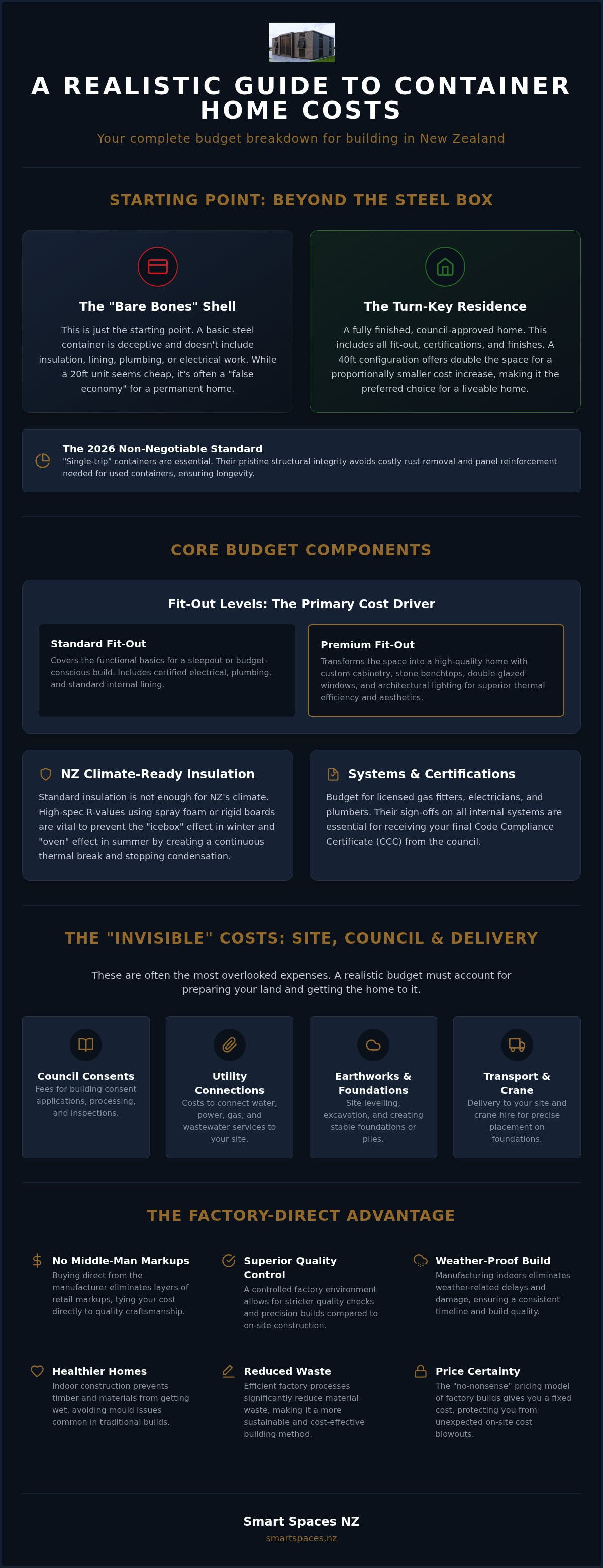
The starting point for any budget is understanding that the price tag on a basic shell is just the beginning of the journey. For many Kiwis, the initial container home cost New Zealand can be deceptive if you only look at the steel box itself. A 20ft unit often appears as the most affordable entry point, but it's frequently a "false economy" for those seeking a permanent residence. A 40ft configuration provides double the space for a relatively small increase in the base structure cost, making it the preferred choice for families wanting a separate lounge and kitchen area.
In 2026, "single-trip" containers have become the non-negotiable standard for residential projects. These units have only carried one load of cargo, meaning the structural integrity is pristine and the surfaces are free from the heavy rust found in retired shipping stock. While you might save a few thousand dollars on a used container, the labour required to grind back corrosion and reinforce weakened panels usually negates those savings. High-quality Shipping container architecture relies on a solid foundation; starting with a fresh, straight shell is the smartest way to ensure your home lasts for generations.
The Shell vs. The Home: Fit-out Levels
A standard fit-out covers the functional basics like certified electrical wiring, plumbing, and internal lining. It's a practical solution for those on a tight budget or looking for a simple sleepout. However, a premium fit-out is where the space truly begins to feel like a home. This level of finish includes custom cabinetry, stone benchtops, and architectural lighting that elevates the aesthetic. These fit-out decisions are the primary drivers of your total 2 bedroom container home NZ investment. Choosing high-spec joinery and double-glazed windows isn't just about looks; it's about creating a thermally efficient environment that stands up to the local climate.
Raw Material Fluctuations in 2026
Global steel prices continue to influence the local market, but the move toward factory-direct manufacturing has helped stabilise costs for the end user. Buying directly from the manufacturer eliminates the layers of retail markups that often inflate prices in the traditional building sector. Because the manufacturing happens in a weather-protected, controlled environment, we can maintain strict quality control and reduce material waste. This efficiency is why 2026 is seeing a massive shift toward modularised container solutions. It allows for a "no-nonsense" pricing model where the container home cost New Zealand buyers pay is tied directly to quality craftsmanship rather than unpredictable on-site delays.
The Components of a Container Home Budget
Once you've secured your shell, the focus shifts to the complex internal systems that transform a steel box into a liveable sanctuary. Budgeting for the container home cost New Zealand councils require means looking closely at certified installations. Understanding the total container home cost New Zealand families face involves more than just the fit-out; it's about the quality of the systems hidden behind the walls. Unlike a traditional timber frame, every penetration in a steel wall must be precision-cut and sealed to maintain structural integrity. You'll need to account for licensed gas fitters, electricians, and plumbers to sign off on their work; this is essential for your final Code Compliance Certificate.
Insulation is another area where you simply cannot cut corners. New Zealand's damp winters and high UV levels mean that "standard" insulation often isn't enough. High-spec R-values are vital to prevent the "icebox" effect in winter and "oven" effect in summer. We recommend using high-density spray foam or rigid board insulation that creates a continuous thermal break between the steel and your internal lining. For enhanced protection, builders often integrate high-quality foil insulation from CargoCare NZ to manage radiant heat. This prevents condensation from forming on the inside of the container walls, protecting your health and your investment.
Kitchen and Bathroom Standards
The kitchen and bathroom are usually the most expensive rooms per square metre. While standardised cabinetry is a great way to keep costs predictable, many homeowners opt to splurge on stone benchtops or custom storage solutions to maximise the limited footprint. For water heating, gas califonts are popular for their space-saving "instant" hot water, though electric cylinders remain a reliable alternative if you have the floor space. Choosing the right balance here ensures your home remains functional and comfortable. If you are starting to plan your layout, you can explore our floor plans to see how these spaces fit together.
Joinery and Glazing Requirements
Joinery is often where a budget can spiral if not managed carefully. Double glazing is now a non-negotiable requirement under the NZ Building Code, and for good reason. It's the primary defence against heat loss. While standard sliding doors are the most cost-effective option, architectural bifold doors offer that seamless indoor-outdoor flow Kiwis love, albeit at a higher price point. Strategic window placement is also key. Positioning larger panes on the northern side of your home will harness passive solar gain, helping to lower your long-term energy bills while keeping the interior bright and airy.
Finally, consider the "extras" that make a house a home. Adding a timber deck or a pergola doesn't just increase your living space; it changes the entire silhouette of the building. External cladding, such as cedar or modern composite panels, can also be added to satisfy specific council aesthetic requirements or simply to help the home blend into a rural landscape.
The Invisible Costs: Consents, Site Prep, and Transport
The sticker price on a factory floor is only one part of the equation. To accurately calculate the container home cost New Zealand buyers will ultimately pay, you must factor in the "soft costs" that occur before the unit even arrives on site. These invisible expenses often catch first-time builders off guard, transforming a seemingly affordable project into a complex financial puzzle. From the moment you decide on a site, the clock starts ticking on professional fees and council requirements.
Site preparation is the first hurdle. Whether you are opting for traditional timber piles or a concrete slab, the land must be ready to receive a heavy steel structure. Earthworks vary wildly depending on the slope of your section and soil stability. If your land requires retaining walls or extensive drainage, these costs can quickly rival the price of the home's fit-out. Utility connections are another major variable. Bringing power, water, and sewage to a remote part of a property involves trenching and professional installation, which must be completed to local standards before the home can be signed off.
Navigating NZ Tiny Home Regulations
Council fees are more than just a simple application charge. In the NZ context, you'll likely deal with both building consents and, in some cases, resource consents. Understanding NZ tiny home regulations is essential for budgeting, as it helps you identify costs like the MBIE levy, which is $1.75 per $1000 for work valued over $64,999. You should also budget for the BRANZ levy (0.1% + GST) for projects $20,000 and over, plus the DBH levy (0.175%) for projects $65,000 and over. Don't forget development contributions; these are a form of "hidden tax" some councils charge to fund local infrastructure, and they can add thousands to your final tally.
Transport and Delivery Logistics
The journey from the factory to your foundations is a precision operation. Distance is the primary driver of the delivery fee, but the complexity of your site access is a close second. While a standard hiab truck can handle many deliveries, difficult sites with steep driveways or low-hanging trees may require a specialised crane. This can significantly increase the container home cost New Zealand homeowners face during the final stage. We always recommend securing transit insurance to protect your investment during the move. It's a small price to pay for peace of mind while your new home is on the road.
Financing and ROI: Is a Container Home a Good Investment?
Deciding to build is as much a financial calculation as it is a lifestyle choice. While the initial container home cost New Zealand buyers encounter is lower than traditional builds, the way you fund that investment and its long-term performance matters most. Many people ask if these structures appreciate like a standard house. In the current market, a well-built, council-consented container home functions much like a secondary dwelling, a "granny flat", or even a dedicated home office. For those setting up a workspace, choosing quality preowned solutions from Smart Buy Office Furniture can help you create a professional environment while keeping your overall fit-out costs low. This adds immediate value to your existing title; it often provides a higher return on investment than a simple renovation or extension.
Banks can be cautious about relocatable structures because they aren't always considered permanent fixtures until they are fixed to the land. This is why understanding container home finance New Zealand options is so vital. To navigate these complexities, working with experts like Mortgage Suite Ltd can help you find the right financing solution for your specific project. Most lenders will require a fixed-price contract before they even look at an application. If you already own property, using equity to fund the build is often the most cost-effective path. Otherwise, specialised lenders offer personal or chattel loans with interest rates typically ranging from 9.95% to 26.95% p.a., depending on your credit profile. You will generally need a deposit of 10% to 20% to get started.
Your monthly power bills are a key part of the ROI equation. By investing in high R-value insulation during the build, you create a thermally efficient space that requires minimal heating. If you live in a coastal environment, the salt air is your primary concern. A simple annual wash-down and checking for any chips in the exterior paint will protect the steel from corrosion for decades. The resale market for high-quality, transportable homes is growing rapidly; more Kiwis are looking for affordable ways to enter the property market without the stress of a massive mortgage.
If you are ready to see how a durable, factory-built home can fit into your financial plan, view our current 2-bedroom container home models today.
Smart Spaces NZ: The Factory-Direct Advantage
Choosing the right partner is just as critical as the budget itself. While we've explored the various layers of the container home cost New Zealand buyers must manage, the factory-direct model offers a level of certainty that traditional on-site builds simply can't match. By manufacturing in a controlled, weather-protected environment, we eliminate the costly delays caused by the unpredictable Kiwi climate. There are no rain-soaked timber frames or muddy site hold-ups here. Instead, our team works with precision and efficiency, ensuring that every weld and join meets our rigorous standards before the unit ever leaves the floor.
Our 40-year legacy as a family-owned business is built on straightforward dealings and personal integrity. We've seen the industry evolve, and we've refined our process to remove the middle-man markups that often inflate prices. This direct connection means you aren't paying for corporate layers or retail commissions; your investment goes directly into the craftsmanship and durability of your home. We specialise in 2-bedroom configurations because they represent the perfect balance of liveability and value, providing a high-quality housing solution that remains accessible to everyday Kiwis.
Predictable Pricing in a Volatile Market
The benefits of this modular approach extend beyond residential use. For those requiring larger-scale commercial or industrial facilities, A1 Precision Solutions offers complete turnkey solutions across Australia, maintaining the same high standards of precision and efficiency.
One of the biggest risks in any construction project is the "cost-plus" trap, where unexpected expenses are passed directly to the homeowner. We believe in a more honest approach. Providing fixed-price contracts is the safest way to buy container home New Zealand wide. This transparency allows you to organise your finance with confidence, knowing exactly what your container home cost New Zealand project will require from day one. For those looking to manage their overall expenses carefully, using WINZ-approved services like Stoddard Dental Square for dental care can provide further financial certainty. We also handle the complex logistics of delivery, coordinating transport and site arrival to keep the entire process as stress-free as possible.
Sustainable Living Without the Price Tag
Repurposing steel containers is a naturally eco-friendly choice, but the sustainability of our method goes further. Modular construction significantly reduces on-site waste, as materials are measured and cut with factory precision. This efficiency doesn't just help the planet; it keeps your costs down. You're left with a high-performance home that features superior insulation and modern finishes, all while fitting a modest budget. It's about providing the tools for a better, freer lifestyle without the burden of an oversized mortgage or the waste of traditional building methods.
Ready to Build Your Modular Future?
Understanding the total container home cost New Zealand families face is the first step toward reclaiming your independence. We've explored how a factory-direct model provides the predictability you need in an uncertain market, while budgeting early for site preparation and council consents ensures there are no surprises down the track. Whether you are looking for a high-yield rental or a durable family home, a 2-bedroom container residence offers a practical "sweet spot" for both liveability and long-term value.
With 40 years of family-owned experience, we're here to guide you through every stage of the process. From providing factory-direct pricing to offering tailored finance solutions, we stand firmly behind the quality of our work. It is time to stop worrying about construction delays and start envisioning a simpler, more flexible lifestyle. View our range of affordable container homes and get a quote today and see how easy it is to bring your vision to life. Your new home is closer than you think.
Frequently Asked Questions
How much does a basic 2-bedroom container home cost in NZ?
A professionally built 2-bedroom unit typically ranges from NZ$80,000 to NZ$250,000 depending on the level of fit-out and internal specifications. While basic shells are more affordable, a liveable home requires certified plumbing, electrical systems, and high-spec insulation. Choosing a factory-direct model helps keep the container home cost New Zealand buyers pay more predictable by eliminating retail markups. The final price will always reflect the quality of materials and the complexity of the internal configuration.
Do I need a building consent for a container home on my land?
Yes, you generally require building consent for any permanent container dwelling to ensure it complies with the New Zealand Building Code. Some councils may also require a resource consent depending on your land's zoning and the home's placement. Many local councils require a deposit for a simple residential Project Information Memorandum (PIM), which can be upwards of $500. Always consult your local council early to avoid delays and unexpected compliance costs during the build.
Can I get a standard home loan for a container house?
Traditional bank mortgages are often difficult to secure for container homes because they are frequently classified as relocatable or non-permanent structures. Most buyers utilise specialised lenders or personal loans, with interest rates typically ranging from 9.95% to 26.95% p.a. depending on your credit history. Lenders like Squirrel or Loan Smart often provide tailored solutions, but you should expect to provide a deposit of 10% to 20% to secure the funding.
What are the most common "hidden costs" when installing a container home?
The most frequent "invisible" expenses include council levies, site preparation, and utility connections. You must budget for the MBIE levy ($1.75 per $1000 for works over $64,999) and the BRANZ levy (0.1% + GST for projects over $20,000). Additionally, earthworks for foundations and the cost of hiring a crane for difficult site access can add thousands to your total container home cost New Zealand budget if not planned for in advance.
How long does a container home last in New Zealand conditions?
A high-quality container home built from a "single-trip" shell can last for 50 years or more with proper maintenance. Steel is incredibly durable, but it requires protection from the elements, especially in coastal areas. Regular wash-downs to remove salt spray and prompt touch-ups of any paint chips will prevent corrosion. When combined with modern, high-spec insulation and quality joinery, these structures provide a robust, long-term housing solution that stands up to New Zealand's seismic activity.
Is it cheaper to build a container home or a traditional prefab?
Container homes typically offer 30% to 50% savings compared to traditional timber-frame construction or some bespoke prefabs. The primary saving comes from the structural shell already being complete, which reduces labour time on-site. However, the final cost gap narrows once you factor in premium internal fit-outs and architectural cladding. The true value lies in the speed of the build and the predictability of manufacturing in a controlled factory environment rather than on an exposed site.
What kind of foundations are required for a shipping container home?
Most container homes in New Zealand are installed on either timber piles or a concrete slab. Concrete foundations provide a permanent feel but are more expensive and difficult to modify. Timber or steel piles are often the preferred choice for relocatable units as they allow for easier transport if you decide to move the home later. Your choice will depend on your land's soil stability, the slope of the section, and specific engineering requirements for seismic resilience.
Does a container home add significant value to my existing property?
Adding a 2-bedroom container home can significantly increase your property's value by providing a secondary dwelling or "granny flat" option. This creates immediate rental yield potential or extra space for multi-generational living, which is highly sought after in the current housing market. Because they are durable and modern, they tend to hold their value well. They represent a smart investment for homeowners looking to maximise their land's utility without the stress of a full-scale renovation.



Comments