

Buying a Marquee for a Wedding Venue: 2026 Buying Guide

Updated: 16 hours ago
A wedding marquee is venue infrastructure, not seasonal décor. If you’re buying a marquee for a wedding venue, the right choice needs to do more than look the part: it should suit your site, support the guest experience and work for the events you plan to host.
It’s easy to focus first on style and capacity. But a marquee that works for one wedding may not suit another. Ground conditions, access, weather exposure and setup needs all affect what’s practical on your property. Consider these details before you buy to reduce the risk of a poor fit later.
This 2026 guide compares A-frame, hip-end frame and pole-and-peg marquees, and covers size, layout, site and compliance factors in New Zealand. It also offers a practical framework for weighing the purchase against ongoing venue use, so you can decide whether a marquee fits your long-term event offering.
Table of Contents
Buying a Marquee for a Wedding Venue: When Ownership Makes Sense
Choose a Wedding Marquee Structure Around the Guest Experience
Which Wedding Marquee Features Matter for Regular Venue Use?
Check Your New Zealand Venue Site Before Buying a Wedding Marquee
Make the Wedding Marquee Purchase Work for Your Venue Long Term
Buying a Marquee for a Wedding Venue: When Ownership Makes Sense
Should your venue own a consistent event space or arrange a hired structure for each booking? The answer depends on your calendar, site and the work your team can take on. A marquee can extend the usable event area beyond an existing function room, creating space for a reception, a wet-weather option or a distinctive setting for the day.
Buying a marquee for a wedding venue is a long-term operating decision, not an automatic way to save money. The value depends on how often you’ll use it, what hiring involves for your events and whether you have the space and people to care for it between bookings. Familiarity with the range of modern tent structures can help frame the decision, but your venue’s event programme should come first.
Does buying suit your wedding venue’s event calendar?
Look beyond your busiest month. Map expected weddings across the year, note seasonal demand and consider whether the structure could serve other suitable venue events. For venues expanding into corporate gatherings or brand activations alongside weddings, modular printed backdrops and custom soft signage from zodiacdisplays.com offer an easy way to transform the space between clients. Recurring bookings make a stronger case for ownership than occasional requests that require an unusual size or layout. A marquee that’s ready for regular use can also make event planning and presentation more consistent.
Separate your core offer from exceptions. If most couples need a similar reception space, a venue-owned marquee may support that experience. If demand is sporadic or each event calls for a very different setup, hiring may preserve flexibility without adding storage and upkeep responsibilities.
What ownership changes for the venue team
Ownership gives you control over when the structure is available and how it fits into your wedding offering. A consistent marquee can help your team plan layouts, coordinate suppliers and create a recognisable event setting. Smart Spaces NZ sells A-frame, hip-end frame and pole-and-peg marquee structures for venues considering a commercial marquee.
That control comes with practical responsibilities. Your team needs a plan for storage, care, setup and checking the marquee is ready for each event. Weigh both sides before deciding:
Potential advantages: predictable access for booked events, more control over presentation and a repeatable space that can extend venue capacity.
Responsibilities to consider: storage space, ongoing upkeep, staff time for preparation and the risk of limited use.
There’s no universal break-even point. Compare likely use with the full demands of ownership, not just the purchase itself. For venues with regular bookings, suitable storage and a team able to manage preparation, a marquee may become a dependable part of the event programme. For occasional use, hiring may be more practical; if you want to explore professional marquee and canopy hire solutions, visit VMS Event Rental (VMS Group).
Choose a Wedding Marquee Structure Around the Guest Experience
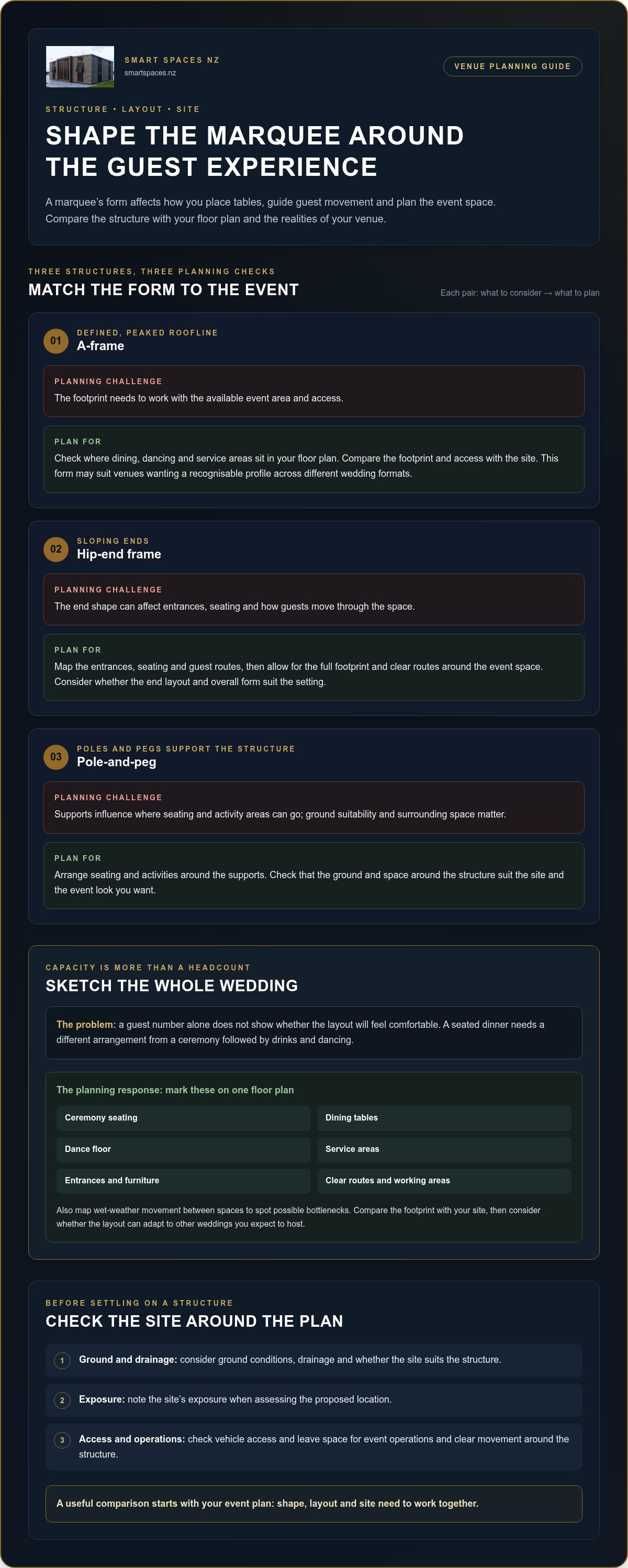
A marquee’s shape affects more than its appearance. It influences how you arrange tables, create a clear route between the ceremony and reception, and give guests room to mingle or dance. Choose a structure for the way people will move through the day, not just for how it looks.
A-frame, hip-end frame or pole-and-peg: what changes?
These categories have different structural forms, and the right fit depends on the look you want and the realities of your venue. An A-frame has a distinct peaked profile; a hip-end frame has sloping ends; a pole-and-peg marquee uses poles and pegs as part of its support. Use these differences as a starting point, then compare each structure with your site and event plan.
Plan capacity around more than a guest count
A guest number alone won’t show whether a layout will feel comfortable. Sketch a representative wedding, including ceremony seating, dining tables, a dance floor, service areas and clear routes for moving through the space. A seated dinner, for example, needs a different arrangement from a ceremony followed by drinks and dancing. Map wet-weather movement, too, so guests can move between spaces without bottlenecks.
Mark entrances, furniture and working areas on the same plan. Compare the footprint with your site, then consider whether the layout can adapt to other weddings you expect to host. This gives you a more useful basis for buying a marquee for a wedding venue than guest capacity alone.
Smart Spaces NZ sells commercial marquee structures in A-frame, hip-end frame and pole-and-peg categories. Use your draft floor plan to compare the options and choose the form that best supports your venue’s guest experience.
Which Wedding Marquee Features Matter for Regular Venue Use?
For a venue marquee, appearance is only part of the decision. Consider how the frame and cover are made, how the structure will be handled between bookings and what your team needs to prepare it for the next event. A detail that seems minor at a single celebration can matter more when staff repeat the same setup and pack-down process across a busy season.
Before purchase, assess frame and cover quality, care requirements, storage needs, event changeovers, access and product-specific technical documentation.
Durability, weather and upkeep over repeated events
Think through the full cycle of use: setup, event operation, cleaning, pack-down and storage. Consider how each step fits your staffing and facilities, and whether the components can be inspected and cared for as part of your venue routine. Commercial event equipment specialists such as Advent.lt highlight that durable engineering and straightforward handling are critical for infrastructure subjected to repeated use. A planned storage area can also help protect marquee components and keep them organised between weddings.
New Zealand conditions vary by site and season, so consider your venue’s exposure rather than relying on a broad claim that a structure suits every situation. Wind performance, anchoring requirements and material properties should be supported by specifications for the particular structure. Treat general sales language as a starting point, not a replacement for product-specific information.
Features that make wedding changeovers practical
Walk through the work your team does between events. Where will guests enter? How will staff move between dining, service and dancing areas? Consider access points and walling options for the structure you’re assessing, and plan how those choices affect guest flow, privacy and the layout.
Separate operational essentials from styling extras. A layout that supports a ceremony one day and a reception another may be more useful than decorative additions that don’t improve function. Check that any proposed configuration works with the selected structure, including how it accommodates audiovisual and lighting requirements; technical production providers like LivewireAV note that integrating lighting and sound early is vital for seamless event execution. Don’t assume every entrance, wall arrangement or layout option applies to every marquee category.
Frame and cover: review construction details and documentation for the specific structure.
Care and storage: plan cleaning, inspection, handling and protected storage between bookings.
Changeovers: consider access, staff movement and how the venue shifts between event formats.
Technical claims: look for product-specific evidence on material properties, wind performance and anchoring.
Optional extras: prioritise features that support practical operations before decorative upgrades.
For venues buying a marquee for a wedding venue, this checklist keeps the focus on repeat use. Smart Spaces NZ sells A-frame, hip-end frame and pole-and-peg marquees designed for durable, weather-resistant use. Product-specific technical details can help you assess a structure against your site and operating needs.
Check Your New Zealand Venue Site Before Buying a Wedding Marquee
A structure can suit your event plans on paper and still be a poor fit for the property. Before buying a marquee for a wedding venue, walk the site and map how the structure, guests, staff and vehicles will use it. Ground conditions, drainage, exposure and access all affect whether the space will work for regular events.
Assess the site, ground and event access
Use this pre-purchase sequence to turn a site visit into a practical plan:
Map the footprint. Mark the proposed marquee area alongside guest entrances, catering access and clear routes for event operations and emergencies.
Read the ground. Note the surface, slope and drainage, including areas that become wet or difficult to use in poor weather. Record wind exposure and other site conditions rather than assuming one structure suits every position.
Trace vehicle access. Consider how the structure and event equipment could reach the area. Check turning space, access restrictions and whether vehicles can approach without crossing guest areas.
Plan the event layout. Allow for entrances, furniture, service activity and guest movement, then test the arrangement against the actual footprint.
Plan storage and preparation. Identify where components can be stored and how your team will move, organise and prepare them between events.
Check compliance. Review the proposed use, floor area and intended duration against current official guidance and relevant council requirements.
Plan for compliance and ownership logistics
New Zealand building consent requirements can depend on a marquee’s floor area and how long it will remain in place. Ministry of Business, Innovation and Employment guidance states that a marquee may be exempt from building consent if it is no more than 100 square metres and in place for less than one month; larger or longer-term installations require consent. Treat this as a prompt to check current official guidance for your specific project, not as a substitute for assessing other site or event obligations.
Temporary event use and a structure kept in place as part of a venue’s regular offering may raise different planning questions. Check the relevant requirements before settling on a location or ownership plan. For broader product-selection context, read the New Zealand commercial marquee buying guide.
Once you’ve completed your site checklist, explore Smart Spaces NZ marquee options and compare the available structure categories with your venue plan.
Make the Wedding Marquee Purchase Work for Your Venue Long Term
A sound purchase starts with your venue’s actual event programme, not a wish list of features. Match the structure to the weddings you expect to host, then test your choice against the site, storage and upkeep your team can manage. This makes buying a marquee for a wedding venue a considered investment in the event experience you want to deliver over time.
Build a venue-specific purchase brief
Write down the details that will shape everyday use. Include typical guest numbers, the layouts you regularly need, how often the marquee could be used and the site’s practical limits. Note whether your programme centres on seated receptions, ceremonies followed by dining, or a mix of formats. Base the brief on booking patterns and venue priorities rather than additions you may rarely use.
Use that brief to compare structure categories and practical features. A-frame, hip-end frame and pole-and-peg marquees each have a different form. Assess them against your preferred event look, planned layout and site. The chosen configuration should support how guests and staff use the space, while storage and upkeep need to fit your operating routine.
Turn the decision into clear next steps
Bring the main parts of the decision together before moving ahead:
Event brief: record typical guest numbers, event formats and likely use frequency.
Structure choice: identify the category that best supports your events and preferred presentation.
Site plan: account for the footprint, access, ground conditions, storage and relevant compliance checks.
Ownership plan: assign responsibility for preparation, care and readiness between bookings.
Then weigh repeat bookings and your wider event mix against the time and space needed to own and maintain the structure. Regular use and a workable storage plan may strengthen the case for ownership; occasional demand or limited operational capacity may point to a different approach. For a broader perspective, read marquee structures for commercial excellence.
Smart Spaces NZ sells commercial A-frame, hip-end frame and pole-and-peg marquees factory-direct, with more than 40 years of family-owned industry experience. Explore marquee options for your venue and compare them with your event brief and site plan.
Turn Your Venue Plan Into a Confident Next Step
The best marquee choice starts with the weddings you want to host, then works back through layout, site conditions and the practical demands of ownership. Assess repeat bookings, storage and upkeep alongside the guest experience to make buying a marquee for a wedding venue a considered long-term decision, not a choice based on appearance alone.
Smart Spaces NZ sells commercial A-frame, hip-end frame and pole-and-peg marquees through factory-direct sales. As a family-owned business with over 40 years of industry experience, Smart Spaces NZ offers a range of structures to compare against your venue brief and site plan.
Ready to explore the options? Explore marquee structures for your wedding venue and take the next step towards creating a flexible event space for your team and the couples you host.
Frequently Asked Questions
Is buying a marquee worthwhile for a wedding venue?
Buying can make sense if your venue has regular bookings that can use a consistent marquee space. Consider your event calendar, the range of weddings you host, and whether you have room and staff time for storage, care and preparation. Compare those responsibilities with the control and availability ownership can bring. If use is infrequent or event requirements vary widely, hiring may be more practical. There’s no universal break-even point.
What type of marquee is best for a wedding venue?
The best fit depends on the guest experience, layout and site you have in mind. A-frame, hip-end frame and pole-and-peg marquees each have a different form, so consider how the structure works with your preferred presentation and event plan. Map entrances, dining, dancing and service areas before deciding. Then compare the proposed footprint and site needs. No single category suits every venue.
How much space do I need for a wedding marquee?
There isn’t one space requirement that suits every wedding. Plan for more than the guest count: include ceremony seating, dining tables, a dance floor, service areas, entrances and room for people to move comfortably. A seated reception needs a different layout from a ceremony followed by drinks and dancing. Sketch a typical wedding plan, then compare the full footprint, including operational access, with the usable space on your property.
Can a marquee be used for weddings in New Zealand weather?
A marquee can support wedding events in New Zealand, but suitability depends on the structure, site, season and conditions on the day. Don’t rely on a broad weather-resistance claim alone. Check product-specific documentation for relevant material, wind-performance and anchoring details, and plan how the venue will manage changing conditions. Consider guest comfort and event operations as well as the structure itself. No marquee should be treated as a guarantee against every weather condition.
What happens if my wedding venue has uneven or exposed ground?
Assess uneven or exposed ground before choosing a structure or setting an event layout. Note the surface, slope, drainage and exposure across the proposed footprint, then consider how these conditions affect access, guest movement and event operations. The site may influence which structure is suitable and how it can be used. Assess relevant technical requirements, including anchoring details, for the specific structure and location rather than assuming one solution fits all.
Do I need consent to install a wedding marquee in New Zealand?
Under New Zealand building consent guidance, a marquee may be exempt if its floor area does not exceed 100 square metres and it is in place for no more than one month. Consent is required if it is larger or remains longer. The landowner is responsible for obtaining any required consent. Check current Ministry of Business, Innovation and Employment guidance and relevant council requirements for your project, as other site or event obligations may also apply.
What should a wedding venue check before buying a marquee?
Start with your event programme: typical guest numbers, layouts and expected frequency of use. Then assess the proposed footprint, ground, drainage, exposure, vehicle access and storage. Review how staff will prepare the structure and manage event changeovers, and consider upkeep between bookings. Compare A-frame, hip-end frame and pole-and-peg categories with your venue’s plans. Finally, check current consent requirements and look for product-specific evidence on technical claims relevant to your site and intended use.



Comments