

Affordable Prefab Homes NZ: The 2026 First Home Buyer’s Guide

What if the key to your first home isn't a million-dollar mortgage, but a smarter way of building that the traditional banks don't want you to focus on? It's exhausting watching your KiwiSaver grow while the median house price stays just out of reach, especially with the OCR sitting at 2.75% and interest rates squeezing every cent from your weekly budget. If you're searching for affordable prefab homes nz, you've likely felt the frustration of a deposit that can't keep up with market growth or the headache of trying to understand complex council regulations.
We believe home ownership should be about freedom, not a lifetime of debt. This guide shows you how to bypass the traditional property trap by combining factory-direct housing alternatives with the latest government support to secure a warm, permanent residence. You'll discover how to leverage the 2026 First Home Loan rules, use your KiwiSaver for a modular build, and navigate the new building consent exemptions for dwellings up to 70m². It's time to stop waiting for the market to change and start building a future that's actually within your reach.
Table of Contents
Navigating the NZ First Home Buyer Market in 2026
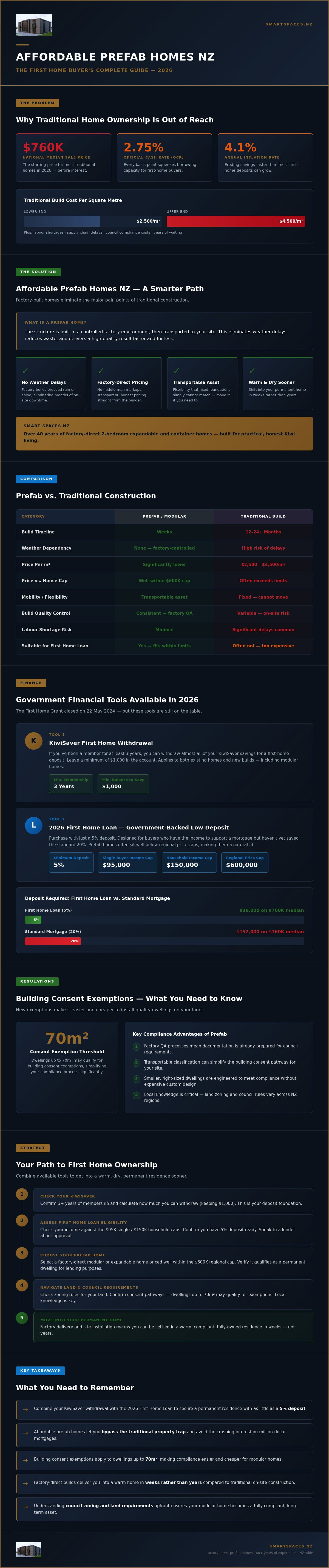
The property market in 2026 is a different beast than it was even five years ago. While the national median sale price has settled around $760,000, the true hurdle for first-home buyers isn't just the price tag. It's the cost of borrowing and the sheer weight of a traditional mortgage. With the Official Cash Rate sitting at 2.75%, securing a massive loan for a standard three-bedroom build often leads to financial lock-in that lasts decades. Many Kiwis are realising that the old dream of a quarter-acre section with a custom-built house is becoming a debt trap rather than a pathway to wealth.
Getting your foot in the door today requires a change in strategy. It's no longer about finding the biggest house you can afford, but about finding the smartest build type for your budget. This shift toward "right-sized" living is a permanent solution for many, providing a high-quality, warm residence without the crushing interest rates of high-value loans. By looking at affordable prefab homes nz, you can bypass the traditional property trap and focus on building equity instead of just paying off bank interest.
The Problem with Traditional Construction
Building a house the old-fashioned way is becoming increasingly difficult to justify for a first purchase. You're looking at costs between $2,500 and $4,500 per square metre, and that doesn't even account for the inevitable labour shortages and supply chain delays that plague on-site builds. If you take out a high-value loan in today's environment, your borrowing capacity is slashed by rising interest rates and a 4.1% annual inflation rate. Choosing a smaller, high-quality residence is a strategic move. It's about owning your home sooner and keeping your lifestyle intact rather than being "house poor" for thirty years.
The Rise of Modular and Prefab Thinking
New Zealanders are catching up with global trends that favour efficiency over ego. What is a prefab home? Essentially, it involves building the structure in a controlled factory environment before transporting it to its final site. This method eliminates weather delays and reduces waste, which is why affordable prefab homes nz are becoming the go-to for savvy buyers. These transportable assets offer a level of flexibility that traditional foundations simply can't match.
At Smart Spaces NZ, we've spent over 40 years honing a no-nonsense approach to housing. We provide factory-direct 2 Bedroom Expandable and Container homes that cut out the middle-man markups. Whether you're looking for a permanent dwelling or a way to get onto the ladder, our philosophy is grounded in practical, accessible quality. It's about providing a reliable, honest roof over your head that you actually own.
Government Grants and Financial Leg-ups for Modular Homes
Securing the keys to your first property feels like a moving target in 2026. While the First Home Grant was permanently closed on 22 May 2024, don't let that discourage you. Other powerful financial tools are still on the table to help you secure affordable prefab homes nz. The landscape has shifted from direct cash handouts to smarter lending and the strategic use of your own savings. Understanding how to pull these levers is the difference between staying in a rental or finally owning your own warm, dry residence.
KiwiSaver and the First Home Withdrawal
Your KiwiSaver is likely your strongest asset when stepping onto the ladder. If you've been a member for at least three years, you're generally eligible to withdraw almost all your savings to put toward a first-home deposit. You just need to leave a minimum of $1,000 in your account. This applies whether you're buying an existing house or opting for a new build. When it comes to modular homes, the withdrawal can often cover a significant portion of the factory-direct price, especially since these units are priced far more realistically than traditional on-site builds.
The First Home Loan is a low-deposit scheme backed by the government that allows eligible buyers to purchase with just a 5% deposit. This is a game-changer for those who have the income to support a mortgage but haven't yet saved the standard 20%. In 2026, the income caps sit at $95,000 for a single buyer and $150,000 for a household. Because prefab options often sit well below regional house price caps, like the $600,000 limit in many parts of the country, they are a natural fit for this lending criteria.
Combining Loans with Alternative Housing
Navigating the rules for transportable homes requires a bit of local knowledge. Banks and government agencies want to see that your home meets the New Zealand Building Code before they release funds. This is where factory-direct builds shine. Because they are constructed in controlled environments to strict standards, they provide the durability and compliance that lenders demand. You can learn more in our ultimate guide to prefab homes in NZ about how these structures are designed for long-term stability.
Choosing a factory-direct model means you aren't paying for middle-man markups or the overheads of a traditional construction site. This keeps the total project cost lower, making it easier to stay within the First Home Loan price caps. If you're looking for a straightforward, no-nonsense way to use your KiwiSaver, our 2 bedroom expandable homes offer a practical path to ownership. By focusing on high-quality, relocatable assets, you're building real equity without the crushing debt of a million-dollar mortgage.
Prefab vs. Traditional Construction: A Side-by-Side Comparison
Traditional building sites are often chaotic, weather-dependent, and prone to budget blowouts. If you've ever walked past a half-finished frame sitting in the rain for months, you know the frustration of watching a timeline slip away. Factory-direct affordable prefab homes nz turn this model on its head. By building in a controlled indoor environment, we eliminate the variables that drive up costs on traditional sites. You aren't paying for contractors to sit in their utes waiting for a storm to pass. Instead, you're investing in a streamlined process where every piece of material is used with precision.
The timeline difference is massive. While a standard build in New Zealand can often take 12 to 18 months from the first sod turned to the final inspection, a prefab unit can be ready for delivery in a fraction of that time. This speed is a huge win for first-home buyers who are currently paying rent while trying to save. Every month you shave off the construction timeline is a month of rent saved. Quality control is also far superior in a factory setting. Every joint is precise, every seal is tight, and the entire structure is built to withstand the rigours of transport, making it exceptionally durable as a permanent residence.
The Expandable Home Advantage
A 2 Bedroom Expandable Home is a clever piece of engineering that arrives as a compact unit and "unfolds" into a full-sized living space once on-site. It's the perfect entry point for couples or small families who need a functional, modern layout without the massive footprint of a traditional mansion. These homes are designed for rapid setup, meaning you can go from an empty site to a finished home in days. If your life circumstances change, these units remain relocatable assets rather than being fixed to a single piece of dirt forever. You can read more in our Guide to 2 Bedroom Expandable Homes in NZ for more details on these versatile structures.
Container Homes: Modern, Industrial, and Affordable
If you value durability and a modern industrial aesthetic, 2 Bedroom Container Homes are a brilliant choice. These are built from commercial-grade steel, making them incredibly resilient against the diverse NZ climate. They offer a sense of security and longevity that's hard to beat at a budget-friendly price point. Because they are factory-direct, you avoid the heavy markups found in traditional retail housing. Our The Ultimate Guide to 2 Bedroom Container Homes in NZ explores why these units are becoming a top choice for Kiwis looking for a permanent, stylish residence that doesn't break the bank.
Solving the Land and Council Consent Puzzle for Transportable Assets
Owning the house is one thing, but finding a place for it to sit can feel like a whole new challenge. In the 2026 market, many Kiwis are looking beyond the traditional model of buying a massive section and building from scratch. If you're searching for affordable prefab homes nz, you've likely realised that decoupling the house from the land is the fastest way to achieve independence. Whether you're eyeing a small rural pocket or a corner of a family member's section, there are more options available now than ever before.
The regulatory landscape has also shifted in favour of the buyer. In early 2026, new rules were introduced that exempt standalone dwellings up to 70m² from needing a full building consent, provided a Licensed Building Practitioner designs or supervises the work. This is a massive win for first-home buyers. It cuts through the red tape that used to stall projects for months and saves you from the standard council fees that typically range between $3,000 and $8,000. While you still need a Project Information Memorandum from your council, the path to occupancy is much clearer than it was two years ago.
Land Options for First Home Buyers
If buying a section feels out of reach, don't overlook land leasing. This involves placing your home on someone else's land for a set fee, which keeps your initial capital focused on the house itself. You can even use your KiwiSaver for a transportable home on leased land, provided you have a formal lease agreement. Another popular choice is the "backyard option." Placing your first home on a family member’s property allows you to live close to support while building equity in a relocatable asset. Just ensure the site is build-ready by checking that foundations are level and services like water and power are accessible before your home arrives.
Navigating NZ Tiny Home Regulations
The distinction between a "building" and a "vehicle" is a common point of confusion under NZ law. Generally, if your home is fixed to the ground and intended for permanent habitation, it's treated as a building. Choosing a compliant manufacturer is essential because it ensures your home meets the structural and safety requirements of the Building Act from day one. This saves you thousands in potential legal headaches and ensures your asset holds its value for the long term. You can check the NZ Tiny Home Regulations and Consents for a deep dive into the 2026 compliance standards. If you're ready to see how these rules apply to a real build, view our 2 Bedroom Expandable Homes to see how we handle the hard work of compliance for you.
Why Smart Spaces NZ is the Fair Dinkum Choice for First Home Buyers
Trust is the most valuable currency when you're making the biggest purchase of your life. At Smart Spaces NZ, we bring over 40 years of family-owned industry experience to every project. We aren't a faceless corporate entity; we're a team of professionals who value hard work and straightforward dealings. If you're looking for affordable prefab homes nz, you need a partner who understands the local market and stands firmly behind the quality of their craftsmanship. We've seen the housing industry evolve, and we've stayed true to our roots of providing honest, reliable housing solutions for Kiwis.
Our commercial-grade heritage means our residential units are built to a higher standard of durability than many standard builds. Whether you choose a container home or an expandable unit, you're getting a structure designed to handle the rigours of nationwide delivery and the diverse New Zealand climate. We focus on personal service and direct accountability. This ensures you feel reassured by our expertise from the very first conversation through to the moment your home is placed on its foundations. We're here to guide you through the process, providing the tools you need to succeed in the 2026 property market.
Factory-Direct Value Explained
The secret to our pricing is simple: we cut out the middle-man. Traditional builds often involve multiple layers of contractors, retail markups, and site overheads that add zero value to your actual living space. By managing everything factory-direct, we keep costs down without compromising on the quality of materials or the safety of the build. A standard Smart Spaces delivery includes a high-quality, fully insulated structure that arrives ready for connection to your services. Because we use commercial-grade steel and components, our 2 Bedroom Container Homes and Expandable units are significantly tougher than standard timber-frame houses. This gives you a durable, long-term asset that requires minimal maintenance over the years.
Getting Started with Your Build
We've streamlined the journey to make it as effortless as possible for you. It begins with choosing a floor plan that fits your lifestyle, followed by a logical, methodical process that leads to nationwide delivery at your site. We understand that bridging the gap between your KiwiSaver deposit and a finished home can be daunting. That's why we offer finance solutions specifically designed to help first-home buyers get across the finish line. You don't have to wait years for a traditional build to be finished or settle for a subpar rental. Contact us today at Smart Spaces NZ to discuss how we can help you secure a high-quality, permanent residence that you can be proud of.
Your Path to Permanent Ownership Starts Here
Owning your first home in 2026 doesn't have to be a distant dream or a debt trap. By choosing affordable prefab homes nz, you're opting for a smarter, faster, and more efficient way to build equity. You've seen how to combine your KiwiSaver with the First Home Loan and how to navigate the latest council exemptions for dwellings up to 70m². Whether you're placing a unit on a leased section or utilising a family member's backyard, the flexibility of modular living puts the power back in your hands.
At Smart Spaces NZ, we've spent over 40 years perfecting our craft. Our factory-direct pricing ensures you aren't paying for middle-man markups, and our nationwide NZ delivery means your new home can be ready wherever you are. We stand behind every structure we build, providing the durability of commercial-grade heritage with the warmth of a family-oriented business. It's time to stop renting and start building a future that's actually within your reach.
Explore our affordable First Home options and get a fair dinkum quote today. You've got the tools and the knowledge; now it's time to take that first step toward a home of your own.
Frequently Asked Questions
Can I use my KiwiSaver to buy an expandable or container home in NZ?
Yes, you can withdraw your KiwiSaver funds for affordable prefab homes nz if the unit is intended as your primary, permanent residence. You need to have been a member for at least three years and leave $1,000 in your account. If you are placing the home on leased land, ensure you have a formal lease agreement in place; banks and providers require this documentation to release your savings for a transportable asset.
Do I need a building consent for a 2 bedroom expandable home?
You may not need a full building consent under the 2026 regulations for standalone dwellings up to 70m². This exemption applies if a Licensed Building Practitioner supervises the design and construction. However, you must still apply for a Project Information Memorandum (PIM) from your local council. This ensures your home meets specific site requirements like boundary setbacks and natural hazard rules, even if the structure itself is exempt from the full consent process.
Is it cheaper to buy a container home than to build a traditional house?
Choosing a factory-direct container home is much more cost-effective than traditional on-site construction. While a standard build in 2026 averages between $2,500 and $4,500 per square metre, modular units bypass the heavy labour costs and weather delays of a typical building site. By purchasing directly from the manufacturer, you avoid retail markups and middle-man fees, allowing you to secure a high-quality home for a fraction of the traditional price.
What is the First Home Loan and can I use it for a prefab?
The First Home Loan is a government-backed scheme that allows you to buy a home with a 5% deposit. You can certainly use it for a prefab or expandable home, provided the total cost sits under the regional price caps. In 2026, these caps vary by region, with higher limits for major metropolitan areas and a $600,000 limit in most other parts of the country. It is an ideal way to bridge the gap if you haven't saved a full 20% deposit yet.
Where can I put my tiny home if I do not own land yet?
If you don't own land, you can explore long-term land leasing or the "backyard option" on a family member's property. Many Kiwis use land-lease agreements to secure a spot for their home without the massive upfront cost of land ownership. This strategy keeps your capital focused on the dwelling itself. Just ensure the site is level and has access to essential services like water, power, and sewage before your unit arrives.
How long does it take to deliver a Smart Spaces NZ home once ordered?
Delivery timelines for our homes are significantly faster than the 12 to 18 months typically required for traditional builds. Because our 2 Bedroom Expandable Homes and container units are manufactured in a controlled factory environment, we avoid the delays caused by bad weather or contractor shortages. Once your order is processed and the unit is ready, we provide nationwide delivery across New Zealand to get you shifted in as quickly as possible.
Are expandable homes warm enough for the New Zealand winter?
Our expandable homes are designed specifically for the New Zealand climate and are fully insulated to meet the NZ Building Code. We use high-quality materials and commercial-grade seals to ensure your residence remains warm and dry throughout the winter. Because they are built in a precision factory environment, these homes often have better thermal performance than older, traditional houses, providing a comfortable and healthy living space for you and your family.
What kind of foundations do I need for a transportable home?
Transportable homes require a level, stable base, which usually involves timber or concrete piles. The specific type of foundation depends on your site’s soil conditions and the weight of the unit. While our affordable prefab homes nz are designed for easy setup, it is crucial to have a professional assess your land. Proper foundations ensure your home remains level, secure, and compliant with local council safety regulations for permanent habitation.



Comments