

Affordable Container Homes New Zealand: The Ultimate 2026 Buying Guide

Updated: Aug 12
You might reckon that building a quality home in New Zealand requires a massive mortgage and years of battling council red tape, but the smartest path to homeownership in 2026 is actually arriving on the back of a hiab. While traditional construction costs continue to climb, savvy Kiwis are turning to affordable container homes New Zealand wide to bypass retail markups and avoid lengthy site delays. It’s a practical shift for anyone who wants a warm, stylish place to call their own without the financial stress that usually comes with a new build.
We understand the frustration of trying to decode complex building regulations or worrying if a modular home can truly stand up to a bitter winter. We agree that the process should be transparent and straightforward, not a source of constant anxiety. In this guide, you’ll discover how to secure a high-quality, council-compliant home by dealing directly with the factory. We’ll explain the latest 2026 building code updates, including the 70m² consent exemption, and provide a clear roadmap to getting your modern 2-bedroom home on-site, fully insulated, and ready for living.
Table of Contents
Why Container Homes are the Smartest Choice for New Zealanders in 2026
Key Features that Define a High-Quality, Affordable Container Home
Comparing the Costs: How to Maximise Your Budget with Factory-Direct Pricing
Navigating Council Consents and Site Preparation for Your New Home
Why Smart Spaces NZ is the Reliable Partner for Your Container Home Journey
Why Container Homes are the Smartest Choice for New Zealanders in 2026
The New Zealand property market has reached a point where traditional timber and brick builds feel like a luxury few can afford. It is why we are seeing a massive surge in interest for affordable container homes New Zealand wide. These aren't just rusty boxes; they are high-strength, corten steel structures engineered to withstand the harshest maritime environments. By repurposing these shells, you're tapping into a global movement of shipping container architecture that prioritises structural integrity over expensive, outdated building methods.
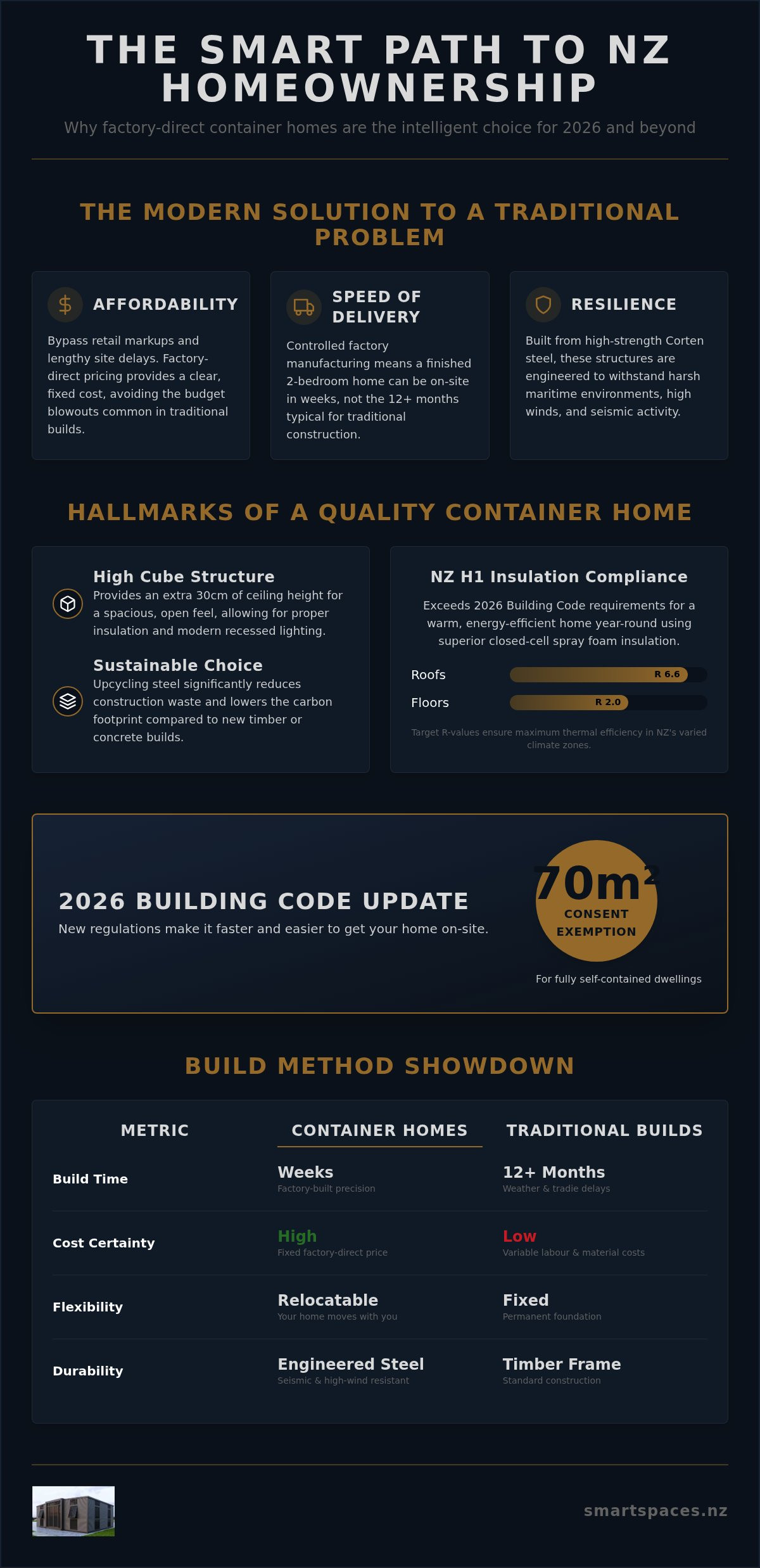
In a country where seismic activity and high wind zones are part of the landscape, the inherent durability of a container is a game-changer. These units are designed to be stacked and moved across oceans, meaning they won't buckle under the pressure of a Southern Alps gale or a minor tremor. As of January 15, 2026, new regulations allow for fully self-contained dwellings up to 70m² to bypass certain building consent requirements, making these homes a highly accessible option for those wanting to add value to their land quickly. Beyond the safety aspect, these homes are relocatable assets. If your circumstances change or you decide to move to a different region, your home can literally come with you. This level of flexibility is something a fixed-foundation house simply cannot offer.
The Sustainability Factor in Aotearoa
Choosing a container home is a conscious decision to reduce construction waste, which currently accounts for a massive portion of New Zealand's landfill. By upcycling existing steel structures, you're significantly lowering the carbon footprint of your build compared to using new concrete or timber. It is a cleaner way to build that doesn't compromise on quality. Modular designs also mean you don't have to overbuild from day one; you can start with a 2-bedroom unit and add another module as your family or your budget grows.
Speed of Delivery: From Factory to Site
The biggest headache with traditional builds is the wait time. You are often looking at 12 months or more of dealing with weather delays and tradie shortages. With a 2-bedroom container home, the manufacturing happens in a controlled factory environment. This means we can deliver a finished unit to your site in a matter of weeks rather than years. For busy Kiwi families, finding affordable container homes New Zealand based is the most practical way to get into a new home quickly. You avoid the stress of a muddy construction site and the uncertainty of variable labour costs, getting a warm, modern space that is ready to move into almost immediately.
Key Features that Define a High-Quality, Affordable Container Home
When you're hunting for affordable container homes New Zealand wide, it's easy to get distracted by fancy cladding or trendy matte black taps. While aesthetics matter, the true value of a container home lies in its bones. A high-quality build starts with a "High Cube" container. These units provide an extra 30cm of vertical space compared to standard shipping containers, which is the difference between feeling cramped and having a home that breathes. This height allows for recessed lighting and proper ceiling insulation without making the rooms feel like a tunnel. For those seeking affordable container homes New Zealand residents can rely on, structural integrity is non-negotiable.
Before you sign any contracts, you should familiarise yourself with the basic rules for building or buying a tiny home in Aotearoa. This ensures you're investing in a structure that meets the legal definitions of a dwelling. Beyond the steel shell, the exterior finishes should be chosen for their low-maintenance durability. Using high-grade marine paint or specialised cladding protects the corten steel from salt spray and corrosion, ensuring your investment lasts for decades without constant upkeep.
Insulation Secrets for NZ Winters
To remain comfortable and compliant with the 2026 NZ Building Code H1 requirements, your container home must achieve specific R-values that vary by climate zone, with many modern builds targeting R 6.6 for roofs and R 2.0 for floors to ensure maximum thermal efficiency.
We strongly recommend closed-cell spray foam over traditional glasswool batts for steel walls. Spray foam creates a seamless thermal break and an airtight seal, which is vital for preventing the condensation that often plagues poorly converted containers. When you combine this with high-performance double glazing, you create a thermal envelope that keeps the heat in during a South Island frost and keeps the interior cool during a humid Auckland summer.
Modern Interiors: More Than Just a Box
The secret to a successful 2-bedroom layout is clever spatial design. You don't have to sacrifice a full-sized kitchen or a comfortable bathroom just because you've chosen a modular path. By using smart storage solutions, such as floor-to-ceiling cabinetry and multi-functional furniture, you can make a 40ft container feel incredibly spacious. If you're planning a permanent residence, consider customising your floor plan to include larger windows or bifold doors that open onto a deck, effectively doubling your living area. If you want to see how these layouts function in person, exploring our range of 2 bedroom container homes is a great place to start your planning.
Comparing the Costs: How to Maximise Your Budget with Factory-Direct Pricing
When you look at the price tag of a standard new build, you're paying for far more than just timber and nails. In the traditional New Zealand housing market, every layer of the supply chain adds a "Middle-Man Tax." From the retail showroom and the sales agents to the sub-contractors who mark up materials; these costs balloon before the first spade even hits the dirt. Securing affordable container homes New Zealand families can actually afford means looking past the shiny showroom and straight at the source. By choosing a factory-direct model, you're cutting out those unnecessary retail margins and putting that money back into the quality of your home's finish.
One of the biggest advantages of this approach is the fixed-price contract. Traditional builds are notorious for variable costs, where "provisional sums" for labour or materials can lead to nasty surprises halfway through the project. With a container build, the price is locked in before the unit leaves the factory. This typically includes the essentials that often catch people out, such as full plumbing, electrical wiring, and high-quality cabinetry. Ensuring your build meets the NZ Building Code requirements for container homes is much easier when the work is completed in a controlled environment by experts who know the regulations inside out.
However, you must still budget for site-specific requirements. While the home itself is fixed-price, you'll need to account for:
Transport and Logistics: Delivery to your site via hiab or specialised trailer.
Cranage: If your site has difficult access or steep terrain, a crane might be required for final placement.
Utility Connections: Booking local tradies to connect your new home to power, water, and waste systems.
The Factory-Direct Advantage
Buying direct from the manufacturer doesn't just save money; it ensures a higher level of quality control. At Smart Spaces NZ, we leverage over 40 years of family-owned experience to streamline the manufacturing process. Because the entire build happens under one roof, we can monitor every weld and every layer of insulation. This low-overhead delivery model allows us to focus on what matters: delivering a durable, modern 2-bedroom container home that doesn't carry the heavy price tag of a retail-branded alternative.
Finance and ROI for Modular Homes
Navigating Council Consents and Site Preparation for Your New Home
Many people assume that choosing a modular build means skipping the paperwork, but that isn't quite the case. In New Zealand, you generally deal with two types of permissions. Building Consent ensures the structure is safe and meets the code, while Resource Consent focuses on how the building affects the land and your neighbours. If you are looking for affordable container homes New Zealand wide, understanding this distinction is the first step toward a stress-free project. While the building might be ready to go, the land it sits on needs to be legally and physically prepared.
The good news is that as of 15 January 2026, the government has simplified the rules for small dwellings up to 70m². While this exemption can save you thousands in council fees, it doesn't mean you can ignore the standards. A Licensed Building Practitioner (LBP) must still oversee the design and construction, and you must notify the council both before and after the work is done. One of the biggest perks of a factory-built home is that much of the technical inspection work happens before the unit even reaches your property. This reduces the number of on-site visits from council officers, which often speeds up the final sign-off and helps you move in sooner.
Council Consent Checklist
Before you get too far down the track, follow these three essential steps to keep your project on the rails:
Step 1: Check your local district plan. Every council has different rules for "Minor Dwellings." Some allow them as a permitted activity, while others have strict limits on floor area, colour schemes, or height.
Step 2: Obtain Multi-Proof approval if available. If a design has already been approved by MBIE, the council only needs to check your site-specific details, which can significantly reduce processing times.
Step 3: Organise a drainage and foundation plan. Even if the building itself is exempt from certain consents, your plumbing and waste connections usually aren't. You will need a registered drainlayer to sign off on these connections to the septic or sewer system.
Site Preparation and National Delivery
Getting your land ready is about more than just clearing some scrub. You need a stable base that won't shift over time. Depending on your soil type, you might opt for traditional timber piles, a concrete pad, or modern screw piles. Screw piles are becoming a favourite for affordable container homes New Zealand residents choose because they are quick to install and have minimal impact on the environment. They are particularly useful for sloped sections where a concrete pad would be too expensive or invasive.
Delivery is the final hurdle. You need to assess your driveway for truck access, looking specifically at overhead clearance from trees or power lines. A standard hiab truck needs a fair bit of room to swing a container into place. If you are building in a remote spot, we can coordinate the "last mile" of delivery to ensure your home arrives safely, no matter how far off the beaten track you are. If you are ready to start mapping out your site, our team can help you organise a site assessment to ensure everything is ready for delivery day.
Why Smart Spaces NZ is the Reliable Partner for Your Container Home Journey
Choosing a home is one of the most significant decisions you will ever make. It is about more than just finding a roof over your head; it is about finding a partner you can trust to deliver on their promises. At Smart Spaces NZ, we don't just build structures. We provide a path to a better lifestyle. With over 40 years of family-owned experience, we have built our reputation on integrity, hard work, and straightforward dealings. When you are searching for affordable container homes New Zealand wide, you need the confidence of a seasoned professional who has seen the industry evolve and knows exactly what it takes to build for our unique conditions.
We believe in a "no-nonsense" approach to business. This means total transparency from the moment you first contact us. You won't find hidden fees or confusing retail markups here. Instead, we offer fixed-price contracts that give you the financial certainty you deserve. Our range of 2-bedroom container homes and 2-bedroom expandable homes is designed to provide high-value, modern living without the traditional price tag. From the initial design phase to the final delivery on your property, we maintain a steady, reassuring rhythm that keeps your project moving forward without the stress of the unknown.
Craftsmanship Rooted in Heritage
Four decades of experience informs every weld, every joint, and every layout we produce. We understand that a home needs to be more than just functional; it needs to feel right. Our designs are grounded in practicality, ensuring that every square metre is used efficiently. Because we are a family-oriented business, we treat every build as if it were for our own kin. You get direct access to the experts who design and build your home, cutting out corporate layers and ensuring your vision is realised with precision. This heritage of craftsmanship is what makes our affordable container homes New Zealand residents can rely on for the long haul.
Your Next Steps to Modular Living
The journey to your new home should be an exciting one, not a series of hurdles. We are here to act as your visionary guide, providing the tools and expertise you need to succeed. Whether you are looking for a permanent residence, a secondary dwelling for family, or a high-yield rental unit, we have a solution that fits. We provide dedicated after-sales support to every customer, ensuring you feel backed by our team long after the delivery truck has left. Your next step is simply to explore the possibilities and see how a modular build can fit your lifestyle.
Start Your Next Chapter with a Smarter Build
Building a new life shouldn't mean being weighed down by decades of debt or the constant stress of a traditional construction site. By choosing affordable container homes New Zealand families can finally access high-quality, warm, and modern dwellings that arrive ready for living. Whether you're taking advantage of the 2026 consent exemptions or looking for a high-yield rental, the combination of factory-direct pricing and high-performance insulation makes this the smartest move for the current market.
We're here to help you navigate the process with ease, backed by over 40 years of family-owned experience and a commitment to transparency. With fixed pricing and national delivery, your goal of owning a durable 2-bedroom home is closer than you think. It's about taking back your freedom and building a space that truly works for your lifestyle and your budget.
Explore our factory-direct container homes and save today
You've got the vision and we've got the tools to make it happen. We look forward to helping you settle into a space you're proud to call home.
Frequently Asked Questions
Are container homes legal to live in permanently in New Zealand?
Container homes are perfectly legal for permanent living in New Zealand, provided they meet the standards set out in the Building Act. Every unit must comply with the New Zealand Building Code, covering aspects like structural stability, fire safety, and moisture control. Once your home is signed off by the council or an approved inspector, it is considered a legal dwelling just like any other house on your property.
How much does an affordable container home cost in NZ for 2026?
Costs for affordable container homes New Zealand wide vary based on the size, layout, and level of customisation you require. Generally, 2-bedroom units are priced differently depending on whether they are standard container conversions or expandable models. By choosing a factory-direct supplier, you can avoid the retail markups that often inflate prices, ensuring your budget goes toward high-quality materials and energy-efficient insulation rather than sales commissions.
Do I need a building consent for a container home on my property?
You generally need to engage with the council, but the process has simplified. As of early 2026, self-contained dwellings up to 70m² may be exempt from the full building consent process if they are designed or supervised by a Licensed Building Practitioner. You must still notify the council before and after the build. It is also vital to check if you need resource consent for things like land use or environmental impact.
How long do container homes last in New Zealand’s coastal environment?
Container homes are incredibly durable because they are constructed from corten steel, which is designed to resist corrosion in harsh maritime environments. If you maintain the exterior with high-quality marine-grade paint and keep it clear of debris, a container home can easily last upwards of 50 years. This makes them an excellent choice for coastal properties where salt spray would quickly damage traditional timber cladding.
Can I finance a container home through a traditional bank?
Financing a modular home is possible, but banks often view them differently than traditional houses. Many lenders treat these as personal or chattel loans until the unit is permanently fixed to the land and signed off by the council. Some banks have specific products for sustainable or prefab housing. We recommend talking to a mortgage broker familiar with the modular industry or checking with your manufacturer for their preferred finance partners.
Are container homes warm enough for South Island winters?
Modern container homes are exceptionally warm, even in the deep south. To meet the 2026 H1 energy efficiency standards, these homes are built with advanced insulation like closed-cell spray foam and high-spec double glazing. This creates a thermal envelope that outperforms many older Kiwi bungalows. You will find that a well-insulated 2-bedroom unit requires very little energy to stay comfortable throughout a South Island winter.
How is a container home delivered to my site?
Your home is typically delivered as a completed unit via a hiab truck or a side-loader. This allows the driver to position the home precisely onto your piles or concrete foundation. You will need to ensure your driveway has enough width and that there is clear overhead access from trees or power lines. For remote or difficult sites, we coordinate with specialist transport teams to ensure your home arrives safely and securely.
Can I customise the floor plan of my container home?
You have plenty of flexibility to customise the interior layout of your home. While the external steel dimensions are fixed, you can customise the placement of internal walls, windows, and doors to suit your needs. Whether you want an open-plan kitchen or specific bedroom sizes, these homes can be organised to fit your lifestyle. It is best to discuss these changes during the design phase to ensure everything remains structurally sound and code-compliant.



Comments