

21 Essential Questions to Ask a Prefab Home Builder Before You Sign

Updated: 7 days ago
The biggest mistake you can make when buying a prefab home isn't choosing the wrong floor plan; it's failing to have a solid list of questions to ask a prefab home builder before you sign any paperwork. You've likely been drawn in by the factory-direct price advantage and the promise of a faster build, yet that nagging worry about hidden delivery fees or flimsy, cold construction is hard to shake. It's frustrating when you're trying to build a better life but feel bogged down by confusion over council consent requirements or fear your new space won't stand up to the elements.
We believe building should be straightforward and empowering, not a series of expensive guesses. By mastering the vetting process now, you'll ensure your home is warm, durable, and built to a commercial standard that lasts for decades. This article provides a comprehensive checklist to help you grill potential builders on everything from insulation to transport logistics. We'll walk through exactly what you need to know to save thousands and secure a home you can actually be proud of.
Table of Contents
The Prefab Partnership: Why Your Choice of Builder Defines Your Result
Identifying a Genuine Manufacturer vs. a Middle-Man
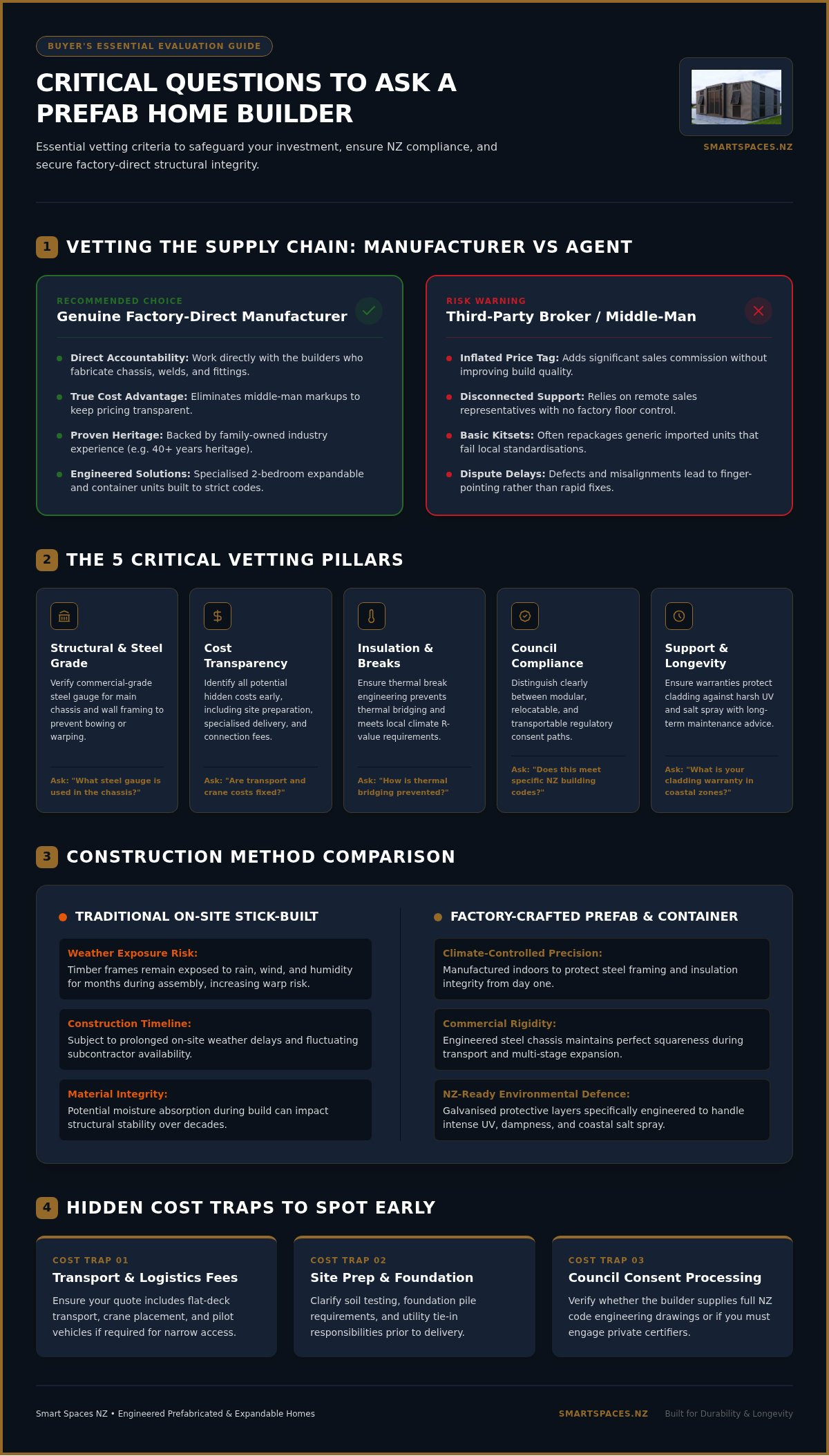
Start with the most direct question: "Do you own the factory where these are built?" Many companies act as mere agents. They add a significant markup without adding any real value to the construction. When you deal with a factory-direct provider, like the team at Smart Spaces NZ with over 40 years of family-owned heritage, you're cutting out the middle-man. This doesn't just lower the price. It ensures accountability. If a weld isn't right or a door doesn't align, you're talking to the people who can fix it, not a sales rep in a remote office. This direct connection is the foundation of a reliable project.
Understanding the Prefab vs. Modular vs. Relocatable Spectrum
Terminology matters, especially when you're dealing with local councils. You might hear terms like modular, transportable, or relocatable used interchangeably, but they often trigger different regulatory requirements. Having a foundational understanding of what a prefab is helps you communicate clearly with authorities. Smart Spaces NZ specialises in 2-bedroom expandable homes and container homes designed for rapid deployment and durability. These aren't simple kitsets. They're engineered solutions. Ensuring your builder understands the specific NZ building code is non-negotiable. These are crucial questions to ask a prefab home builder before you commit your hard-earned savings to a contract.
Construction Integrity: Questions to Ask About Materials and Workmanship
The "bones" of your home dictate how it will handle the next twenty years of wind, rain, and sun. While a traditional timber frame might warp or rot if moisture gets in, a steel-framed container or expandable home offers superior structural rigidity. However, not all steel is equal. You need to verify exactly what's supporting your roof. If the builder is using thin, low-grade alloys, your home might feel flimsy or, worse, succumb to corrosion in coastal environments. These technical details form the core of the questions to ask a prefab home builder during your initial consultation.
The Durability Checklist for Steel and Cladding
Ask your builder about the specific gauge of steel used in the main chassis and wall frames. You're looking for commercial-grade materials that provide the same strength found in industrial structures. Enquire about the specific galvanisation process and the warranty on exterior cladding. If you're living near the coast, salt spray is a silent killer for metal buildings. A genuine manufacturer will be able to explain their corrosion protection layers without hesitation. Using commercial-grade materials in residential prefab units ensures the structure remains square and stable, even after transport and multiple expansions. If you want to see how these standards look in practice, you can view our durable range of homes today.
Insulation and Internal Comfort Standards
Steel is an excellent conductor of heat, which makes thermal bridging a major concern. Without a proper thermal break, your home will be freezing in winter and like an oven in summer. Ask how the builder prevents heat from escaping through the steel studs. You should also check that the insulation meets or exceeds local R-value requirements. While some imported units follow basic federal safety standards for international markets, you need "NZ-ready" specs that handle our unique dampness and temperature swings.
Don't forget the joinery. Double glazing and high-quality seals on the windows are essential for noise reduction and energy efficiency. For expandable structures, the mechanical hinges and weather-stripping are the most vulnerable points. Ask how these components are tested for water tightness. If the seals are generic rubber instead of high-performance EPDM, you'll likely face leaks within a few years. These are the questions to ask a prefab home builder that separate a long-term residence from a temporary shed. Ensuring every hinge and seal is commercial-grade is the only way to guarantee year-round comfort.
Financial Transparency: Navigating Quotes, Deposits, and Finance
Signing a contract for a new home is a massive milestone. It should feel like a win, not a gamble. However, many buyers get stung by "hidden" costs that aren't mentioned in the initial brochure. When you're building a budget, you need specific questions to ask a prefab home builder to ensure the number on the page is the number you'll actually pay. A fixed-price contract is your best friend here. In a market where material costs can shift overnight, having a builder who stands by their quote provides the peace of mind you need to move forward without fear.
You'll want to dig deep into what "fully inclusive" really means. Does the price cover floor coverings and LED lighting, or are those extra? What about the delivery and foundation work? Often, the base price only covers the unit leaving the factory floor. To avoid a nasty shock, ask for a line-by-line breakdown of every component. You should also enquire about deposit protection and payment milestones. A reliable builder won't ask for all the cash upfront. Instead, they'll tie payments to clear production stages, like the completion of the chassis or the final fit-out.
The Factory-Direct Pricing Advantage
One of the best ways to keep costs down is by choosing a factory-direct model. Ask: "What middle-man fees are being bypassed in this quote?" When you buy from a family-owned business like Smart Spaces NZ, you aren't paying for a massive retail showroom or a third-party sales agent's commission. This direct relationship significantly impacts your final valuation and overall ROI. Comparing a 2-bedroom container home to a traditional build usually reveals a stark difference in value, especially when you consider the speed of delivery and the commercial-grade materials used.
Finance and Loan Compatibility
Securing a mortgage for a prefab home can be a bit different from a standard house loan. Banks often have specific rules about progress payments for off-site builds. You'll need to ask your lender how they handle these transactions. It's also worth checking if your builder offers in-house finance or works with partner solutions that understand the industry. When planning your build budget, you can explore Home Loans to find flexible financing solutions that align with off-site construction requirements. Understanding these financial levers early ensures your project doesn't stall before the first weld is even made. These are essential questions to ask a prefab home builder to keep your dreams on track.
Logistics and Compliance: From Factory Floor to Your Site
Moving a home from a factory to your residential lot is a precision exercise. It isn't just about a truck and a trailer; it's a coordinated effort that requires a clear roadmap to avoid costly delays at your front gate. While the factory-direct model saves you money, the physical transition to your land is where the theory of your build meets reality. You need a partner who understands the local terrain and the specific mechanics of delivery. These logistics form a core part of the questions to ask a prefab home builder before you commit to a delivery date.
Navigating Council Consents and Compliance
Council paperwork is often the biggest hurdle for new homeowners. You need to know exactly who is responsible for what. Ask: "Do you provide the necessary plans and certificates for building consent?" A reliable builder should provide the structural engineering reports and electrical certificates required by your local authority. Understanding how your unit fits into NZ tiny home regulations is essential for a smooth approval process. You should also clarify the "relocatable" status of your home. This distinction is vital for future flexibility, as it impacts how the council views your structure and what you can do with it if you ever decide to move.
The Delivery and Installation Roadmap
Your site must be ready before the truck arrives. Ask: "What specific site preparations must I complete before arrival?" This might include leveling the ground, pouring footings, or ensuring there's enough clearance for a crane. If your driveway has tight bends or low-hanging branches, you need to flag this early. Enquire about the setup time for your specific unit. For instance, a 2-bedroom expandable home can often be secured and weather-tight within hours, whereas other modular styles might take days. Don't forget to ask about the delivery radius and any potential transport surcharges for remote locations. Being upfront about these details prevents a "delivery day disaster" and keeps your budget intact. If you're unsure if your lot is suitable, book a site assessment with our team to get a professional opinion.
The right builder will act as a visionary guide through this process, standing firmly behind the quality of their work while helping you clear the regulatory hurdles. It's about honesty and straightforward dealings. By getting these questions to ask a prefab home builder answered early, you ensure that the excitement of delivery day isn't overshadowed by avoidable compliance or access issues.
Longevity and Support: Ensuring Your Investment Holds Its Value
A home is one of the most significant assets you'll ever own. Its value shouldn't peak the day it's delivered; it should endure for decades. While the initial build quality is vital, the long-term success of your project depends on the support you receive years after the keys are handed over. Many buyers overlook this phase, assuming that "new" means "maintenance-free." However, your home will face the elements every single day. You need to know that your builder will be there if you need them. Including specific questions to ask a prefab home builder about their long-term support framework is the only way to protect your investment.
Warranty and After-Sales Framework
Not all warranties provide the same level of protection. You must ask: "What is your process if a structural issue arises in year five?" It's essential to clarify the difference between the structural warranty, which covers the integrity of the frame and chassis, and the warranties on appliances or fixtures. The latter are often held by third-party manufacturers, whereas the structural integrity is the builder's responsibility. Dealing with a family-owned business with a 40-year legacy offers a distinct advantage here. You aren't just a ticket number in a corporate system. Instead, you're dealing with people whose reputation is built on personal integrity and straightforward dealings. This personal touch often leads to faster resolutions and more honest advice regarding upkeep.
Future-Proofing and Customisation Options
Your needs might change over time. Perhaps you'll want to add another module or transition to a completely off-grid lifestyle. Ask your builder if the unit can be easily expanded or modified later. Genuine expandable homes are designed with this flexibility in mind, but you need to confirm that the structural points and electrical systems are "future-ready." Enquiring about off-grid readiness for solar power and waste management is also a smart move, especially as energy costs continue to rise. For a broader look at how modern designs are changing the way we live, explore our resource on prefab homes NZ. By selecting a builder who understands innovation as well as tradition, you ensure your home remains a functional, valuable space for the long haul. These final questions to ask a prefab home builder will give you the confidence that you're not just buying a house, but securing a future.
Building Your Future with Confidence and Clarity
Building a new home should be an empowering journey that leads to a lifestyle of freedom and comfort. By arming yourself with the right questions to ask a prefab home builder, you've shifted from being a spectator to a visionary guide for your own project. You now understand that the strength of the steel and the depth of the insulation matter just as much as the final aesthetic. You also know how to spot the value of a factory-direct model, where honesty and personal integrity replace middle-man markups.
Whether you're looking for a 2-bedroom container home or an expandable unit, the right partnership ensures your investment is built to last. With 40+ years of family-owned experience, Smart Spaces NZ stands behind every weld, offering nationwide delivery across New Zealand and factory-direct pricing with no middle-man fees. Don't leave your future to chance when you can build on a foundation of proven expertise and straightforward service.
Your durable, warm, and modern new home is closer than you think, and we're ready to help you make it a reality.
Frequently Asked Questions
Do I need council consent for a prefab home on my property?
Yes, you will generally need council consent if the unit is intended for permanent residential use. While some smaller structures might fall under specific exemptions, a 2-bedroom container home or expandable unit usually requires a building consent to ensure it meets safety and sanitary standards. We provide the necessary structural plans and certificates to help streamline this process with your local council, making the regulatory hurdle much easier to clear.
How long does it typically take to build and deliver a prefab home?
One of the biggest advantages of factory construction is the speed of delivery. Because we build in a controlled environment, we avoid weather delays that plague traditional sites. A standard unit can often be ready for transport within weeks rather than months. Once it arrives on your lot, the setup for an expandable home is remarkably quick, often taking just a few hours to become weather-tight and ready for final utility connections.
Can I customise the floor plan of a 2-bedroom expandable home?
You certainly can customise aspects of your home to suit your lifestyle. While the core structural footprint of our 2-bedroom expandable homes is designed for maximum efficiency and transportability, there is flexibility in the internal finishes and fixtures. You can choose different cabinetry, flooring, and bathroom layouts to make the space feel like your own. It's about balancing the benefits of a proven, engineered design with the personal touches that make a house a home.
Are prefab and container homes as well-insulated as traditional houses?
Modern prefab homes are often better insulated than older traditional houses. We use high-performance materials and commercial-grade insulation to ensure your space stays warm in winter and cool during the summer months. When considering questions to ask a prefab home builder, always check the R-values of the walls and ceiling. Our units are designed for the local climate, featuring double glazing and thermal breaks to prevent heat loss through the steel frame.
What kind of foundations are required for a relocatable home?
Relocatable homes generally sit on a system of piles or level concrete pads. The specific type depends on your soil quality and the slope of your land. Because these units are engineered for rigidity, they don't require a traditional heavy foundation slab. However, ensuring the ground is properly levelled and compacted before delivery is vital. We can provide guidance on the exact specifications required for your site to ensure a stable, long-term placement for your home.
Is it harder to get a mortgage for a prefab home than a standard build?
Securing finance for a prefab home is a slightly different process but is very achievable. Most major banks now recognise the value of these structures, provided they are built to code and placed on a permanent foundation. You'll need to provide your lender with a fixed-price contract and proof of council consent. We offer finance solutions and can work with your bank to explain the progress payment milestones during the factory construction phase.
What happens if my site has difficult or narrow access for delivery?
Difficult access is a common challenge that we solve through careful planning. If your driveway is narrow or has tight bends, we can often use a hiab truck or a specialised crane to lift the unit into place. A site assessment is the best way to identify these hurdles early. We look for overhead wires, low branches, and ground stability to ensure the delivery goes smoothly without risking damage to your home or property.
How does factory-direct pricing actually work?
Factory-direct pricing means you're buying straight from the people who build your home. By removing retail showrooms and third-party sales agents, we cut out the significant commissions and markups that usually inflate the price of a new build. This model allows us to put higher-quality, commercial-grade materials into every unit while keeping the final cost accessible. It's a transparent way of doing business that prioritises value and straightforward dealings for every customer.



Comments