

Granny Flat Return on Investment in NZ: A 2026 Guide

Could rent from a granny flat cover its real costs, or does the return depend on a rise in your property’s value? It’s a fair question, especially when build costs, site requirements and rental demand vary from one property to the next. The return on investment granny flat nz homeowners can achieve isn’t guaranteed by adding a dwelling alone. What matters is the income left after ongoing expenses, alongside any change in resale value.
If you’re weighing up whether a granny flat could work on your property, start with your own figures rather than headline yield claims. This guide shows you how to estimate rental income against project and running costs, and how to assess possible resale-value changes separately from rental cash flow. You’ll also learn which practical checks, including site constraints, rules and project scope, can shape the result before you commit.
Whether you’re considering a prefabricated dwelling or another approach, the choice affects more than the initial outlay. We’ll break down the assumptions to test so you can make a grounded decision for your place in Aotearoa.
Table of Contents
Granny flat ROI in NZ: what returns can an extra dwelling actually deliver?
A granny flat can produce a return in two distinct ways: rental income while you own it, and a possible change in your property’s resale value. Keep these pathways separate. Rent may provide regular cash flow, while any resale uplift is uncertain until a sale and depends on the property, the dwelling and buyer demand.
In plain language, return on investment (ROI) compares what you gain with what you spend over a chosen period. For the return on investment granny flat nz owners might calculate, the result depends on project-specific inputs: the full cost of adding the dwelling, how it’s used, income received and expenses paid. Start with your own assumptions, not a promised return.
Rental yield, cash flow and resale value are not the same
Gross rental yield is a screening measure: annual rent divided by the total investment, shown as a percentage. It can help compare rental potential, but it leaves out the costs of earning that rent. Net cash flow is closer to what you keep. It accounts for recurring expenses and vacant periods, so it can look quite different from gross yield.
Rent earned isn’t net return: expenses, vacancy and the full project cost determine how much income remains.
Resale value is a separate calculation. A dwelling might affect what buyers are willing to pay for the whole property, but that possible change isn’t income you receive during ownership. Treat it as an uncertain outcome rather than adding an assumed value uplift to rent and calling the total a guaranteed ROI.
Who might benefit from a secondary dwelling?
An investor may focus on achievable rent, likely vacancy, ongoing expenses and the amount of capital tied up in the project. A household creating space for a parent, adult child or guest may value privacy, proximity and flexibility more than rental income. In that case, the financial assessment can include the accommodation’s practical value to the household, but it shouldn’t treat avoided rent or future resale gains as cash in hand.
The term “granny flat” covers a range of secondary dwellings and uses. For broader context, see Secondary suite (granny flat) definition and uses. Your intended use shapes the assumptions to test: a rental plan needs realistic income and vacancy estimates, while family accommodation calls for a careful look at how the space will serve your household over time.
Dwelling choice is part of the assessment, not a return guarantee. If a two-bedroom layout suits your plans, explore the guide to two-bedroom expandable homes in NZ as you compare options. A sound decision should make sense for your site, intended use and total project assumptions, even before any possible resale benefit is counted.
How to calculate granny flat return on investment in New Zealand
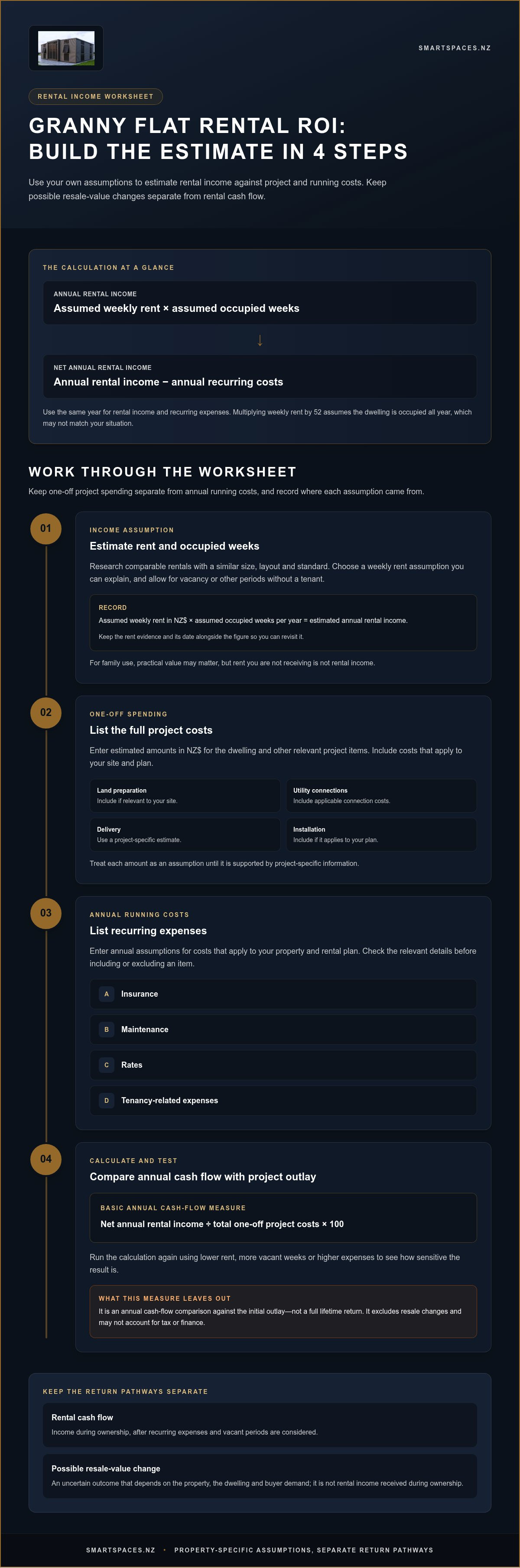
A useful estimate starts with your own inputs, not a generic example. Work through this worksheet in order, keep one-off project spending separate from annual running costs, and record where each assumption came from. This makes it easier to see what the estimate depends on and which figures need more investigation.
Build a realistic rental-income assumption
For a rental plan, research comparable rentals with a similar size, layout and standard. Note the source and date of each comparison, then choose a weekly rent assumption you can explain. Allow for vacancy or other periods without a tenant. Multiplying weekly rent by 52 assumes the dwelling is occupied all year, which may not match your situation. Family use is a different scenario: it may offer practical value to your household, but don’t count rent you aren’t receiving as rental income.
Estimate income. Enter your assumed weekly rent in NZ$ and your assumed occupied weeks per year. Multiply them to estimate annual rental income. Keep the rent evidence and date alongside the figure so you can revisit it.
List one-off project costs. Enter your estimated amounts in NZ$ for the dwelling and other relevant project items, such as land preparation, utility connections, delivery and installation. Include other costs that apply to your site and plan. Treat each figure as an assumption until it’s supported by project-specific information.
List recurring costs. Enter annual assumptions for applicable insurance, maintenance, rates and tenancy-related expenses. Costs won’t apply in the same way to every property. Check the relevant details before including or excluding an item.
Calculate and test. Work out annual rental income minus annual recurring costs. Then compare that net figure with your total one-off project outlay. Run the calculation again with lower rent, more vacant weeks or higher expenses to see how sensitive the result is.
Net annual rental income is the rent you expect to receive over a year, less recurring expenses for that same year.
Include the full project and operating picture
Use a simple formula, with each amount entered as your assumption: annual rental income = assumed weekly rent × assumed occupied weeks; net annual rental income = annual rental income − assumed annual recurring costs. For a basic annual cash-flow comparison, divide net annual rental income by total assumed one-off project costs, then multiply by 100 for a percentage. This gives an annual cash-flow measure against the initial outlay, not a full lifetime return. It excludes resale changes and may not account for tax or finance. For broader property-investment checks, consult New Zealand Government guidance on property investment.
For the return on investment granny flat nz homeowners estimate, label each figure “assumption”, add its source and review date, and keep rental and family-use scenarios separate. If an expandable home is part of your plan, you can explore two-bedroom expandable home options and use the same worksheet to account for your project’s full costs.
Will a granny flat increase property value enough to improve ROI?
Adding a granny flat doesn’t guarantee that your property’s resale value will rise by the amount you spent, or rise at all. The dwelling may appeal to some buyers, but its effect depends on how well it works on the site and what the market supports. Treat resale value as a possible return pathway, not a promised payback.
Keep the two sides of the investment separate. Rent is income received during ownership; resale value is an uncertain change in what a buyer may pay for the property later. Combining them too early can make the return on investment granny flat nz owners estimate look more certain than it is.
What can influence the resale-value effect?
Buyers need to see how the extra dwelling fits the property. Consider whether access is practical, occupants have privacy, and the layout leaves the main home and outdoor areas usable. A separate dwelling that feels awkward to reach or compromises the main home’s function may not attract the same interest as one that works naturally with the site.
Comparable sales can help frame expectations, but choose comparisons carefully. Look for properties with relevant features and note differences in location, condition, land and dwelling layout. Market conditions also affect buyer demand, so an estimate based on a past sale or broad claim isn’t a reliable prediction. A formal valuation is an independent assessment at a point in time, not a guarantee of the eventual sale price.
Why rental income can matter without a large value uplift
The rental case can still make sense even if you assume little or no resale uplift. Estimate income over your intended ownership period, then account for running costs and vacant periods. A longer hold may allow more time for net rental income to accumulate, but it also means more years of expenses and exposure to changing rental conditions.
Test the income pathway on its own, without relying on a future sale or refinance to make the numbers work. If the dwelling is used by family instead, assess its practical value to your household separately from rental income. Gross rent isn’t profit, and an estimated increase in property value isn’t cash received. Keep both as assumptions until supported by current, property-specific evidence.
What to check before investing in a granny flat in NZ
Before choosing a dwelling, make sure the property, intended use and budget assumptions work together. A tidy return calculation can still fall over if the site needs costly preparation or the proposed use doesn’t fit applicable rules. Work through these checks in order and keep notes so you can update your figures as the project takes shape.
Set the intended use. Decide whether the dwelling is for tenants, family or a mix of uses. That choice affects the layout you need, your income assumptions and the costs to include. Write down the essential requirements before comparing dwelling options.
Assess the site and services. Check practical access for people and delivery, along with drainage, water and power connections. Consider the available space, ground conditions and how the dwelling will sit in relation to the existing home and boundaries. These factors can affect feasibility and project scope, so include known work in your assumptions.
Confirm current requirements. Check MBIE guidance and speak with your relevant local authority about the proposal and property. The Building Act and Resource Management Act may both be relevant, but requirements depend on the specific dwelling, site and local rules. Don’t assume that a building consent exemption removes every obligation. For qualifying standalone dwellings, exemptions may still come with conditions and council steps, and resource consent may remain relevant. Read the NZ tiny home regulations guide as a starting point, then verify current requirements for your own site before committing.
Price the whole project and ownership. Build a project-specific list covering the dwelling, delivery, installation, site preparation and service connections where applicable. Separately consider ongoing maintenance, insurance, rates and tenancy costs, checking which apply to your circumstances. If you’re borrowing, discuss the proposal and funding assumptions with your lender. Also review insurance and tax treatment with the relevant professionals.
Stress-test the numbers. Run conservative, expected and optimistic scenarios using your own evidence. Change the rent assumption, vacant weeks and operating costs in each version. If the project only looks workable under the most favourable assumptions, pause and revisit the scope before settling on a dwelling.
Keep a simple record of each estimate, its source and the date you checked it. Revisit the figures if the intended use changes, site work is added or the dwelling specification shifts. That way, a change to one part of the plan flows through to the investment case rather than being overlooked.
A prefabricated dwelling is one option to assess against your site and full project assumptions. If you’re comparing secondary living-space options, explore Smart Spaces’ prefabricated homes as part of your due diligence.
How a prefabricated home can fit a granny flat investment plan
A prefabricated home can be one option to assess when you’re planning a secondary dwelling. Smart Spaces offers two-bedroom expandable homes and two-bedroom container homes, sold factory-direct with customisable options and nationwide delivery. These formats give you a practical starting point for comparing possible layouts, but they don’t determine whether a project will earn rent or add resale value. Those outcomes depend on your use, site and assumptions.
Match the dwelling format to the intended use
Start with the people who’ll use the space. Two bedrooms may suit a household needing room for family or guests, or a rental plan aimed at tenants who want separate sleeping spaces. Then consider how the dwelling’s position and layout could work on your site, including access, privacy and its relationship to the main home. Assess expandable and container-home formats against those needs rather than assuming one will suit every property.
Keep product choice separate from the investment forecast. A dwelling that fits your site and household may still face different rental demand or buyer interest from another property. Don’t use the format itself as evidence of a particular rent, resale uplift or return. Instead, use the option you’re considering to refine your project assumptions, then test those figures against your intended use.
Turn the ROI assessment into a practical next step
Before settling on a dwelling, bring your key inputs together. Note the purpose, income assumptions if it’ll be rented, the full project scope and the ongoing costs that apply. Include delivery and site-related work in your project planning, and revisit the figures if the intended use or site requirements change. Factory-direct purchasing gives you a clear product option to assess, but your worksheet should reflect the whole project, not just the dwelling.
For the return on investment granny flat nz homeowners are considering, the format is only one part of the decision. Your site, rules, funding, running costs and realistic use all matter. Smart Spaces is a family-owned business with over 40 years of industry experience and provides after-sales support. That buying context can be useful as you weigh up a prefabricated option alongside your own project figures, without treating any particular outcome as assured.
Purpose: who will use the space, and how?
Site: how will the dwelling fit the property and its access?
Project scope: what delivery, preparation and other work should your budget allow for?
Investment assumptions: what income, vacancy and ongoing costs have you included?
Once those questions are on paper, explore two-bedroom expandable homes in NZ as one option to assess for your secondary living-space plan.
Make your next step a confident one
A useful investment decision isn’t about chasing the most attractive forecast. It’s about knowing which assumptions you’re comfortable relying on, and whether the dwelling would still serve a purpose if rental plans changed. Set a clear threshold for what would make the project worthwhile to you, then compare your preferred layout and intended use against that measure.
That personal benchmark can keep the return on investment granny flat nz calculation grounded in your priorities, rather than a resale estimate or rent figure taken out of context. If a two-bedroom prefabricated option suits your plans, take the next step by comparing available formats and customisable choices.
Explore Smart Spaces’ prefabricated home options and consider how an expandable or container home could fit your site and plans. With a clearer view of what matters to your household, you can move forward thoughtfully and choose a direction that feels right for your property.
Frequently Asked Questions
Is a granny flat a good investment in New Zealand?
It can be, but the answer depends on your property, intended use and costs. Rental cash flow is income received during ownership, while resale value is a possible change in what buyers may pay later. For example, a dwelling used by family may be worthwhile to your household without producing rent. Compare the financial case with the practical value you expect, and don’t treat rental income or a future sale price as guaranteed.
How do you calculate the return on investment for a granny flat?
Use your own figures for income, project spending and running costs. Estimate annual rent from your assumed rent and occupied weeks, then subtract recurring expenses to find net rental income. Compare that result with your total project outlay over the period you plan to own the property. Keep one-off costs separate from annual costs, and label each amount in NZ$ as an assumption. Test how the result changes if rent is lower or expenses rise.
Can I rent out a granny flat in New Zealand?
You may be able to rent one, but the proposed use must suit the property and comply with applicable rules. Before advertising, check the dwelling’s status, local council requirements and any conditions that apply to its construction or use. A space intended for family accommodation isn’t automatically suitable for a rental arrangement. Also consider whether the layout, access and facilities will work for tenants, and keep records of rental income and expenses.
Is rental income from a granny flat taxable in NZ?
Rental income generally needs to be included when working out your tax position in New Zealand. The way it’s reported can depend on how the property is owned and used, and on the details of the rental arrangement. Check current Inland Revenue guidance on rental income before you begin letting the dwelling. If your circumstances involve family use, shared expenses or mixed use, get advice from a tax professional rather than relying on a general example.
Can granny-flat expenses be claimed against rental income in New Zealand?
Some expenses may be claimable, but eligibility depends on the type of cost, how the dwelling is used and current tax rules. Don’t assume that all project spending can be deducted: construction and other capital costs may be treated differently from eligible costs of earning rental income. Keep invoices and records that show what each expense relates to, then check current Inland Revenue guidance or speak with a tax professional about your circumstances.
Do consent exemptions mean every granny flat can be built without approval in NZ?
No. A consent exemption applies only when the proposal meets its conditions, and it doesn’t remove every building or site obligation. Under the rules effective from 15 January 2026, certain new, standalone, single-storey dwellings up to 70 square metres may qualify for a building consent exemption if specified requirements are met. Council steps and resource consent may still apply. Check current MBIE guidance and your local authority’s requirements before work begins.
What happens to granny-flat ROI if the property is vacant?
Vacancy reduces rental income because rent isn’t received while the dwelling has no tenant, but some ownership costs may continue. For example, if a tenant leaves between tenancies, include the empty period in your annual income estimate rather than assuming a full year of rent. Model different vacancy assumptions to see how much net income changes. This helps you judge whether the investment remains manageable during a slower letting period.



Comments